
Reviewed · 2-DAY EXPERIENCES
2-Day Eight Temple Tour with Optional Sunrise
The best thing about this two-day private temple tour is its range. You move from the steep towers of Pre Rup to the pink sandstone carvings of Banteay Srei, then spend time with Angkor Wat, jungle-wrapped Ta Prohm, and the many-faced Bayon. It gives you a broad look at the Angkor area without having to arrange transport for each stop.
I like the private setup, since your guide can explain the carvings and adjust the pace for your group. I also like the practical hotel pickup and included cold water, two small comforts that matter under Cambodia’s hot sun. The main catch is cost: the $98 tour price does not include the required $62 three-day temple pass, food, drinks, or personal expenses.
Key points to know before booking
- Eight major temples in two days: The route covers Pre Rup, Banteay Samre, Banteay Srei, Ta Prohm, Banteay Kdei, Angkor Wat, Preah Khan, and Bayon.
- A genuinely private outing: Only your group takes part, with private transport suited to the group size and a private guide.
- Strong variety in the ruins: Expect pink sandstone detail at Banteay Srei, jungle growth at Ta Prohm, grand scale at Angkor Wat, and giant carved faces at Bayon.
- The temple pass costs extra: Budget $62 per person for the three-day Angkor pass, in addition to the $98 tour price.
- A guide can add real value: One guide named in the feedback is Sam, praised for storytelling and photography skills.
- Plan your clothing carefully: Shoulders and knees must be covered inside the temples.
Why two days works better than one
Angkor Archaeological Park is not one compact ruin. Its temples are spread across a wide area, and the styles change from one site to the next. Trying to fit every major stop into one hurried day can turn grand monuments into a blur of towers and stone corridors.
This itinerary gives you one day for several outer and jungle temples, then a second day centered on the park’s biggest names. That division makes sense. Day one has a more varied feel, while day two focuses on the three sites most people associate with Siem Reap: Angkor Wat, Preah Khan, and Bayon.
You are not locked into a large coach schedule. Since the tour is private, you can explore at your own pace within the day’s route. That does not mean unlimited time at every ruin, but it should make it easier to pause for a carving, take photographs, or ask your guide to explain a detail rather than being hurried along by a large group.
The tour is described as including an optional sunrise. The supplied details do not give a separate sunrise time or explain how that option changes the route, so confirm the exact arrangement when booking. Angkor Wat at sunrise can affect the rest of the morning, and you will want to know whether the first day’s schedule changes.
A few more Siem Reap trips to weigh up
- Angkor Wat Sunrise or Sunset Tour with Guide from Siem Reap
★ 5.0 · 12,109 reviews - Siem Reap: Angkor Wat: Small-Group Sunrise or Sunset Tour
★ 5.0 · 9,444 reviews - Siem Reap: Angkor Wat 2-Day Tour with Sunrise and Sunset
★ 4.9 · 4,429 reviews
Day one begins at Pre Rup’s high towers
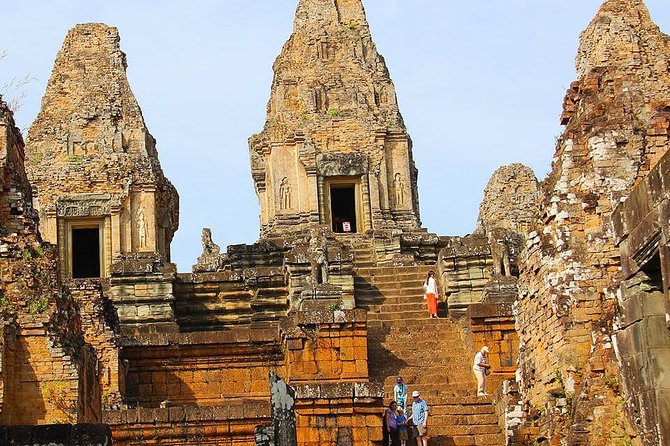
Pre Rup is a good opening stop because it immediately shows you a different side of Khmer temple design. Built by one of the earlier Khmer kings, it is often called a mountain temple because of its steep climb to the upper towers.
The climb is not especially friendly to anyone who dislikes uneven stone steps, and you should take it slowly. At the top, you get a broad view across the countryside around Siem Reap. The setting helps you understand why the Khmer builders used height so often: the temple was not simply a building, but a symbolic mountain rising above the surrounding plain.
Pre Rup is popular, so do not expect to have the place entirely to yourself. Its open structure and strong geometry still make it a useful first lesson in Angkor architecture, especially with a guide pointing out how the towers and levels fit together.
Banteay Samre brings Angkor Wat-style detail
The next stop, Banteay Samre, offers a compact and handsome example of Khmer architecture. It was built in a style similar to Angkor Wat, so it makes a useful comparison before you visit the giant temple on day two.
You can spend about an hour examining the towers and carved surfaces. The site has enough detail to reward a slower walk, but it does not have the overwhelming scale of Angkor Wat. That smaller size can be an advantage. You can see the layout more clearly and focus on the design instead of trying to take in an enormous complex all at once.
I would pay attention to the stonework here rather than treating Banteay Samre as a quick photo stop. Its value is partly in showing how Khmer architectural ideas appear in a more manageable setting.
Banteay Srei is the day one highlight
Banteay Srei is one of the most distinctive stops on the route. Its name is often translated as Citadel of Women, and the temple is famous for its pink sandstone and unusually fine carvings.
The stone gives the temple a warmer color than many of the gray sandstone ruins around Angkor. The carvings are small, detailed, and often remarkably crisp. Legends claim women made them because the work was too beautiful to have been carved by men, but treat that as folklore rather than established fact.
Banteay Srei is also farther from the central Angkor group than several other temples on this tour. The route is worthwhile if you care about sculpture and close detail, but it adds to the day’s travel time. You are trading some extra road time for a temple that looks and feels quite different from Angkor Wat, Bayon, or Ta Prohm.
A private guide is particularly useful here. Without context, the intricate figures can become a wall of decorative stone. With an explanation of what you are seeing, the carvings become easier to read and compare.
Same country, a completely different kind of day:
- From Siem Reap: Kampong Phluk Floating Village Tour by Boat
★ 4.9 · 6,979 reviews - Sunset tour of Kampong Phluk stilts home village on the Tonle Sap
★ 5.0 · 4,865 reviews - Siem Reap: Kampong Phluk Floating Village Tour with Boat
★ 4.9 · 3,843 reviews - Siem Reap: Full-Day Angkor Wat Guided Tour with Sunset
★ 4.9 · 3,803 reviews
Ta Prohm gives you the famous jungle setting
Ta Prohm is widely known as the Tomb Raider temple because it was used as a filming location for the movie starring Angelina Jolie. That connection draws many people here, but the site is more than a film set.
The temple has been left close to the elements, with trees and jungle growth pushing through parts of the structure. Restoration has made the area safe for visitors, while the vegetation still gives the ruin its famous atmosphere. You will see fallen stones, narrow passages, carved doorways, and roots pressing against old walls.
Ta Prohm can feel crowded because it is one of the best-known temples in the park. The private format helps with your own pace, but it cannot remove other people from a major attraction. Listen to your guide’s advice on where to pause, and take care around uneven ground and partially ruined sections.
This is also a place where patience pays off. The most obvious tree-covered doorway may attract attention, but the wider complex has many smaller corners worth seeing. Give yourself time to look beyond the single image you may have seen in photographs.
Banteay Kdei adds a quieter Buddhist counterpoint
Banteay Kdei is located near Ta Prohm and is known as the Citadel of Chambers, or the Citadel of Monks’ Cells. It is a Buddhist temple with a more enclosed, maze-like feel than some of the grander monuments.
After Ta Prohm, Banteay Kdei can seem less dramatic at first. That is exactly why it is useful on the itinerary. You can focus on corridors, chambers, and the way the building is organized rather than chasing one famous viewpoint.
The two nearby sites also make practical sense. You get a second look at the area’s Buddhist architecture without adding another long transfer. If your energy is fading late in the day, this is a stop where you may appreciate your guide’s judgment about how much to see.
Angkor Wat deserves most of day two
Day two starts with Angkor Wat, the temple that draws most people to Siem Reap. It is the largest temple built during the Khmer Empire and the centerpiece of the Angkor Archaeological Park, which is recognized as a UNESCO World Heritage site.
Do not think of Angkor Wat as a single viewpoint. The complex includes long approaches, courtyards, galleries, towers, and carved scenes. Its scale is the first thing you notice, but the details become more rewarding as you move through the site.
Allow yourself time to look up and down. Upper levels, carved walls, broad courtyards, and the balance of the central towers all tell part of the story. A guide can help you connect the structure to Khmer religious ideas and explain the changes between Hindu and Buddhist use.
The temple attracts very large numbers of people, so this will likely be the busiest part of the tour. The private format gives you flexibility, but it does not guarantee quiet. Comfortable clothing and covered shoulders and knees are essential, and sturdy footwear will help on stone surfaces and steps.
The optional sunrise is worth considering if you want the classic early view of Angkor Wat. Since the tour information does not specify the exact sunrise plan, ask about pickup time, the order of the temples, and how long you will have inside the complex before choosing it.
Preah Khan shows a temple left close to the jungle
Preah Khan is another 12th-century temple associated with King Jayavarman VII. Unlike some monuments that have received extensive restoration, much of Preah Khan has been left close to the elements, although it has been made safe for visitors.
That gives the temple a more raw appearance. Fallen stones, trees, and worn corridors help you see how the ruins might have looked before modern conservation work. The tradeoff is that the site can be harder to read. It may not offer the same clean lines as a more restored monument, and you need to watch your footing.
I like Preah Khan because it rewards curiosity. Instead of simply admiring a complete facade, you are piecing together the building from surviving walls, doorways, and carved sections. Your guide’s stories matter here, especially when the original purpose and layout are not obvious from the remains.
Bayon closes the temple circuit with giant faces
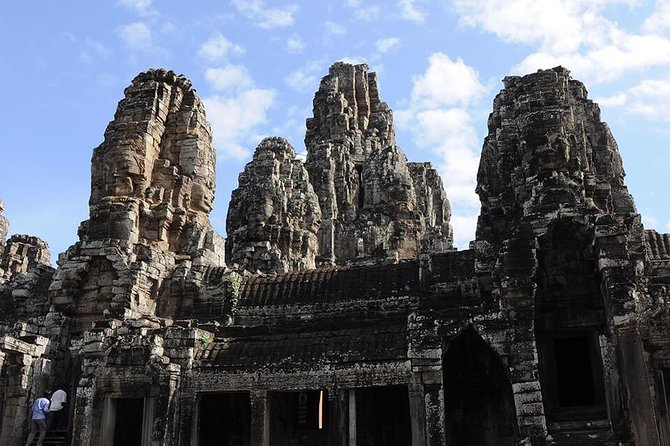
Bayon is usually the most memorable stop for people who enjoy atmospheric ruins. The temple is famous for its huge carved faces, and it also contains traces of Hindu inscriptions along with Mahayana and Theravada Buddhist inscriptions.
Those layers make Bayon especially interesting. The site is not a simple snapshot of one belief or one period. It reflects changes in religious practice and royal history, which your guide can help explain as you move through the towers.
Give Bayon several hours, as the itinerary allows. The temple has many nooks, narrow passages, and carved surfaces, and the central area can feel confusing without a route. Look for the faces from different angles. They seem to change expression as you move around the towers, which is one reason the temple holds attention long after the first photograph.
Bayon is not polished in the way some visitors expect from a famous monument. Its appeal comes from the close, enclosed experience and the sense that you are walking through a maze of stone faces and passageways.
What the $98 price really covers
The tour costs $98, but you should calculate the full basic cost before deciding. The required three-day temple pass costs $62 per person, bringing the tour and pass to $160 per person before food, drinks, and personal expenses.
That is not a cheap day trip. It can still be a fair price if you value private transport, hotel pickup, a guide, and a route that reaches eight important temples over two days. Organizing each of these sites independently would require transport planning and a clear understanding of the park’s layout.
The value is strongest for people who want interpretation rather than just a car and a list of stops. A guide can explain the difference between Hindu and Buddhist elements, point out details you might walk past, and help you understand why one temple is famous for carvings while another is important for its layout or state of preservation.
The price is less attractive if you already have transport, prefer to explore alone, or want a very relaxed schedule with only two or three temples. This is an active sightseeing plan with a lot of stonework in two days.
Group discounts are listed, but no discount amount is provided. Ask for the current group rate if you are booking for more than one person. Food and drinks are not included, so plan for those separately, and bring water even though cold water is supplied during the tour.
The private guide can make or break the day
The strongest praise attached to this experience centers on the guide. Sam is specifically named as a guide with strong storytelling and photography skills. That combination matters at Angkor, where the ruins are impressive but the meaning behind them is not always obvious.
A good guide should help you see connections between the temples rather than recite isolated dates. At Banteay Srei, that means explaining the carvings. At Ta Prohm, it means putting the jungle growth and restoration into context. At Bayon, it means helping you read the religious layers and understand the giant faces.
Since only your group participates, you can ask questions without holding up a coach full of people. You can also tell the guide if you need more time at Banteay Srei or Bayon, although the full route means the day still needs structure.
The operator is Angkor Pura Tours. Confirmation is provided at booking, and pickup is available from your Siem Reap hotel. The stated meeting point is in Siem Reap, so confirm the exact pickup details after booking.
Clothing, walking, and daily comfort
The temple dress rule is simple: shoulders and knees must be covered. Wear clothing that meets that requirement from the start, rather than relying on a cover-up you may forget in the vehicle.
You will walk over stone, climb at Pre Rup, and handle uneven surfaces at older ruins such as Ta Prohm and Preah Khan. The supplied information says most people can participate, but the route still demands steady walking and some climbing.
Cold water is included, which is useful in Cambodia’s heat. Food and other drinks are not included. You should also budget for personal expenses and the temple pass.
The tour is private, but it is not described as a slow-paced or low-walking outing. If you want to see all eight temples, expect a full sightseeing schedule across both days.
Who should book this tour
I would choose this tour if you are staying in Siem Reap for at least two days and want to see both the famous monuments and less familiar sites such as Banteay Samre and Banteay Kdei. It suits first-time visitors who want a guide to provide the background and a private vehicle to handle the distances.
It is also a good match for small groups who value flexibility. Families or friends can share the private experience, and group discounts may improve the price, though the exact savings are not stated.
I would hesitate if your priority is a very quiet temple visit, because Angkor Wat, Ta Prohm, and Bayon are popular. I would also think twice if $160 before meals feels high, or if you prefer to spend an entire morning at one temple rather than follow a broad route.
Free cancellation is available when you cancel at least 24 hours before the start time. Changes or cancellations made inside that window are not accepted for a refund.
Should you book the eight-temple route?
Book it if you want a well-rounded Angkor introduction with private transport, a guide, hotel pickup, and eight major temples divided across two days. The strongest reasons are the variety, the private pace, and the chance to hear stories from a guide such as Sam, whose storytelling and photography skills are specifically praised.
Skip it if you want a cheaper, slower plan or only care about Angkor Wat. Before paying, add the $62 temple pass to the advertised $98 price, confirm the optional sunrise details, and make sure the clothing and walking demands suit your group.
FAQ
How long does the tour last?
The experience lasts approximately two days.
Which temples are included?
The route includes Pre Rup, Banteay Samre, Banteay Srei, Ta Prohm, Banteay Kdei, Angkor Wat, Preah Khan, and Bayon.
Is the tour private?
Yes. Only your group participates in the private tour.
Is hotel pickup included?
Yes. Private transport includes convenient pickup from your Siem Reap hotel.
Is a tour guide included?
Yes. A tour guide is included. Sam is one guide associated with this experience.
Is the Angkor temple pass included?
No. The three-day temple pass costs $62 per person and is not included in the tour price.
What does the $98 tour price include?
The price includes the tour guide, cold water, and transport suitable for the group size. Food, drinks, accommodation, the temple pass, and personal expenses are not included.
What should I wear to the temples?
You must cover your shoulders and knees when entering the temples.
Can I cancel for a full refund?
Yes, if you cancel at least 24 hours before the experience start time. Cancellations made less than 24 hours in advance are not refunded.
Just added around Siem Reap
- Ultimate Sunrise to Angkor Wat, Angkor Thom and Bayon Temple★ 5.0 · 3 reviews
- Twilight Tastes of Siem Reap Include Dinner★ 5.0 · 13 reviews
- Trekking Tour at Phnom Kulen National Park from Siem Reap★ 5.0 · 3 reviews
- Full-Day Private Tour of Angkor Wat with Pick Up★ 5.0 · 12 reviews
- Private Day Trip to Angkor Temples with Expert Guide★ 5.0 · 4 reviews
- Waterfall & River of 1000 Siva Linga- Kulen Mountain Private Tour★ 5.0 · 3 reviews
- Professional Photo Shoot in Angkor Archaeological Park, Siem Reap★ 5.0 · 42 reviews
- Ultimate Siem Reap Food Tour by Tuk Tuk – 20 Tastings, 8 Stops★ 5.0 · 13 reviews
2-Day Experiences, compared.

Angkor Wat 2-Day Tour with Sunrise and Sunset
Read our review →
2 Days Exclusive Temple Highlights with Sunset and Sunrise Tour
Read our review →
Angkor Sunrise 1- or 2-Day Guided Temples Tour
Read our review →
2-Day Angkor Wat With Small, Big Circuit and Banteay Srei Tour
Read our review →
2-Day Temple Highlights Sunrise and Sunset Option
Read our review →
Angkor Wat 2-Day complex Sun rise & Sun set with Guided Tour
Read our review →
2-Days Angkor Wat with Sunrise Small-Group Tour
Read our review →
2-Day Angkor Wat Tour with Banteay Srei and Floating Village
Read our review →Browse the lists this tour appears in