
Reviewed · ANGKOR WAT TOURS
Angkor Wat 2-Day Tour
The best part of this private Angkor Wat tour is the amount of ground it gives you in two days. You move from the giant towers of Angkor Wat to Bayon’s many stone faces, then on to tree-covered Ta Prohm and the quieter corners of the ancient capital. It is a strong first look at Siem Reap’s main sights.
I like the flexible private format, which lets your driver and guide adjust the day to your pace. I also like the simple comforts: cold towels and drinking water matter when you return to the vehicle hot and dusty. Guides and drivers named in past bookings include Vutha, Ly, Seng, Lucky, and Pheach.
The main catch is that the $360 price does not include temple tickets or lunch. The second day is also described in broad terms rather than with a complete list of named stops, so you should confirm exactly what is planned before booking.
Key points to know before booking
- Angkor Wat and Angkor Thom lead the first day: See the park’s biggest names, including Bayon, Baphuon, Ta Prohm, and the South Gate.
- A private vehicle keeps the schedule flexible: You travel only with your own group and can discuss pauses or changes with your guide.
- Cold towels and water are included: These are small but useful comforts after walking among hot stone temples.
- Sunset is part of the plan: You may finish at Angkor Wat or Bakheng Mountain, depending on the arrangement.
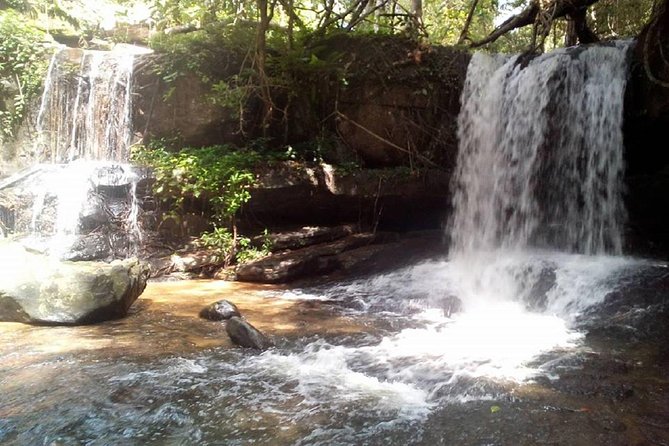
- The second day needs clarification: The tour promises the jewel of Angkorian art and the river of thousand Lingas, but the supplied details do not name every stop.
- Extra costs are easy to overlook: Temple admission, lunch near the park, and personal expenses are separate.
Two days give Angkor room to breathe
A single day at Angkor can feel like a race between temple gates. This two-day plan is better suited to you if you want the major monuments without trying to cram every stop into one long outing.
The tour begins at 8:00 a.m. from Siem Reap. Transportation is included, along with an English-speaking guide, drinking water, and cold towels. The activity is private, so you are not tied to the pace of a large coach group. That matters at Angkor, where one person may want a quick look while another wants time for carvings, photos, and questions.
The schedule covers the famous small circuit on the first day. The second day is intended to add more of Angkorian art and the thousand Lingas site. Since the exact day-two route is not fully set out, I would ask the operator for the named temples, departure time, and expected return time before paying.
Past arrangements have also included extra flexibility. Vutha arranged an airport pickup for one solo visitor, and Seng added a Tonle Sap Lake boat trip when requested. Those additions should not be treated as part of the standard tour, but they show why a private booking can be useful if you want to discuss side trips.
More Angkor Wat Tours in Siem Reap:
- Angkor Wat Sunrise or Sunset Tour with Guide from Siem Reap
★ 5.0 · 12,109 reviews - Siem Reap: Angkor Wat: Small-Group Sunrise or Sunset Tour
★ 5.0 · 9,444 reviews - Siem Reap: Angkor Wat 2-Day Tour with Sunrise and Sunset
★ 4.9 · 4,429 reviews
Angkor Wat rewards an early, careful look
Angkor Wat is the obvious centerpiece, and rightly so. It is the largest religious building in the world, with long galleries, grand towers, courtyards, and detailed carvings. Your guide can help turn a huge pile of stone into a place with purpose, symbols, and royal ambition.
The first-day plan begins with an 8:00 a.m. departure, rather than promising a sunrise start. The itinerary later mentions sunset at Angkor Wat or Bakheng Mountain, while one past two-day arrangement combined sunrise and the small circuit. If sunrise is important to you, confirm that timing directly, since it is not clearly included as the regular start.
Angkor Wat is large enough to tire you before the day is half over. Wear clothing that follows temple dress rules and covers the required shoulders and knees. Comfortable walking shoes matter more here than stylish footwear. You will cross uneven stone and spend time in exposed courtyards.
The guide is especially useful inside the galleries, where carvings can look like decoration until someone explains the scene. You will have more freedom to stop for photographs on a private tour, but the monument still requires patience. Take time to look up, then step back to see how the towers frame one another.
Angkor Thom begins at the South Gate
The South Gate is one of the most memorable entrances in the park. Its causeway is lined with two rows of devas and asuras, figures from the Hindu story of the Churning of the Sea of Milk. They appear to pull at a great serpent, creating a dramatic approach to the old capital.
This is a good place to ask your guide about the meaning of the gate before moving on. The entrance was built to protect Angkor Thom, and it gives you an immediate sense that you are entering a planned royal city, not simply visiting separate ruins.
The stop can also be busy, particularly because it is a popular way into Angkor Thom. Your private guide may help you find a better position for photographs, but there is no promise of an empty causeway. Be ready to move at a steady pace.
Bayon and the faces at the center of Angkor Thom
About one kilometre from the South Gate, Bayon served as the state temple of King Jayavarman VII. Its 54 towers are decorated with 216 smiling faces of Avalokiteshvara, creating one of Angkor’s strangest and most powerful sights.
Bayon is not best understood from one wide photograph. I like to walk slowly through the crowded inner passages, where faces appear between towers and seem to watch from different angles. The stonework can feel confusing at first, so this is one of the stops where a good guide adds real value.
The temple is compact but demanding. Passages are narrow, levels change, and the site can become congested. You should not expect a quick, smooth walk from entrance to exit. Give yourself time to look carefully, especially if your guide explains the religious and royal ideas behind the faces.
A few more Siem Reap trips to weigh up
- Angkor 2-Day Sunset & Sunrise Small-Group Tour
★ 5.0 · 2,567 reviews - 2 Days Exclusive Temple Highlights with Sunset and Sunrise Tour
★ 5.0 · 1,157 reviews - Siem Reap: Angkor Sunrise 1- or 2-Day Guided Temples Tour
★ 4.9 · 1,132 reviews - 2 Days Guided Historical Tour in Angkor
★ 5.0 · 855 reviews
Baphuon, the terraces, and the royal center
Baphuon is the second-largest temple in Angkor Thom. Built in the mid-11th century as a state temple for the Hindu god Shiva, it rises in a three-tiered pyramid form. Its shape makes it different from Bayon, and the climb offers a sharper sense of temple architecture as a series of terraces.
Next come the Terrace of the Elephants and the Terrace of the Leper King. The Terrace of the Elephants stretches about 350 metres and once served as a viewing platform for public ceremonies and military training. It was part of the royal center, so its importance comes from both its carvings and its role in court life.
The Terrace of the Leper King sits beside it, with carved details inside. These terraces are less about entering one enclosed temple and more about reading the old capital’s public spaces. I would pay attention to the walls and reliefs rather than treating them as a short photo stop.
Because these sites are close together, the private format works well here. You can ask your guide to pause when a carving catches your eye instead of simply following a fixed line through the complex.
Chau Say Tevoda, Thommanon, and Takeo add variety
Outside Angkor Thom, the tour includes Chau Say Tevoda, Thommanon, and Takeo. These temples are smaller than Angkor Wat and less famous than Ta Prohm, but that is part of their appeal. Their scale gives you a break from the huge crowds and giant ceremonial spaces.
Chau Say Tevoda and Thommanon are especially useful for comparing temple design. They are located near one another, so you can notice differences in condition, form, and carved decoration without spending much of the day in transit.
Takeo has a more forceful pyramid shape. The stone terraces make it a good stop for seeing how Angkorian builders used height and symmetry to express power. The details provided do not specify how much climbing is involved on the day, so ask your guide about access if stairs are a concern.
These three stops help prevent the first day from becoming only a parade of famous names. They give you a wider sense of the park and show how Angkorian temple design changed from one royal project to the next.
Ta Prohm is beautiful, crowded, and hard to forget
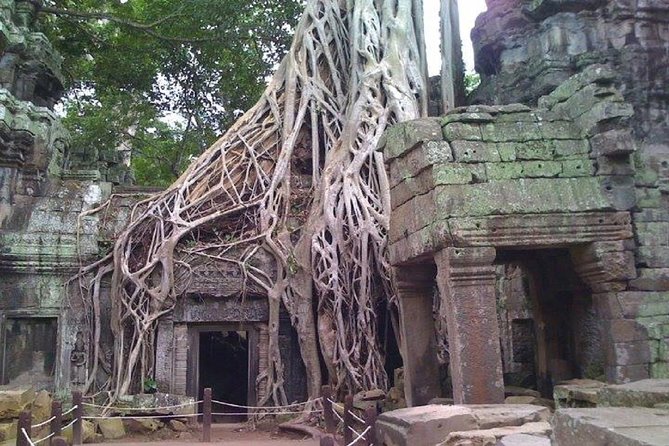
Ta Prohm was used as a Buddhist monastery and university during the Angkor period. It later became widely known as the Tomb Raider temple after appearing in the film. Its most famous feature is the large tree growing through the stonework.
The trees are not just a decorative backdrop. Roots press against walls and galleries, making the temple feel as if the forest is taking the building back. That contrast between carved stone and living growth is why Ta Prohm is often the most immediately memorable stop for first-time visitors.
It is also one of the busiest places on the route. The best-known tree-and-ruin views can slow the walking pace, especially when people stop for photographs. A private guide can help you understand the layout and point out less obvious carvings, but cannot remove the crowds.
Take care on uneven ground and narrow passages. Ta Prohm rewards looking beyond the one famous photo point. Notice the small reliefs, door frames, and changing views through the trees.
Banteay Kdei and Srah Srang slow the pace
Banteay Kdei was recently restored and remains open to visitors. Surrounded by forest, it has a quieter, more mysterious feel than Ta Prohm. I like it as a follow-up because it lets you see a similar relationship between trees and old stone without making the entire experience about one famous movie location.
Srah Srang is a reservoir, or baray, associated with Banteay Kdei. Its open water gives your eyes a rest after the enclosed galleries and shaded corridors of the temples. The setting is especially attractive around sunrise or sunset.
The itinerary mentions Srah Srang as a place with striking views at both times of day. The exact timing depends on the final plan, so do not assume you will see sunrise there unless the operator confirms it. If you prefer fewer stops and more time at each monument, tell your guide early in the day.
Sunset at Angkor Wat or Bakheng Mountain
The first day can end with sunset at Angkor Wat or Bakheng Mountain. Angkor Wat gives you a view of the world-famous monument in softer light. Bakheng offers a high position above the surrounding area and a different way to see the end of the day.
The choice matters. Angkor Wat is the stronger option if you want another look at the central towers and reflection pools. Bakheng Mountain appeals if you prefer a raised viewpoint and the temple setting itself.
The wording allows for either site, not necessarily both. Sunset spots can also involve limited viewing areas and a slow exit, so ask which location your guide expects to use. You may also want to confirm how the vehicle handles the return to Siem Reap after sunset.
What the second day promises, and what to confirm
The second day is described as a visit to the jewel of Angkorian art and the river of thousand Lingas. Those phrases point to important outlying temple and river sites, but the supplied itinerary does not provide a complete list of names, driving times, or stop lengths.
That missing detail is the biggest practical weakness of the tour description. Day one is laid out stop by stop. Day two needs a direct question: Which temples are included? Is lunch still separate? How early do we leave? How long will we spend walking? Are entrance roads and return times different from day one?
You should also confirm whether the same guide and driver will accompany you for both days. Names connected with past bookings include Vutha, Ly Hol, Seng, Lucky, Bunanal, Ten, and Pheach. Availability can change, so treat those names as examples rather than a promise.
A private second day can be a good fit if you want to adjust the pace. A guide can spend more time on carved details, shorten a stop if the heat becomes too much, or discuss a possible addition such as Tonle Sap Lake. Any extra excursion should be agreed on in advance.
Guides, drivers, and the small comforts
The strongest pattern in the supplied information is the praise for the drivers’ punctuality, flexibility, and care. Ly Hol is described as professional and open to detours, while Vutha is noted for being helpful with families and children. Pheach is described as responsive when a last-minute alternative was needed.
That matters because Angkor is not only a walking experience. You repeatedly return to the vehicle between temples, and a reliable driver makes those transitions easier. Drinking water and cold towels are included, which is a welcome relief after a hot walk across stone courtyards.
The English-speaking guide is there to explain the temples and answer questions. One past booking specifically used a guide who also helped with photography. If photographs matter to you, ask at booking whether that kind of guide is available, since it is not guaranteed for every departure.
Because this is a private activity, the group size is limited to your own party. The supplied details do not state the vehicle type, so confirm whether your booking uses a tuk-tuk, car, or another form of transport.
The $360 price and the real value
At $360 for about two days, the price can make sense if you value private transport, a guide, and flexibility. You are not simply paying for admission to temples. You are paying for someone to connect the sites, manage the route, provide local explanations, and get you back and forth from Siem Reap.
Still, the cost needs careful comparison. Temple tickets are not included. Lunch near the temples is also extra, as are personal expenses. For a solo visitor, $360 may feel steep because the private arrangement is not spread across a large group. For a family or small group, the same price may offer better value per person.
The tour includes confirmation at booking and free cancellation up to 24 hours before the start time. Changes or cancellations inside that window are not accepted for a refund. The meeting point is in Siem Reap, with an 8:00 a.m. start.
I would budget beyond the advertised price for admission, food, and any optional addition. Most people can participate, but you still need to follow the temple dress code and be ready for substantial walking over uneven surfaces.
Who should book this Angkor Wat tour?
I would choose this experience if you want the major Angkor temples with a private guide and the ability to discuss the pace. It suits couples, families, solo visitors who do not want to join a group, and anyone who wants help making sense of Bayon’s carvings and Angkor Thom’s royal spaces.
It is also a good choice if small comforts matter. Water, cold towels, and a flexible driver are useful after several hours in the heat. The strong driver feedback suggests that the transport side can be one of the tour’s best features.
I would hesitate if you want a fully fixed, highly detailed second-day schedule printed in advance. The day-two description needs clarification. I would also compare prices carefully if you are alone and want only transport, since the value of a private guide depends on how much explanation and flexibility you plan to use.
Before booking, ask for the exact second-day temples, the vehicle type, the guide’s name, whether sunrise is included, and the temple ticket cost. Those answers will tell you far more than the headline price.
Should you book it?
Book this tour if you want a relaxed private introduction to Angkor’s essential temples, with an English-speaking guide, helpful transport, and sunset built into the plan. The first day is especially strong, covering Angkor Wat, Angkor Thom, Bayon, Baphuon, the terraces, Ta Prohm, Banteay Kdei, Srah Srang, and several smaller temples.
Think twice if you need every detail settled before departure or if the $360 price leaves little room for tickets and meals. Confirm the second-day route first. If the named stops match your interests, this is a practical way to see Angkor without handing your two days over to a large group schedule.
FAQ
Where does the tour start?
The tour starts in Siem Reap, Siem Reap Province, at 8:00 a.m.
Is this a private tour?
Yes. Only your group participates in the private activity.
Is an English-speaking guide included?
Yes. Transportation and an English-speaking guide are included.
Are temple tickets included in the $360 price?
No. Temple tickets are listed as an additional expense.
Is lunch included?
No. Lunch near the temples is not included. Personal expenses are also separate.
Can I cancel for a full refund?
Yes, if you cancel at least 24 hours before the experience start time. Cancellations or changes made less than 24 hours before the start time are not accepted for a refund.
Just added around Siem Reap
- Ultimate Sunrise to Angkor Wat, Angkor Thom and Bayon Temple★ 5.0 · 3 reviews
- Twilight Tastes of Siem Reap Include Dinner★ 5.0 · 13 reviews
- Trekking Tour at Phnom Kulen National Park from Siem Reap★ 5.0 · 3 reviews
- Full-Day Private Tour of Angkor Wat with Pick Up★ 5.0 · 12 reviews
- Private Day Trip to Angkor Temples with Expert Guide★ 5.0 · 4 reviews
- Waterfall & River of 1000 Siva Linga- Kulen Mountain Private Tour★ 5.0 · 3 reviews
- Professional Photo Shoot in Angkor Archaeological Park, Siem Reap★ 5.0 · 42 reviews
- Ultimate Siem Reap Food Tour by Tuk Tuk – 20 Tastings, 8 Stops★ 5.0 · 13 reviews
Angkor Wat Tours, compared.

Angkor Wat Sunrise or Sunset Tour with Guide from Siem Reap
Read our review →
Angkor Wat: Small-Group Sunrise or Sunset Tour
Read our review →
Angkor Wat 2-Day Tour with Sunrise and Sunset
Read our review →

Angkor Wat Sunrise tour with Small – Group and Guide tours
Read our review →
Angkor Wat Highlights and Sunrise Guided Tour from Siem Reap
Read our review →
Angkor Wat Sunset Small Group Tour with Lunch Included
Read our review →
Full-Day Angkor Wat Sunrise Private Tour with Guide from Siem Reap
Read our review →Browse the lists this tour appears in