
Reviewed · ANGKOR WAT SUNRISE TOURS
Private 2 Days Angkor Wat Sunrise and Discover all Major Temples
Angkor Wat at sunrise is the hook, but the real strength of this two-day tour is its range. You begin before dawn at Cambodia’s national symbol, then move through royal city gates, giant stone faces, jungle-wrapped ruins, delicate carvings, and quieter temples far from the busiest paths.
I like the private vehicle and flexible format, especially when you need a cool break between temples. I also like the mix of famous sights and less-visited stops such as Ta Nei and Banteay Kdei. Guides named Sara and Leap have been praised for clear English, useful historical background, and a willingness to adjust the pace.
The drawback is the early start and packed schedule. You will see a remarkable amount in two days, but this is not a slow, contemplative temple holiday. The Angkor Pass and meals cost extra, and sunrise can bring a large crowd even when your tour itself is private.
Key points to know before booking
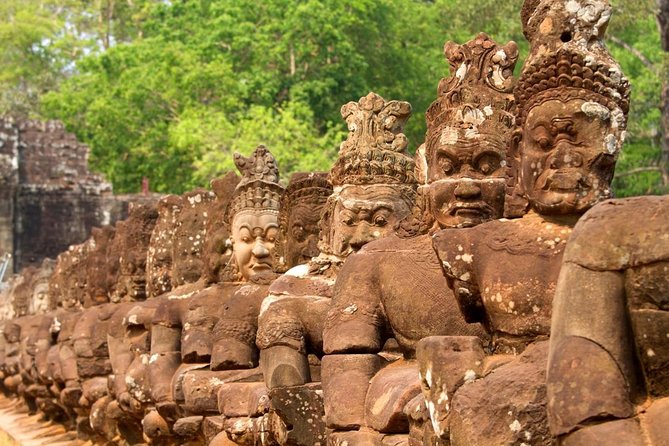
- A 4:30 a.m. start gets you to Angkor Wat for sunrise, with the temple’s famous towers forming the classic first view of the day.
- The private setup matters, since only your group participates and the guide can adapt the pace or focus.
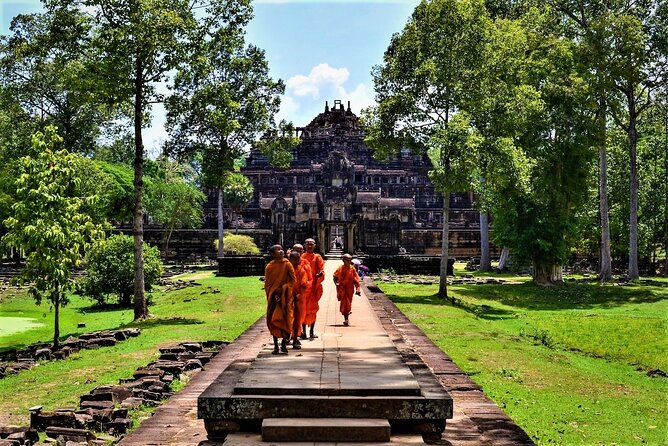
- Day one covers Angkor Wat and Angkor Thom, including Bayon, Baphuon, the royal terraces, Ta Nei, and Banteay Kdei.
- Day two reaches the outer temples, including finely carved Banteay Srei, atmospheric Preah Khan, Neak Pean, Ta Som, and Pre Rup.
- Air conditioning, bottled water, and cool towels are included, a small comfort that matters in Cambodia’s heat.
- The $149.46 price excludes the Angkor Pass and food, so plan for those added costs before comparing value.
Why this private two-day plan works
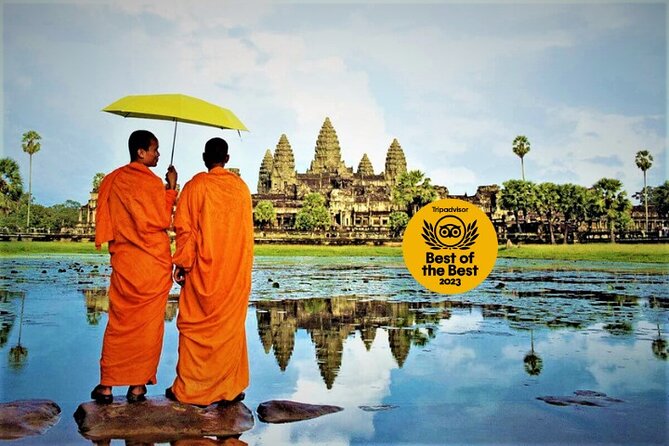
Angkor Archaeological Park covers about 390 square miles, or 1,000 square kilometers. Its temples are not lined up in one compact museum complex. Roads, reservoirs, forest, and long distances separate many of the best sites.
That makes a private car more useful than it may sound. You are not simply paying for transport. You are buying a practical way to cover the major temples without spending your energy arranging each ride, finding the correct entrance, or negotiating every stop.
The vehicle has air conditioning, and bottled water and fresh cool towels are provided. After walking across hot stone and climbing temple steps, those towels are welcome. Hotel pickup and drop-off also remove a common Siem Reap nuisance, especially on the pre-dawn morning.
Only your group takes part. That gives you room to ask questions, spend longer at a carving that catches your eye, or move along when you have reached your limit. The experience is still fairly full, so flexibility does not mean an entirely unstructured day.
The guides vary. Names associated with the experience include Sara and Leap, while drivers include La, Ry, Pheap, Sophal, and Paul. The strongest praise centers on guides who explain the history in clear English and drivers who are careful, helpful, and attentive to families. You should not assume a particular guide or driver unless the company confirms one in advance.
More Angkor Wat Tours in Siem Reap:
- Angkor Wat Sunrise or Sunset Tour with Guide from Siem Reap
★ 5.0 · 12,109 reviews - Siem Reap: Angkor Wat: Small-Group Sunrise or Sunset Tour
★ 5.0 · 9,444 reviews - Siem Reap: Angkor Wat 2-Day Tour with Sunrise and Sunset
★ 4.9 · 4,429 reviews
Angkor Wat at 4:30 a.m.
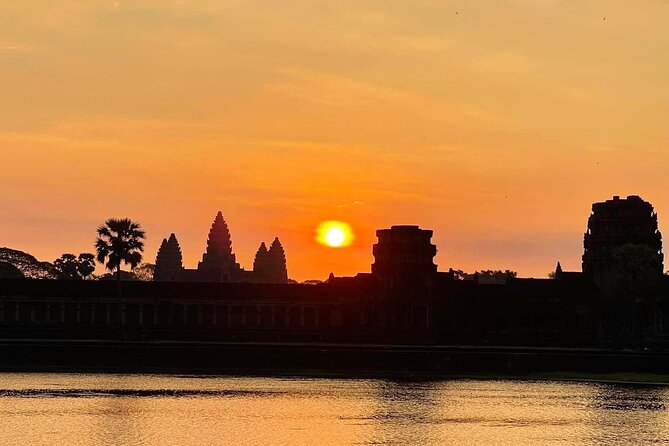
The first morning begins at about 4:30 a.m. for Angkor Wat sunrise. That is a serious wake-up call, but it puts the most famous temple first, when the light is changing and the outline of the towers becomes the focus.
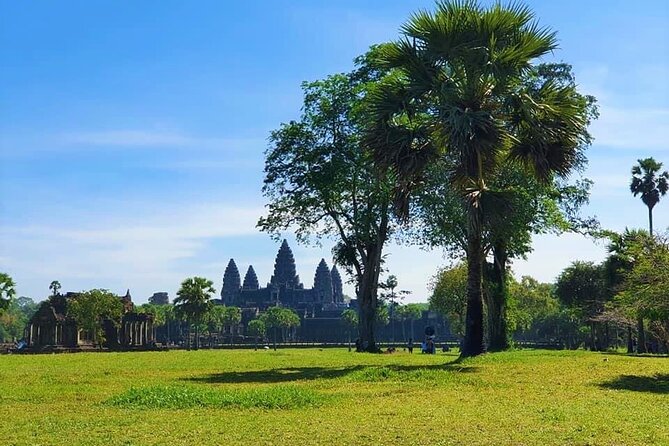
Angkor Wat is Cambodia’s national emblem and one of the great religious monuments of the Khmer Empire. Its five-tower design is especially recognizable from the front, where the central silhouette can appear as three towers from a straight-on view.
You have about two hours here. Sunrise itself can be brief, and the waiting area may be busy, so keep your expectations sensible. The private tour gives you a personal guide, not a private sunrise platform. After the color fades, your guide can help explain the temple’s layout, symbolism, and place in Khmer history.
The admission ticket is not included. You need the Angkor Pass to enter the temples, and the guide assists with buying it at the entrance to the park. The price of the pass is not provided, so check the current cost before departure.
Angkor Thom and Bayon’s stone faces
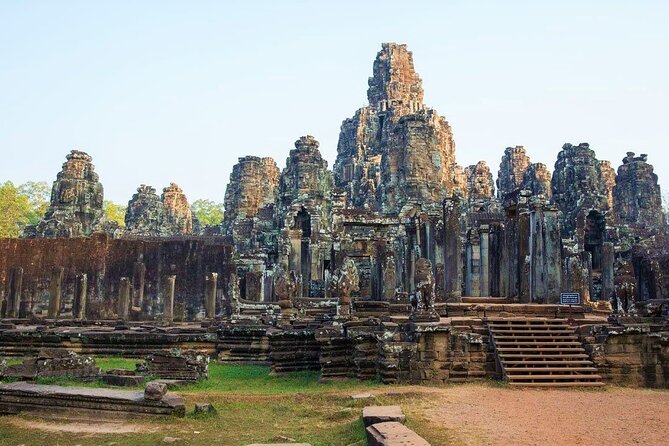
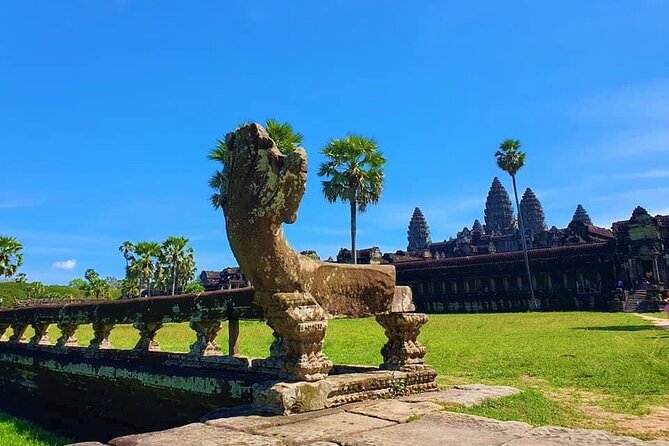
The next major area is Angkor Thom, the great royal city that followed Angkor Wat as the Khmer capital. Your first stop is the South Gate, where a broad moat and a restored stone causeway frame rows of large sculptures.
Allow about 40 minutes here. The causeway is more than a quick photo stop. Look closely at the figures lining the approach, and ask your guide to explain the imagery and the role of the gate in the city’s design.
Inside Angkor Thom, you spend time at the city itself, then continue to Bayon. Bayon was built around 1200 and is famous for its many serene stone faces. Its towers create a maze-like effect, with faces appearing at different heights and angles as you walk around the monument.
The planned time at Bayon is about 90 minutes, which is useful. This is not a temple to rush through. The outer walls also carry carved scenes, and the close-packed structure rewards a slower look. The stone faces are the obvious draw, but the guide’s explanation helps you see Bayon as part of Jayavarman VII’s great city rather than as a collection of mysterious heads.
Royal terraces, Baphuon, and Phimeanakas
Baphuon sits only a short distance from Bayon. Once the largest Khmer temple before Angkor Wat was built, it has a tall, mountain-like form and a long approach.
You have about an hour here. Expect uneven walking and steps, as with many Angkor monuments. The close location makes Baphuon an efficient addition to the morning, but by this point you may already feel the heat and the early start.
Phimeanakas receives about 20 minutes. Its name refers to a celestial or aerial palace, and it sits within the former royal area. This is a shorter stop, best treated as a piece of the larger royal center rather than a standalone highlight.
The Terrace of the Elephants follows, with about 30 minutes. It forms much of the western edge of Angkor Thom’s Royal Square. Nearby, the Terrace of the Leper King gets another 30 minutes. The carved surfaces and royal setting make these stops worthwhile, but they are less instantly dramatic than Bayon or Angkor Wat.
This stretch of the day shows one benefit of a guide. Without context, terraces can look like long stone walls. With an explanation of their function and setting, you can picture the ceremonies and royal activity that once filled the square.
More Angkor Wat Sunrise Tours in Siem Reap:
- Angkor Wat Sunrise tour with Small – Group and Guide tours
★ 5.0 · 3,655 reviews - Full-Day Angkor Wat Sunrise Private Tour with Guide from Siem Reap
★ 5.0 · 2,920 reviews - Angkor Wat Sunrise & 3 Main Temples with Breakfast – Small Group
★ 5.0 · 2,857 reviews - Siem Reap: Angkor Wat Sunrise and Full-Day Sightseeing Tour
★ 4.9 · 2,828 reviews
Ta Nei and Banteay Kdei: quieter temple time
Ta Nei is a late 12th-century temple built during the reign of Jayavarman VII and dedicated to the Buddha. The planned visit lasts about 50 minutes.
Its appeal is its smaller scale and more remote feel. You are not seeing another giant centerpiece. You are seeing how Khmer temple design works in a less polished, less crowded setting. That contrast is valuable after the grand monuments of Angkor Thom.
Banteay Kdei is another 50-minute stop. It sits close to the junction of the Small Circuit and Grand Circuit, opposite the Srah Srang reservoir. Its location makes it easy to reach, but it can feel more atmospheric than the major monuments because the structures are less imposing and the setting invites a slower walk.
These stops help keep the two days from becoming a checklist of only the most famous names. I especially like this part for people who want some variety. You get scale, detail, and atmosphere rather than five versions of the same temple.
Day two begins with Banteay Srei
Day two reaches Banteay Srei, about 25 miles from Siem Reap. The planned visit lasts two hours, making it one of the day’s main stops.
Banteay Srei is smaller than Angkor Wat, but its pink sandstone carvings are exceptionally fine. The temple is often singled out as one of the most beautiful in Cambodia. Its detailed decoration gives you a different view of Khmer art, one based less on giant scale and more on careful workmanship.
The longer drive also changes the rhythm of the tour. You spend more time away from the central Angkor group, and the journey to the temple is part of the day rather than a quick hop between nearby ruins.
Banteay Srei is also a good reason to choose a private car. The schedule includes several additional temples after this stop, and having door-to-door transport avoids arranging a separate trip to the outer part of the park.
Banteay Samre and Preah Dak Village

Banteay Samre is a Hindu temple built in the early 12th century during the reigns of Suryavarman II and Yasovarman II. You have about 50 minutes here.
Its design gives you another look at the period of large, carefully planned temple construction. After the delicate carving at Banteay Srei, Banteay Samre brings the focus back to stronger architectural forms and a more enclosed temple setting.
The day also includes a stop at Preah Dak Village. It is known for souvenirs, objects, and local arts, and the description allows time to discover local places and surroundings.
This is the least detailed part of the schedule, so keep your expectations open. It is not presented as a major monument stop. Instead, it offers a break from temple walls and a chance to see a small local commerce and craft setting. Any purchases are your responsibility, and the experience does not promise a particular workshop or demonstration.
Preah Khan and the unusual Neak Pean

Preah Khan receives about an hour. Built by Jayavarman VII in 1191, it was dedicated to his father, represented by a central statue named Jayavarmeshvara.
Preah Khan is one of the most rewarding places on the second day because it combines a substantial temple plan with long corridors, carved details, and a sense of gradual discovery as you move through it. An hour gives your guide time to explain the dedication and the temple’s place in the reign of Jayavarman VII.
Neak Pean is planned for another hour, and it is one of the most unusual stops in the entire two-day route. Rather than following the standard temple mountain form, it was built on an artificial island in a large reservoir.
The approach and layout are the point here. Neak Pean does not resemble Angkor Wat or Bayon, so it adds architectural variety. You may find the stop less visually overwhelming than the major temples, but it helps explain the Khmer use of water, sacred islands, and carefully planned temple settings.
Ta Som, Eastern Mebon, and Pre Rup
Ta Som receives about 40 minutes. Built in the late 12th century by Jayavarman VII, it may have been dedicated to his father or one of his teachers, though its exact purpose is not certain.
That uncertainty is worth accepting. Angkor is full of incomplete answers, and a good guide can explain what is known without pretending that every stone has a clear story. Ta Som is a compact stop that gives you another late 12th-century temple without requiring a long visit.
Eastern Mebon gets about 30 minutes. This mountain temple was built in the 10th century by Rajendravarman II and dedicated to Shiva. Its earlier date makes it a useful comparison with the later monuments built under Jayavarman VII.
The final listed temple is Pre Rup, with about an hour. Founded in 961, it is one of the major surviving works of Rajendravarman II. The temple’s elevated form gives it a strong finish to the route, and the tour description also highlights sunset viewing in Angkor.
The exact sunset timing is not spelled out, so confirm with the operator if sunset at Pre Rup is essential to your plans. The experience promises sunrise and sunset viewpoints, but the final light depends on the day’s schedule and local conditions.
How much walking and heat should you expect?
You will spend much of both days walking on uneven ground, crossing open courtyards, and moving through temple entrances and corridors. Some monuments include steps, and the route covers many sites rather than one or two relaxed visits.
The schedule is especially demanding because day one starts at 4:30 a.m. The private car gives you a place to cool down between stops, but it does not make the walking disappear. Bring practical clothing, sun protection, and shoes that handle rough stone comfortably.
The fresh towels and bottled water are included. Meals are not. Lunch is available at local restaurants, with vegetarian and non-vegetarian choices, and dishes generally cost between $3 and $10. Carry enough money for meals and any village purchases.
Is $149.46 a fair price?
At $149.46 per person, the value depends partly on the size of your private group. The price includes hotel pickup and drop-off, an official licensed English-speaking guide, private air-conditioned transport, bottled water, cool towels, service charges, and government VAT.
It does not include the Angkor Pass or meals. Those are not minor details, so add them to your working budget before comparing this tour with a temple-only car hire.
The value is strongest if you want a guide for the historical explanation and want to reach both the central temples and the farther sites without arranging separate transport. It is also useful for families, since private touring can be less stressful than keeping up with strangers. The extra service and comfort are less important if you only want to see Angkor Wat and Bayon at the lowest possible cost.
The experience has a 4.9 rating from 23 reviews and a 96 percent recommendation rate. The most consistent praise is directed at the guides and drivers: Sara and Leap are noted for clear explanations and friendly help, while drivers such as La, Ry, Pheap, Sophal, and Paul are described as careful and supportive. Those names show the company has several well-regarded teams, but they are not a guarantee of who will be assigned to you.
Who should book this Angkor tour?
I would choose this tour if you have only two days in Siem Reap and want to see the major monuments without giving up smaller stops. It suits first-time visitors who want historical context, families who value a private vehicle, and couples who prefer to move at their own pace.
It is also a good match if Banteay Srei, Preah Khan, and the Grand Circuit matter as much to you as Angkor Wat. The route gives you a broad view of Angkor’s art and architecture, from 10th-century Eastern Mebon and Pre Rup to the 12th-century works of Jayavarman VII.
I would look elsewhere if you dislike early mornings, want long quiet periods at each temple, or plan to spend most of your budget on the admission ticket and food. The schedule is full, and the two days are designed for coverage.
Booking includes free cancellation if you cancel at least 24 hours before the local start time. Changes or cancellations inside that window are not accepted for a refund.
Should you book it?
Book this private tour if you want an efficient, well-supported introduction to Angkor with a guide who can connect the monuments to Khmer kings, religion, and city planning. The combination of sunrise, the famous faces of Bayon, Banteay Srei’s fine carvings, and quieter sites such as Ta Nei gives you far more than a quick Angkor Wat photo stop.
Before paying, confirm the pickup details, ask which guide is assigned, and check the current Angkor Pass price. If you are ready for an early alarm and two active days, the private format offers solid value for seeing a wide stretch of the park without handling the transport yourself.
FAQ
What is included in the tour price?
The price includes hotel pickup and drop-off, a licensed English-speaking guide, private air-conditioned transportation, bottled water, cool towels, service charges, and current government VAT.
Is the Angkor Pass included?
No. The Angkor Pass is not included. Your guide assists you with purchasing it at the entrance to Angkor Park.
Are meals included?
No. Lunch is at your own expense. Local restaurants offer vegetarian and non-vegetarian dishes, generally priced from $3 to $10 per dish.
What time does the tour begin?
Day one begins at about 4:30 a.m. for the sunrise visit to Angkor Wat. The information provided does not state a separate exact start time for day two.
Is this a private tour?
Yes. Only your group participates, and transport is provided in a private air-conditioned vehicle.
Does the tour include both sunrise and sunset?
The experience is designed to include sunrise and sunset viewpoints in Angkor. The listed route begins with sunrise at Angkor Wat and includes Pre Rup on day two, but the exact sunset timing should be confirmed with the operator.
Can I cancel for a full refund?
Yes, if you cancel at least 24 hours before the experience start time. Cancellations or changes made less than 24 hours before the local start time are not accepted for a refund.
More 2-Day Experiences in Siem Reap
- 2 Days Exclusive Temple Highlights with Sunset and Sunrise Tour
★ 5.0 · 1,157 reviews - Siem Reap: Angkor Sunrise 1- or 2-Day Guided Temples Tour
★ 4.9 · 1,132 reviews - 2 Days Guided Historical Tour in Angkor
★ 5.0 · 855 reviews - 2-Day Angkor Wat With Small, Big Circuit and Banteay Srei Tour
★ 5.0 · 545 reviews
More Morning in Siem Reap
- Angkor Wat Highlights and Sunrise Guided Tour from Siem Reap
★ 5.0 · 3,213 reviews - Angkor 2-Day Sunset & Sunrise Small-Group Tour
★ 5.0 · 2,567 reviews - Siem Reap: Angkor Wat Sunrise or Sunset Guided Tour
★ 4.9 · 2,123 reviews - Angkor Wat: Highlights and Sunrise Guided Tour
★ 4.9 · 1,586 reviews
Just added around Siem Reap
- Ultimate Sunrise to Angkor Wat, Angkor Thom and Bayon Temple★ 5.0 · 3 reviews
- Twilight Tastes of Siem Reap Include Dinner★ 5.0 · 13 reviews
- Trekking Tour at Phnom Kulen National Park from Siem Reap★ 5.0 · 3 reviews
- Full-Day Private Tour of Angkor Wat with Pick Up★ 5.0 · 12 reviews
- Private Day Trip to Angkor Temples with Expert Guide★ 5.0 · 4 reviews
- Waterfall & River of 1000 Siva Linga- Kulen Mountain Private Tour★ 5.0 · 3 reviews
- Professional Photo Shoot in Angkor Archaeological Park, Siem Reap★ 5.0 · 42 reviews
- Siem Reap City Tour with War Museum and Killing Field★ 5.0 · 27 reviews
Angkor Wat Sunrise Tours, compared.

Angkor Wat Sunrise or Sunset Tour with Guide from Siem Reap
Read our review →
Angkor Wat Sunrise tour with Small – Group and Guide tours
Read our review →
Full-Day Angkor Wat Sunrise Private Tour with Guide from Siem Reap
Read our review →
Angkor Wat Sunrise & 3 Main Temples with Breakfast – Small Group
Read our review →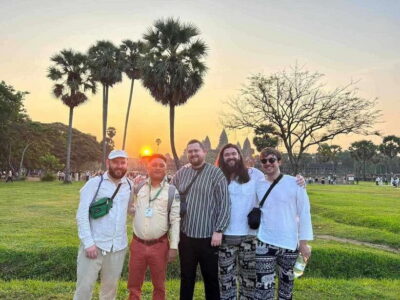
Angkor Wat Sunrise and Full-Day Sightseeing Tour
Read our review →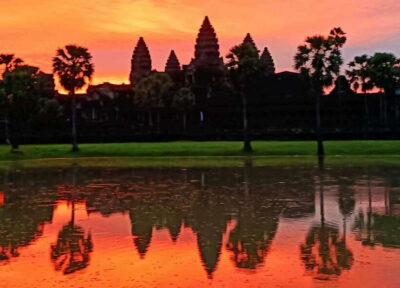

Angkor Sunrise 1- or 2-Day Guided Temples Tour
Read our review →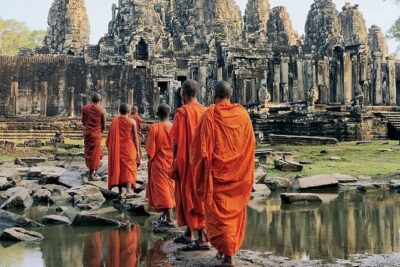
Siem Reap Tour: Angkor Wat Sunrise, Bayon, Ta Prohm, Banteay Srei
Read our review →Browse the lists this tour appears in