
Reviewed · ANGKOR WAT TOURS
2-Day Angkor Wat With Small, Big Circuit and Banteay Srei Tour
Angkor is best seen slowly, and this two-day plan gives you room to do that. Instead of racing through the main temples in one long day, you explore the Small Circuit first, then return for an early Angkor Wat sunrise and the wider Big Circuit. The pink sandstone carvings at Banteay Srei provide a fine finish.
I like the private guide-and-driver setup, especially because guides such as Jimmy, Chay, Vanna, and Thean have been praised for explaining temple symbolism, finding good photo spots, and adjusting the pace. I also like the small comforts: a cool, air-conditioned vehicle, cold water, and wet towels waiting after long walks.
The main drawback is simple: this is a packed temple schedule. You will walk on uneven ground, climb stairs, rise at 5:00am, and spend much of two days looking at ruins. The $158.50 price also excludes the $62 Angkor pass and lunch, so budget for those separately.
Key points at a glance
- Sunrise at Angkor Wat: Start day two at 5:00am for the temple’s famous morning view.
- Two different temple circuits: See major landmarks on the Small Circuit and a broader set of monuments on the Big Circuit.
- Private guide and vehicle: Your group travels with an English-speaking guide and dedicated driver rather than a large coach.
- Ta Nei offers a quieter stop: This less-restored temple is a good break from the busiest sites.
- Banteay Srei adds fine pink sandstone detail: Its smaller scale and delicate carvings contrast with Angkor Wat.
- Cold towels matter: After hot walks, the air-conditioned vehicle, water, and scented wet towels are more useful than they sound.
Why two days works better than one
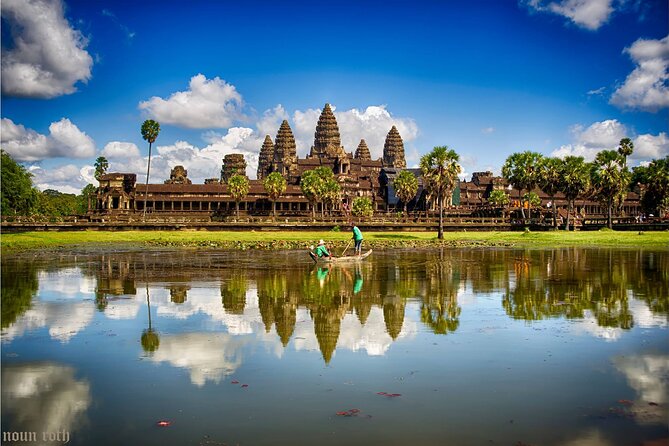
Angkor Wat is only one part of the Angkor Archaeological Park. The temples spread across a large area, and the two main sightseeing routes offer very different moods.
The Small Circuit brings you to the famous names: Angkor Wat, Ta Prohm, Angkor Thom, Bayon, Baphuon, and the royal terraces. The Big Circuit reaches farther out to Preah Khan, Neak Pean, Ta Som, Eastern Mebon, and Pre Rup, then continues to Banteay Srei and Banteay Samre.
I prefer this split because the temples have room to register. On day one, you begin at 8:00am, which is more forgiving than the sunrise start. Day two begins before dawn, but the rest of the route gives you a different look at Angkor, with more spread-out monuments and fewer moments of feeling boxed into the main crowd.
The tour is private, so the guide can change the rhythm. Several guides named in the feedback, including Chay, Choub, Jimmy, and Thean, were praised for adjusting plans to suit energy levels, spending more time where interest was high, and shortening walks when needed. That flexibility is a real part of the value.
More Angkor Wat Tours in Siem Reap:
- Angkor Wat Sunrise or Sunset Tour with Guide from Siem Reap
★ 5.0 · 12,109 reviews - Siem Reap: Angkor Wat: Small-Group Sunrise or Sunset Tour
★ 5.0 · 9,444 reviews - Siem Reap: Angkor Wat 2-Day Tour with Sunrise and Sunset
★ 4.9 · 4,429 reviews
Day one: from Angkor Wat to the faces of Bayon
Your guide meets you in your hotel or guesthouse lobby at 8:00am. The first practical stop is the ticket office, since the Angkor pass is not included. The tour price is $158.50 per person, while the pass costs an additional $62 per person.
Angkor Wat comes first, with about two hours set aside. The scale is the immediate lesson: long galleries, towers, courtyards, and carved walls make it hard to take in the whole complex at once. Your guide can help explain the religious ideas and stories shown in the carvings, rather than leaving you to guess what each scene means.
The length of this stop is useful. You have time to walk, listen, take photographs, and pause without treating the temple like a quick photo stop. The drawback is that Angkor Wat can feel busy, particularly around the most recognizable views, so your guide’s timing and choice of paths matter.
Ta Prohm and Ta Nei: famous roots, quieter ruins
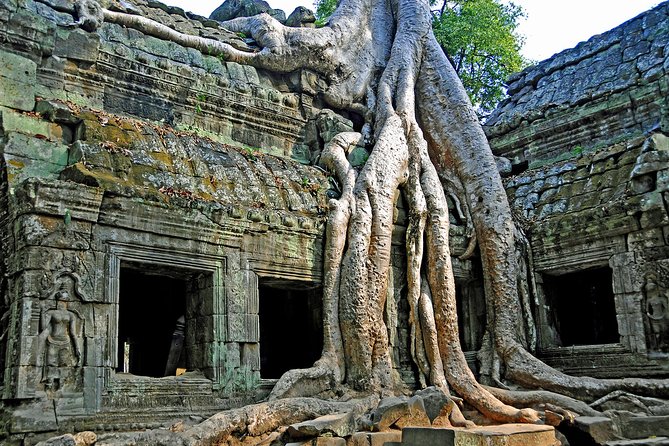
Ta Prohm follows, with another two hours planned. This is the temple of giant tree roots pushing across walls and galleries, and it is also associated with the film Tomb Raider. The roots are not a special effect. They are part of what makes the place feel so different from the more open stone terraces of Angkor Wat.
Ta Prohm is one of the busiest places on the route. Its narrow passages can slow your progress, and the most photographed sections are not peaceful for long. Still, the contrast between architecture and vegetation is worth seeing, especially when your guide points out details that can disappear beneath the headline attraction.
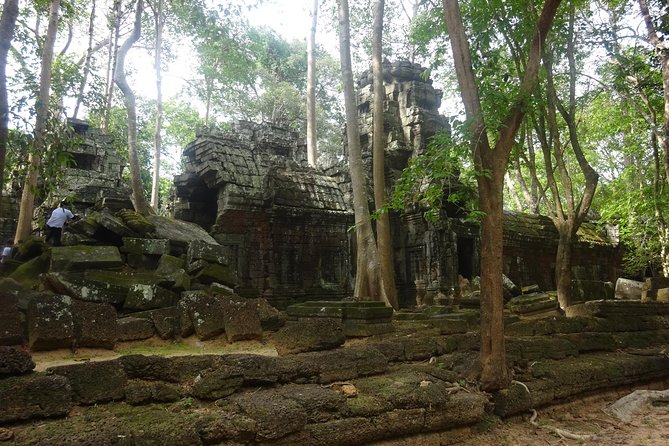
Ta Nei is a much smaller stop, lasting about 45 minutes. It has seen less restoration and sits among large trees, giving you a quieter look at Angkor’s ruins. This is a smart inclusion. After Ta Prohm, Ta Nei helps you see what the temple zone feels like away from the most famous monuments.
Angkor Thom: gates, towers, and royal platforms
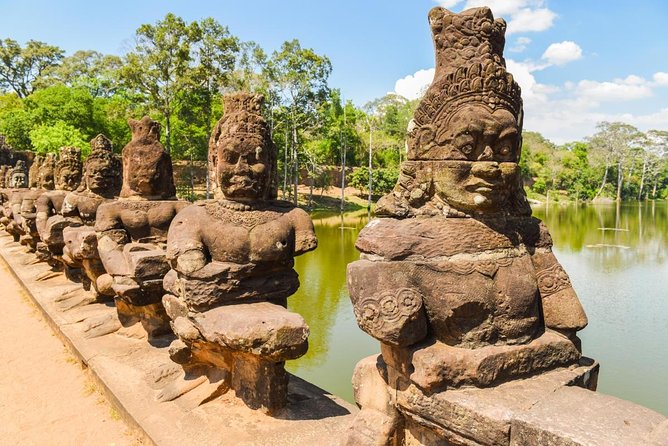
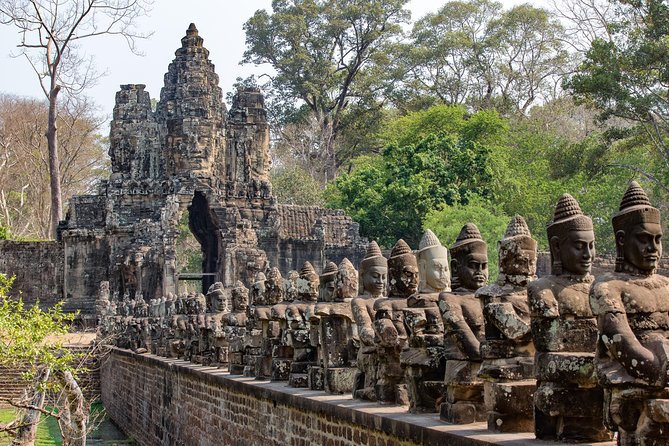
The route then enters Angkor Thom at the Victory Gate on the east side. The stop is brief, around 10 minutes, but it gives you a chance to photograph the gate before continuing to Bayon.
Bayon sits at the center of the old city. Its towers carry the famous carved faces, and the plan lists 49 towers with four faces on each, for 196 faces in total. The numbers help, but the real pleasure is walking close to the towers and seeing how the faces appear, vanish, and reappear as you move through the temple.
You get roughly 30 minutes at Bayon. That is enough for a focused visit, though you may want to tell your guide if you would rather spend longer here than at one of the shorter terrace stops.
Baphuon is nearby. This Hindu temple predates Angkor Wat, and a large reclining Buddha was added behind it in the 16th century. The site includes stairs and changes in level, so good shoes help. It is a short visit of about 30 minutes, but the combination of an earlier Hindu temple and later Buddhist imagery gives the stop added interest.
Phimeanakas follows for about 15 minutes. This pyramid-shaped Hindu temple stood in the center of the old royal palace area of Angkor Thom. You also see the ancient Royal Enclosure Wall in the same area. The stop is brief, so think of it as part of a larger royal-center walk rather than a full temple exploration.
The Terrace of the Elephants takes about 10 minutes. Its carvings of elephants are the obvious feature, but its purpose is just as interesting: kings used the platform to watch victorious armies return. The nearby Terrace of the Leper King receives another 10 minutes. Both are compact stops, ideal for photographs and a short explanation rather than extended wandering.
More Banteay Srei Tours in Siem Reap:
- Full-Day Banteay Srei & 4 Temples – Grand Tours Join-in Tour
★ 5.0 · 1,155 reviews - Siem Reap Tour: Angkor Wat Sunrise, Bayon, Ta Prohm, Banteay Srei
★ 5.0 · 931 reviews - From Siem Reap: Banteay Srei Temple & Grand 5 Temple Tour
★ 4.8 · 262 reviews - 3-Days Discovery Of Angkor: Waterfalls,Floating Village and Banteay Srei temple
★ 5.0 · 214 reviews
Phnom Bakheng sunset: optional, crowded, and worth planning
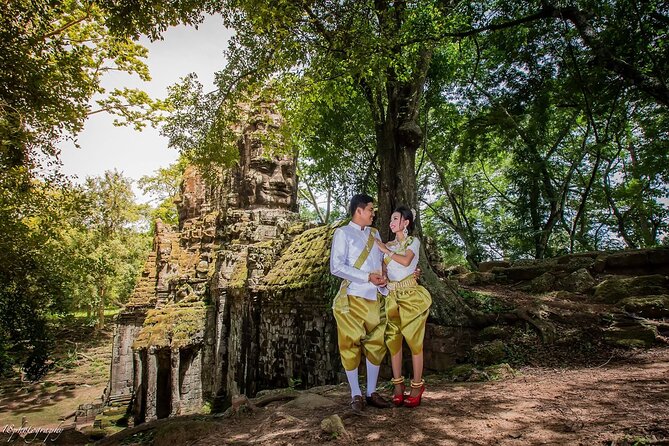
The first day can end at Phnom Bakheng, where you climb the hill and wait for sunset. The stop is scheduled for about two hours, but sunset is optional. If you do not want to wait, you can skip it.
There is also a limit on the number of tourists allowed at the top, according to the tour information. That makes timing important, and a sunset is never guaranteed. Cloud cover can spoil the view, as it can at sunrise. I would treat Phnom Bakheng as an extra chance for evening light, not as a reason to book the tour by itself.
The climb and waiting time make this the most tiring part of day one. If you are already worn out, returning to Siem Reap earlier may be the wiser choice.
Day two: sunrise, reservoirs, and smaller temples
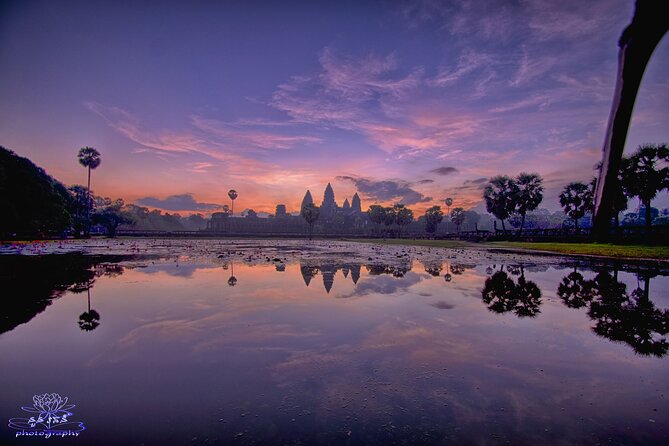
Day two starts at 5:00am. You return to Angkor Wat for sunrise, with about one hour and 45 minutes at the site. This is the tour’s most demanding start, but it gives you a cooler period for walking and a chance to see the temple in changing light.
Sunrise depends on weather and clouds. Some people get a dramatic sky, while others get a muted morning. The important point is to approach it as a time to see Angkor Wat before the heat builds, not as a guaranteed postcard.
After sunrise, you return for breakfast before setting out again. Breakfast is not included, and lunch is also separate. The lunch estimate is about $5 per person, depending on the menu.
Preah Khan is the first major stop, with about an hour. King Jayavarman VII built it and dedicated it to his father. It is a large monastic complex with corridors, courtyards, and carved stone details. Preah Khan rewards a guide who can explain how the building functioned, because its size can otherwise become a blur of doorways and walls.
Neak Pean is a smaller temple on an island in the middle of a reservoir, with about 30 minutes planned. Its setting makes it different from the enclosed temple compounds. The walk to it also gives you a change of pace after Preah Khan.
Ta Som takes around 15 minutes. It is small and classic in form, making it easy to see without committing to another long temple circuit. The short stop may feel rushed if you want to study every carving, but it helps keep the day moving.
Eastern Mebon and Pre Rup: temple mountains in open country
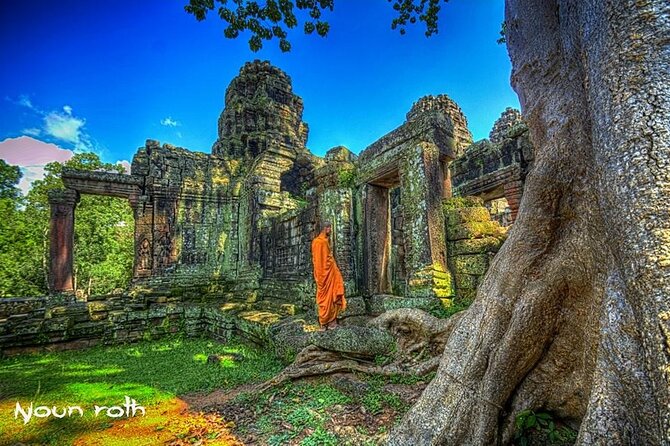
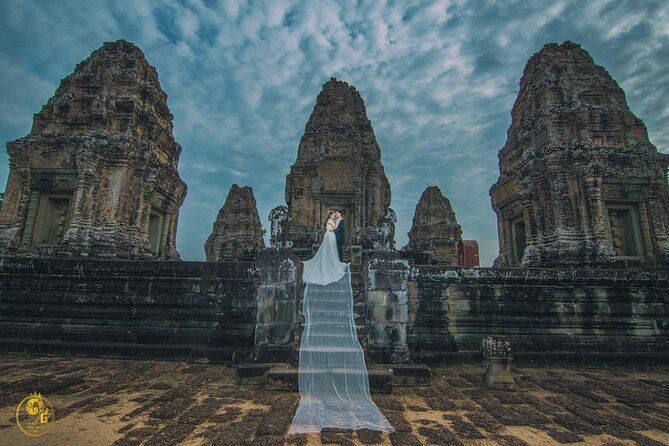
Eastern Mebon is a larger temple-mountain ruin with three levels and five towers. The visit lasts about 15 minutes. Its structure is easier to understand from a distance, so listen for the guide’s explanation before climbing around the stonework.
Pre Rup receives about an hour and is dedicated to Hindu gods. Its name is often explained as turn the body, connected with beliefs about funerals and the temple’s position at the edge of the ancient area. The stairs and upper levels can be demanding, but they also give the site a strong sense of height and structure.
These stops are less instantly famous than Angkor Wat or Ta Prohm. That is part of their appeal. The Big Circuit gives you more variety: monastic complexes, island temples, smaller ruins, and temple-mountains rather than one repeated style.
Banteay Srei: the most delicate stonework
After lunch, you travel farther out to Banteay Srei, known as the Ladies Temple. It was built in the 10th century from pink sandstone and dedicated to Hindu deities.
Banteay Srei is smaller than Angkor Wat, but its carvings are unusually fine and detailed. The pink stone gives the temple a warmer appearance, particularly in good light. I would save room in your attention for this stop, since it provides a sharp contrast to the larger, heavier structures seen earlier.
The tour allows about an hour here. That is enough to walk around the main area and study the carved decoration, though the smaller scale does not mean less to see. The road journey also makes Banteay Srei a substantial part of the day, so expect this stop to add travel time as well as temple time.
Banteay Samre and Banteay Kdei finish the circuit
Banteay Samre is a 12th-century Hindu temple with architectural similarities to Angkor Wat. You have around 45 minutes to explore it. It is a useful final contrast because it feels more compact than the main Angkor Wat complex while still showing the same broad Khmer building tradition.
Banteay Kdei takes another 45 minutes. This Buddhist temple dates to the 12th century and shares stylistic links with Ta Prohm and Bayon. By this point, the similarities and differences between temple layouts should be easier to spot. You will have seen Hindu and Buddhist sites, royal platforms, monastic complexes, and temples shaped around towers or terraces.
Nine stops in one day is a lot. The schedule works best if you accept that some places receive a short look rather than a full study. Your private guide can help you decide where to linger.
The guide and driver are central to the experience
The guide is more than someone who points at a tower. The strongest part of this format is the explanation of symbolism, religious change, architecture, and Khmer culture. Guides named in the feedback include Jimmy, Chay, Choub, Vanna, Thean, Chandra, Mao, and Mr. Chhay.
English ability can vary by guide, and one assessment noted that some explanations were occasionally hard to follow. Still, the overall emphasis is on clear historical context and personal attention. Guides also helped with stairs, suggested photo locations, took family pictures, and adjusted the plan for tired visitors.
The driver is equally useful. You walk through hot temple grounds, then return to an air-conditioned vehicle with cold water and a wet towel. Some towels were described as scented, and umbrellas may be available for sun or rain. These are small details, but after several hours outdoors they can make the difference between pushing on and calling it a day.
Cost, comfort, and who should book
At $158.50 per person, the tour is not the cheapest way to see Angkor. But the price covers two days, a private guide, private air-conditioned transport, hotel pickup and return, a driver, water, and towels. You still need to add the $62 temple pass and pay for meals, with lunch estimated at $5 per person.
The value is strongest for couples, families, or small groups who want their own schedule. A private tour can also make sense for photography, since guides have helped guests find good angles and take panoramic family pictures. The dedicated vehicle saves you from arranging transport between widely scattered sites.
This is not a low-effort sightseeing trip. Expect steps, uneven paths, long walks, heat, and an early alarm. It may not suit very young children or anyone with mobility issues, though guides can offer support and adjust the plan. Wear sturdy walking shoes and keep the schedule flexible.
Hotel pickup and drop-off are included, as is an English-speaking licensed guide. Confirmation comes at booking, and service animals are allowed. Free cancellation is available up to 24 hours before the start time. The experience has a 5/5 rating from 546 ratings and a 100% recommendation rate, which fits the consistent praise for guides, drivers, comfort, and flexibility.
Should you book this Angkor tour?
Book it if you want to see far more than Angkor Wat and prefer having one guide explain the connections between the temples. The two-day format is especially useful if sunrise matters to you, if you want Banteay Srei, or if you would rather not arrange transport across the park yourself.
Choose a shorter visit if you dislike early mornings, stairs, or repeated temple walks. Also compare the full cost after adding the Angkor pass and meals. For history fans, photographers, and first-time visitors with two days in Siem Reap, this is a strong, well-supported choice. Guides such as Jimmy, Chay, Vanna, and Thean have helped make the experience personal, while the driver, cold water, towels, and cool vehicle keep the hard work manageable.
FAQ
How long is the Angkor tour?
The experience lasts approximately two days. Day one begins with an 8:00am hotel pickup, and day two begins with a 5:00am pickup for sunrise at Angkor Wat.
Is the Angkor temple pass included?
No. The Angkor and temple pass costs $62 per person and must be paid separately.
Are meals included?
No. Meals are not included. Lunch is estimated at about $5 per person, depending on the food selected from the menu.
Is this a private tour?
Yes. Only your group participates, with a private English-speaking licensed guide and a dedicated driver.
Does the tour include hotel pickup and drop-off?
Yes. Pickup and return to your hotel or guesthouse in Siem Reap are included.
Is transportation air-conditioned?
Yes. The tour uses an air-conditioned vehicle with a driver. Cold water and cool wet towels are also provided.
Does the tour include Angkor Wat sunrise?
Yes. Day two begins with a visit to Angkor Wat for sunrise. The sunrise view depends on the weather.
Is the Phnom Bakheng sunset visit required?
No. Sunset at Phnom Bakheng is optional, and you can skip it if you do not want to wait.
Can the tour be canceled for a full refund?
Yes. You can cancel at least 24 hours before the experience start time for a full refund. Cancellations or changes made less than 24 hours ahead are not accepted for a refund.
More 2-Day Experiences in Siem Reap
- Angkor 2-Day Sunset & Sunrise Small-Group Tour
★ 5.0 · 2,567 reviews - 2 Days Exclusive Temple Highlights with Sunset and Sunrise Tour
★ 5.0 · 1,157 reviews - Siem Reap: Angkor Sunrise 1- or 2-Day Guided Temples Tour
★ 4.9 · 1,132 reviews - 2 Days Guided Historical Tour in Angkor
★ 5.0 · 855 reviews
Just added around Siem Reap
- Ultimate Sunrise to Angkor Wat, Angkor Thom and Bayon Temple★ 5.0 · 3 reviews
- Twilight Tastes of Siem Reap Include Dinner★ 5.0 · 13 reviews
- Trekking Tour at Phnom Kulen National Park from Siem Reap★ 5.0 · 3 reviews
- Full-Day Private Tour of Angkor Wat with Pick Up★ 5.0 · 12 reviews
- Private Day Trip to Angkor Temples with Expert Guide★ 5.0 · 4 reviews
- Waterfall & River of 1000 Siva Linga- Kulen Mountain Private Tour★ 5.0 · 3 reviews
- Professional Photo Shoot in Angkor Archaeological Park, Siem Reap★ 5.0 · 42 reviews
- Ultimate Siem Reap Food Tour by Tuk Tuk – 20 Tastings, 8 Stops★ 5.0 · 13 reviews
Angkor Wat Tours, compared.

Angkor Wat Sunrise or Sunset Tour with Guide from Siem Reap
Read our review →
Angkor Wat: Small-Group Sunrise or Sunset Tour
Read our review →
Angkor Wat 2-Day Tour with Sunrise and Sunset
Read our review →

Angkor Wat Sunrise tour with Small – Group and Guide tours
Read our review →
Angkor Wat Highlights and Sunrise Guided Tour from Siem Reap
Read our review →
Angkor Wat Sunset Small Group Tour with Lunch Included
Read our review →
Full-Day Angkor Wat Sunrise Private Tour with Guide from Siem Reap
Read our review →Browse the lists this tour appears in