
Reviewed · ANGKOR WAT TOURS
2 Day Cambodia Private Guided Tour in Angkor Temples
Angkor is too large for a quick photo stop, and this two-day private tour gives you time to see its famous monuments and quieter corners. You move from the smiling stone faces of Bayon to jungle-wrapped Ta Prohm, then out to the delicate carvings at Banteay Srei.
I like the private vehicle and flexible pace, especially in Siem Reap’s heat. I also like the mix of major sights and smaller temples such as Ta Nei and Banteay Prei. The drawback is a full schedule: Day 1 runs from Angkor Thom through sunset at Phnom Bakheng, so it can feel long.
The price is $113.05 per person, before the Angkor Pass and meals. For a private guide, hotel transfers, transport, and two days of sightseeing, that can be good value, particularly for two or more people sharing the experience.
Key points to know before booking
- Angkor Wat gets two hours: You have time for the main galleries, towers, and bas-reliefs rather than a rushed walk past the entrance.
- The tour includes quiet stops: Ta Nei and Banteay Prei offer a calmer look at Angkor away from the best-known monuments.
- Your guide shapes the experience: Guides including Leap, Sara, Rain, and others have led past departures, with English explanations and help finding good photo angles.
- Day 1 is packed: Angkor Thom, Bayon, Baphuon, Ta Prohm, Angkor Wat, and Phnom Bakheng make for a demanding day.
- Banteay Srei is far from the central temples: Its fine pink sandstone carvings are worth the trip, but the second day covers a wide area.
- The temple pass costs extra: Meals are also separate, usually with dishes priced from $3 to $10 at local restaurants.
Why two days makes sense at Angkor
The Angkor Archaeological Park is not one building. It is a huge group of temples, reservoirs, terraces, roads, and former royal centers spread across a broad area near Siem Reap. A one-day visit can cover the headline sights, but it often leaves little room for smaller places or a second look at Angkor Wat.
This tour uses two different approaches. Day 1 concentrates on Angkor Thom and the best-known inner temples. Day 2 follows a wider circuit, reaching Banteay Srei and several quieter monuments.
I like that structure. You get the grand ceremonial sites first, then a broader sense of how the Khmer Empire built religious and royal centers across the area. The private format matters here because you can ask for more explanation at a favorite temple, or keep moving if a smaller stop does not hold your interest.
A licensed English-speaking guide is included each day. Guides such as Leap, Sara, and Rain have been praised for clear explanations, humor, historical stories, and help with photographs. Your exact guide is not guaranteed, but the best use of the service is to ask questions as you go. Angkor is far more interesting when someone explains how a temple was used, who built it, and why its carvings look different from those at the next stop.
More Angkor Wat Tours in Siem Reap:
- Angkor Wat Sunrise or Sunset Tour with Guide from Siem Reap
★ 5.0 · 12,109 reviews - Siem Reap: Angkor Wat: Small-Group Sunrise or Sunset Tour
★ 5.0 · 9,444 reviews - Siem Reap: Angkor Wat 2-Day Tour with Sunrise and Sunset
★ 4.9 · 4,429 reviews
Day 1: Angkor Thom and the great inner temples
Your guide and driver meet you at your hotel lobby in Siem Reap. The tour provides a private air-conditioned vehicle, though past arrangements have also included tuk-tuks for some inner-circuit visits and a minivan for the wider circuit. Confirm the vehicle planned for your dates if air-conditioning is important to you.
Angkor Thom South Gate
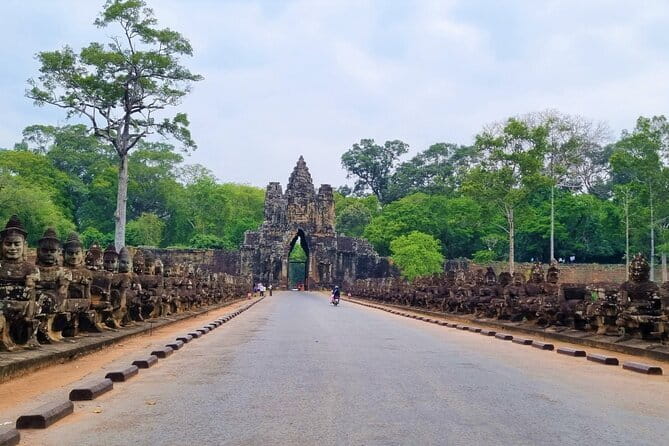
The South Gate is a dramatic entrance to the ancient capital. A causeway crosses the moat, lined with figures holding a great serpent. The gate itself has been restored, and many of its carved heads remain in place.
The stop is scheduled for about 30 minutes. That is enough to see the gate and take photographs, though the road can be busy with other vehicles. Ask your guide to explain the figures on both sides of the causeway rather than treating this as only a photo stop.
Bayon Temple
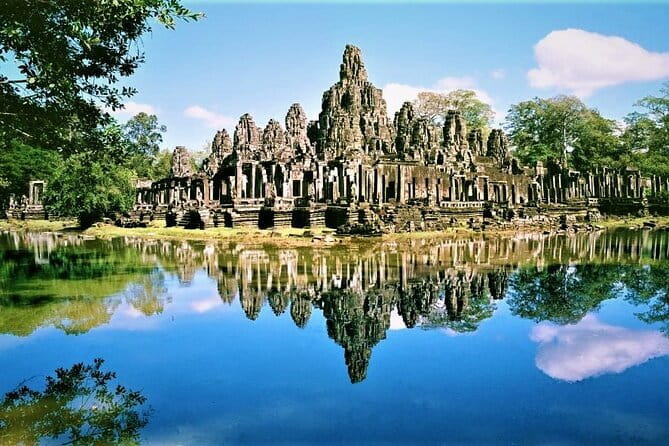
Bayon is one of Angkor’s most memorable buildings. Towering stone faces look out from the temple, and their expressions change as you move through the narrow galleries and upper levels.
You have about an hour here. That is useful because Bayon can be confusing at first. The temple was built during the reign of Jayavarman VII and served as a Buddhist state temple, unlike many of the major Hindu temples nearby.
This is a place where a guide adds real value. The bas-reliefs show scenes from daily life and military campaigns, while the temple’s crowded plan reflects a different idea of sacred space from the carefully aligned Angkor Wat.
A few more Siem Reap trips to weigh up
- Angkor 2-Day Sunset & Sunrise Small-Group Tour
★ 5.0 · 2,567 reviews - 2 Days Exclusive Temple Highlights with Sunset and Sunrise Tour
★ 5.0 · 1,157 reviews - Siem Reap: Angkor Sunrise 1- or 2-Day Guided Temples Tour
★ 4.9 · 1,132 reviews - 2 Days Guided Historical Tour in Angkor
★ 5.0 · 855 reviews
Angkor Thom, Baphuon, and Phimeanakas
The broader Angkor Thom stop helps connect the separate monuments. This was not simply a collection of temples. It was a planned royal capital with monumental gates, terraces, and religious buildings.
Baphuon is a tall temple built on a long sandstone base. Its levels are unusually similar in size, giving it a broad, powerful shape. You have about 40 minutes to explore it, though steep stairs and uneven surfaces can make the climb tiring.
Nearby Phimeanakas sits in the former royal enclosure. It is less visually complete than Bayon or Angkor Wat, but its position helps you understand the scale of the old palace area. The scheduled visit lasts about 30 minutes.
Terraces of the Elephants and the Leper King
The Terrace of the Elephants is a long ceremonial platform decorated with elephants, riders, and processional scenes. It is best understood as part of a royal avenue, not as a stand-alone temple.
The Terrace of the Leper King has some of the most striking carvings on Day 1. Figures fill the inner and outer walls, and the narrow passages reveal details you could easily miss from the open side.
Each terrace receives roughly 30 minutes. That timing works for a guided look, but you will not have long to study every carving. If you are especially interested in sculpture, tell your guide early so the pace can be adjusted.
Ta Nei, a quiet stone temple
Ta Nei is a smaller late 12th-century temple dedicated to the Buddha. It does not have the scale of Bayon, yet that is exactly its appeal. The setting feels quieter, and the partly unrestored structure gives you a clearer sense of how much work has gone into preserving the main monuments.
The visit lasts about 40 minutes. This is one of the stops I would value most if you want time away from the busiest temple paths. It also gives your guide a chance to discuss how archaeologists approach smaller, less complete sites.
Ta Prohm and its tree-covered ruins
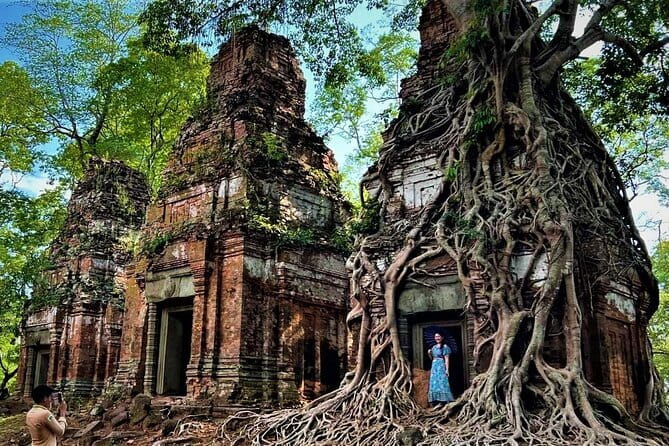
Ta Prohm is the temple many people recognize from Tomb Raider. Its fame is deserved, but the real attraction is the way trees and stone have grown into one another.
The site has been cleared enough for visitors to walk through, and parts have been strengthened to prevent further collapse. You can expect narrow passages, fallen blocks, carved doorways, and roots wrapped around walls.
An hour is scheduled here. That gives you time to enjoy the atmosphere and take photographs, although popular sections can be crowded. Follow your guide’s route and look beyond the most famous tree. Ta Prohm has many quieter corners with detailed carvings.
Angkor Wat, the day’s centerpiece
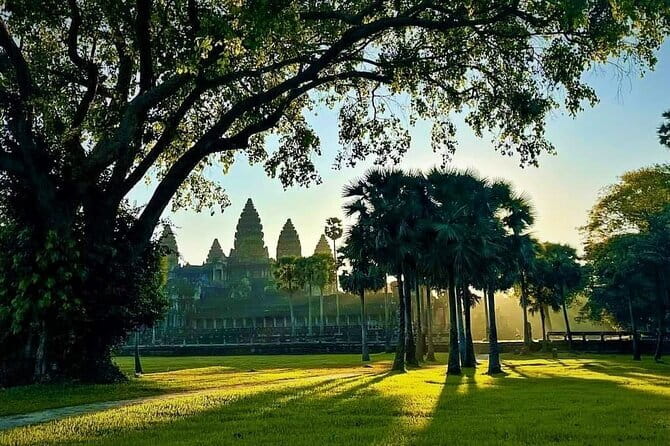
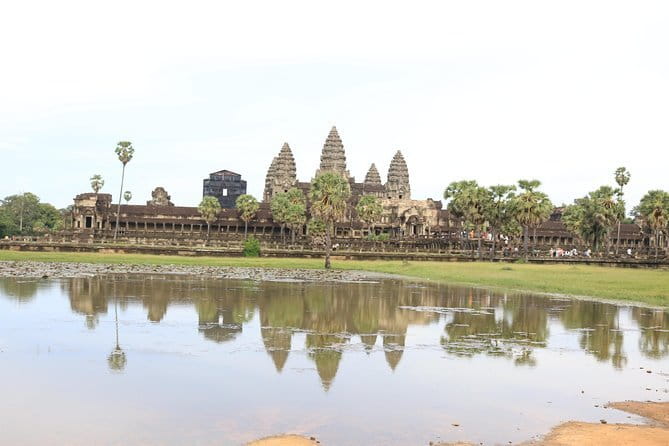
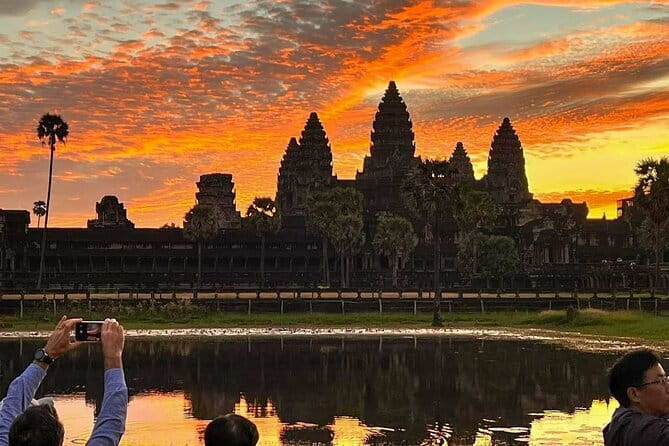
Two hours at Angkor Wat is a strong feature of the itinerary. This is the largest and best-preserved monument in the Angkor group, and it deserves more than a quick exterior photograph.
The temple’s balance is easy to admire from a distance. Inside, the galleries reveal long bas-reliefs, carefully planned corridors, towers, and layers of sacred space. Your guide can help you read the scenes and point out architectural details that blend together when you walk alone.
The Angkor Pass is not included. Your guide assists with buying it at the entrance before the temple visits begin. Make sure you budget for this separate cost when comparing the tour with cheaper options.
Sunset at Phnom Bakheng
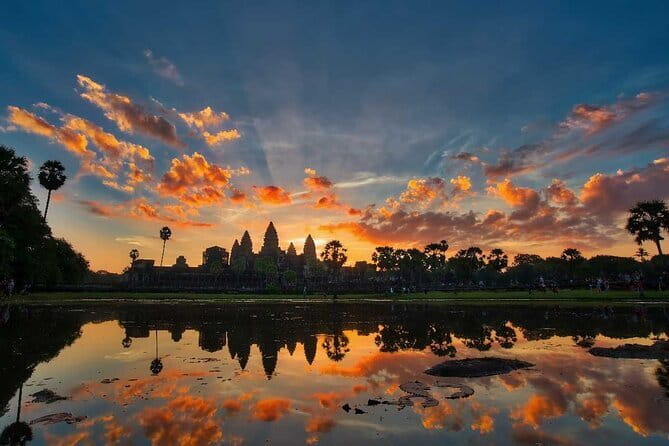
The day ends at Phnom Bakheng, a temple mountain dedicated to Shiva and one of the highest points in the park. From here, you can look over the surrounding area and toward the temples as daylight fades.
The schedule allows about an hour. Sunset conditions are never guaranteed, and the approach and steps can be tiring after a full day. Still, the viewpoint gives Day 1 a memorable finish, especially if you prefer broad views after spending hours among enclosed galleries.
Day 2: Banteay Srei and the Grand Circuit
Day 2 reaches farther from the central temples. The route includes several sites connected with the Grand Circuit, plus Banteay Srei and a stop at Preah Dak village.
This day is less dominated by one famous monument. Instead, it shows you changes in scale, decoration, restoration, and setting.
Banteay Srei, the finest detailed carving
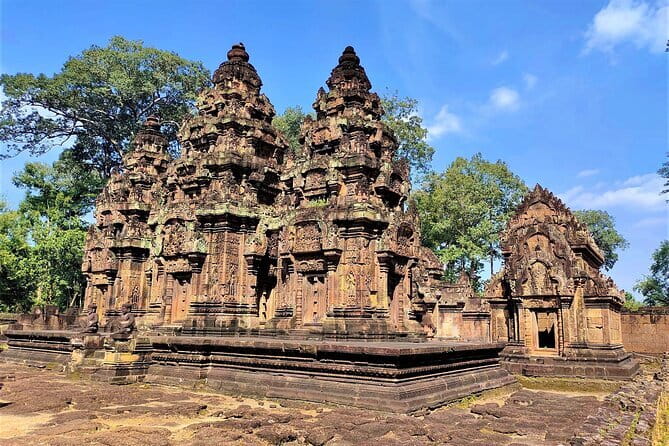
Banteay Srei is often called a jewel of Khmer art, and the nickname makes sense once you see its pink sandstone carvings. The temple is smaller than Angkor Wat, but its doorways, lintels, and figures are unusually fine and detailed.
Two hours are planned here, making it the longest stop of Day 2. That extra time is useful. You can walk slowly, compare the carvings on different towers, and ask your guide about the temple’s design rather than rushing through.
The distance from the main Angkor group is part of the tradeoff. You spend more time in the vehicle, but the change of scenery and the quality of the stonework make Banteay Srei one of the day’s strongest stops.
Banteay Samre
Banteay Samre is a complete-looking complex restored using anastylosis, a method that reassembles original architectural pieces. The temple has a strong, enclosed design and a quieter feel than the central monuments.
The visit lasts about 40 minutes. Maintenance has been uneven in recent years, so do not expect every section to look freshly cared for. That limitation is also a useful reminder that Angkor is an active preservation project, not a polished theme park.
Pre Rup and Ta Som
Pre Rup is a bold brick-and-sandstone temple mountain with strong proportions and a clear, rising shape. It resembles East Mebon in style, though it was built later. The 40-minute visit lets you see the structure without making it another long climb after Day 1.
Ta Som is smaller and quieter. It has not been fully restored, and trees have become part of its character. The temple is a good counterpoint to Angkor Wat: less grand, less complete, and easier to appreciate at a slower pace.
Neak Pean and Preah Khan
Neak Pean is arranged around a large square man-made pond, with smaller pools around it. The water-centered design gives the site a different mood from the temple mountains and long galleries elsewhere in the park.
The walk to Neak Pean takes about 40 minutes of the schedule. The approach is part of the experience, though anyone hoping to enter every structure may find the visit more limited than at a large temple.
Preah Khan receives about an hour. Built by Jayavarman VII and dedicated to his father, it is a large complex with corridors, courtyards, carvings, and sections where trees and stone meet. I would give this stop your full attention. It rewards slow walking, and the guide’s explanations can help you understand how the temple functioned as more than a single shrine.
Banteay Prei and Preah Dak village
Banteay Prei is a minor temple near Prasat Prei. It is best for people who enjoy archaeology and want to see a less-visited site, not for anyone looking only for grand monuments.
The final stop is in the Preah Dak area, where you can see steamed toddy palm cake and visit a local market known for souvenirs, objects, and arts. It lasts about 30 minutes and adds a small local-food and village element to a day otherwise focused on stone temples.
Do not expect this stop to replace a full cultural village visit. Its value is modest but practical: you get a break, a look at a local product, and a chance to browse before returning to Siem Reap.
Private transport, food, and the real cost
Hotel pickup and drop-off are included if you provide your hotel name and address. The private format means only your group participates, so you are not tied to a large coach schedule.
Transport is listed as a private air-conditioned vehicle. Cool drinking water and fresh tissues are included, details that matter in Cambodia’s heat. Past groups have also used two tuk-tuks on one day and a minivan on another, so ask in advance if you have a strong preference.
Lunch is not included. Local restaurants offer vegetarian and non-vegetarian choices, with menu prices listed at roughly $3 to $10 per dish. You should also plan for tips for the guide and driver.
At $113.05 per person, the value depends on group size. A solo visitor pays more for the private arrangement, but a couple or small group gets private transport, two full days, a licensed English-speaking guide, hotel service, water, and access to a route that covers far more than the usual short Angkor circuit.
The Angkor Pass is extra and covers the temples on this route. Since the ticket cost is outside the advertised price, include it in your total before booking.
Who will enjoy this temple tour most
I would choose this tour if you want the major Angkor sights but also care about smaller monuments. It suits first-time visitors who want a guide to explain the carvings, the royal city, and the different styles of temple construction.
It also works well for couples, families, and small groups who prefer to stop for photographs or ask questions without a busload of strangers. The private setup gives you more control than a standard group excursion.
You should think twice if you dislike early starts, long temple days, uneven paths, or repeated climbs. Day 1 is especially ambitious. The schedule is rewarding, but it is not a relaxed two-day stroll.
Guides such as Leap, Sara, and Rain have been praised for friendly explanations, good humor, passion for Cambodian history, and attention to photo opportunities. That human element is central to the tour. A quiet temple becomes much more meaningful when you understand why it was built and how its carvings fit into the wider story.
Practical details before you reserve
Most people can participate, and the tour is near public transportation. Confirmation is provided at booking, and pickup requires your Siem Reap hotel name and address.
Free cancellation is available up to 24 hours before the local start time. Cancellations or changes made inside that window are not accepted for a refund.
Bring clothing suitable for temple visits, comfortable walking shoes, sun protection, and a small amount of money for food, tips, and purchases. The operator provides water, but you should still plan for heat, especially during the long first day.
Should you book the two-day private Angkor tour?
Book it if you want a well-rounded first visit to Angkor, with Angkor Wat, Bayon, Ta Prohm, Banteay Srei, Preah Khan, and several smaller temples in one carefully packed route. The private guide and vehicle make the $113.05 price easier to justify for a couple or small group.
Choose a shorter or slower tour if you want long breaks, extensive photography, or time to study every monument. This experience covers a lot of ground. Its strength is range: by the end, you will have seen both the celebrated faces of Bayon and the quieter, partly restored temples that make Angkor feel like a vast archaeological region rather than a single attraction.
FAQ
Is hotel pickup included?
Yes. Pickup and drop-off at your Siem Reap hotel are included. You need to provide the hotel name and address so the guide and driver can meet you in the lobby.
Is the Angkor Pass included in the price?
No. The temple entrance fee is separate. Your guide assists you with purchasing the Angkor Pass at the entrance to Angkor Park.
Are meals included?
No. Lunch is at your own expense. Local restaurants offer vegetarian and non-vegetarian dishes, with listed menu prices of about $3 to $10 per dish.
Is this a private tour?
Yes. Only your group participates, and transport is provided privately.
What type of guide is included?
A professional, officially licensed English-speaking guide is included for the destinations on the tour.
Is transportation air-conditioned?
The included transport is described as a private air-conditioned vehicle. Some past arrangements have used tuk-tuks for inner temples and a minivan for the wider circuit, so confirm the vehicle details if needed.
Which temples are visited?
The route includes Angkor Thom South Gate, Bayon, Baphuon, Phimeanakas, the Terraces of the Elephants and Leper King, Ta Nei, Ta Prohm, Angkor Wat, Phnom Bakheng, Banteay Srei, Banteay Samre, Pre Rup, Ta Som, Neak Pean, Preah Khan, and Banteay Prei.
Is water provided?
Yes. Cool drinking water and fresh tissues are included during the tour.
Can I cancel for a full refund?
Yes, if you cancel at least 24 hours before the experience start time. Cancellations or changes made less than 24 hours before the start are not refunded or accepted.
Just added around Siem Reap
- Ultimate Sunrise to Angkor Wat, Angkor Thom and Bayon Temple★ 5.0 · 3 reviews
- Twilight Tastes of Siem Reap Include Dinner★ 5.0 · 13 reviews
- Trekking Tour at Phnom Kulen National Park from Siem Reap★ 5.0 · 3 reviews
- Full-Day Private Tour of Angkor Wat with Pick Up★ 5.0 · 12 reviews
- Private Day Trip to Angkor Temples with Expert Guide★ 5.0 · 4 reviews
- Waterfall & River of 1000 Siva Linga- Kulen Mountain Private Tour★ 5.0 · 3 reviews
- Professional Photo Shoot in Angkor Archaeological Park, Siem Reap★ 5.0 · 42 reviews
- Ultimate Siem Reap Food Tour by Tuk Tuk – 20 Tastings, 8 Stops★ 5.0 · 13 reviews
Angkor Wat Tours, compared.

Angkor Wat Sunrise or Sunset Tour with Guide from Siem Reap
Read our review →
Angkor Wat: Small-Group Sunrise or Sunset Tour
Read our review →
Angkor Wat 2-Day Tour with Sunrise and Sunset
Read our review →

Angkor Wat Sunrise tour with Small – Group and Guide tours
Read our review →
Angkor Wat Highlights and Sunrise Guided Tour from Siem Reap
Read our review →
Angkor Wat Sunset Small Group Tour with Lunch Included
Read our review →
Full-Day Angkor Wat Sunrise Private Tour with Guide from Siem Reap
Read our review →Browse the lists this tour appears in