
Reviewed · ANGKOR WAT TOURS
Exclusive Angkor temples and Small group temples tours
Angkor’s finest sights fit into one long day here, ending with sunset from Phnom Bakheng. You move between jungle-wrapped ruins, giant stone faces, royal terraces, and the world’s largest religious monument without being tied to a large coach.
I like the small-group format, capped at 25 people, and the practical hotel pickup and air-conditioned transport. I also like that the guide and driver help with photo positions and can take pictures for you. The catch is the headline $19 price: you must add the $37 temple pass, buy your own meals, and prepare for a full, sometimes tiring day.
Key points
- Sunset at Phnom Bakheng: The tour closes with views from a Hindu and Buddhist mountain temple above the Angkor area.
- Seven major stops: You visit Angkor Thom, Bayon, the royal terraces, Ta Prohm, and Angkor Wat, with time at each main site.
- Small group transport: A van or bus with air conditioning is more comfortable than a packed large coach.
- Useful guide support: Your English-speaking guide explains Khmer history and helps with photos, while the driver handles the long circuit.
- Low tour price, extra temple cost: The $19 rate includes transport, guide service, water, and hotel transfers, but not the $37 entrance fee or meals.
A full day through Angkor’s greatest monuments
This is a greatest-hits tour of the Angkor Archaeological Park, designed for first-time visitors who want the major temples in one outing. The schedule lasts roughly 6 to 10 hours, depending on the day’s timing and the sunset finish.
You begin with hotel pickup in Siem Reap and ride in an air-conditioned van or bus. That matters in Cambodia, where heat can make a temple day feel much longer than the map suggests. Complimentary mineral water is provided, but bring extra water if you drink often, since the tour does not promise unlimited supplies.
The group limit is 25 people. That is still large enough to feel like a shared tour rather than a private outing, but it should be easier to hear the English-speaking guide than it would be with a full-size coach group. The guide explains the Khmer Empire and the purpose of each site, while the driver takes care of the transfers between ruins.
The tour price is $19, which is good value for the transport and guiding alone. You need to budget another $37 per person for the temple entrance fee, plus the cost of lunch and dinner. Once you add those expenses, the real cost is higher than the advertised rate, but the outing remains a practical way to cover several major sites without arranging transport yourself.
More Angkor Wat Tours in Siem Reap:
- Angkor Wat Sunrise or Sunset Tour with Guide from Siem Reap
★ 5.0 · 12,109 reviews - Siem Reap: Angkor Wat: Small-Group Sunrise or Sunset Tour
★ 5.0 · 9,444 reviews - Siem Reap: Angkor Wat 2-Day Tour with Sunrise and Sunset
★ 4.9 · 4,429 reviews
South Gate: the first look at Angkor Thom
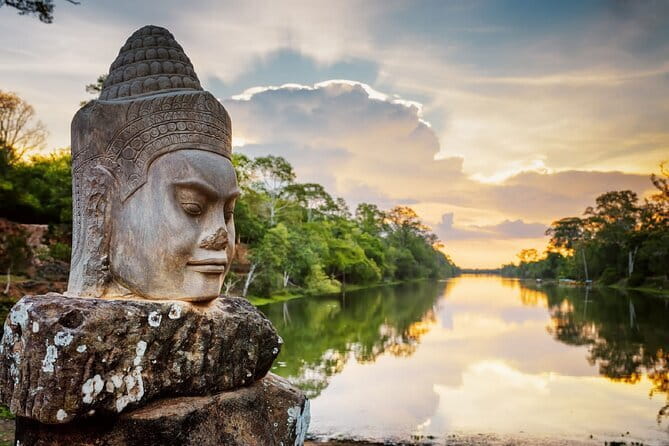
The first stop is the South Gate of Angkor Thom, one of the most memorable approaches in the park. Plan on about 30 minutes here.
Angkor Thom means great city, and that name gives you a useful sense of scale. This was not simply a single temple, but a royal capital enclosed by walls and a moat. The approach across the causeway gives you an early glimpse of the symbolic world of the Khmer rulers.
The gate is especially useful as an introduction because it sets up the rest of Angkor Thom. You see the city’s defensive design, its monumental entrance, and the stone figures lining the approach. Your guide can explain how the gate fits into Khmer religious and royal ideas before you move inside.
Thirty minutes is enough for photographs and a short explanation, though it is not long enough for a slow architectural study. If you want to examine every carved figure along the causeway, you may feel pressed for time. On a group schedule, the sensible approach is to listen first, take a few pictures, and save your longer exploration for the main temples.
Angkor Thom and the royal center
The tour then gives Angkor Thom about an hour. This is where the earlier gate begins to make sense.
The ancient city contains several important monuments, and your guide provides the historical frame that can be hard to gain from wandering alone. You learn how the site functioned as the Khmer capital and how its religious buildings related to royal power.
The one-hour visit is a useful middle ground. You get more than a quick photo stop, but the schedule does not allow an exhaustive tour of every corner. Wear shoes that can handle uneven ground, and keep your belongings light. The day includes several stops, and a large bag becomes tiresome as the hours pass.
Angkor Thom also gives you a break from the single-monument approach. Instead of seeing one temple in isolation, you begin to understand Angkor as a planned city with gates, public spaces, terraces, and state temples. That broader view is one of the best reasons to choose a guided circuit rather than visiting only Angkor Wat.
Bayon Temple and its stone faces
Bayon receives about an hour, and it is one of the day’s essential stops. Built in the late 12th or early 13th century as the official state temple, Bayon is famous for its towers carved with large serene faces.
The temple feels different from Angkor Wat. Angkor Wat has broad galleries and a strong sense of order, while Bayon is tighter, more vertical, and full of changing views as you move through its towers. The carved faces appear from different angles, creating one of the most distinctive sights in the park.
Your guide’s role is valuable here. Bayon’s galleries and towers can seem confusing at first, and a good explanation helps you understand what you are seeing rather than simply collecting photographs. The guide can also point out details you might miss while trying to navigate the stone corridors.
An hour gives you time to see the main areas and take pictures. It may not satisfy you if you want to inspect every bas-relief. Still, Bayon is a place where a short, focused explanation often adds more than an extra half-hour of aimless walking.
Same country, a completely different kind of day:
- From Siem Reap: Kampong Phluk Floating Village Tour by Boat
★ 4.9 · 6,979 reviews - Sunset tour of Kampong Phluk stilts home village on the Tonle Sap
★ 5.0 · 4,865 reviews - Siem Reap: Kampong Phluk Floating Village Tour with Boat
★ 4.9 · 3,843 reviews - Siem Reap: Full-Day Angkor Wat Guided Tour with Sunset
★ 4.9 · 3,803 reviews
The Terrace of the Elephants and the Leper King
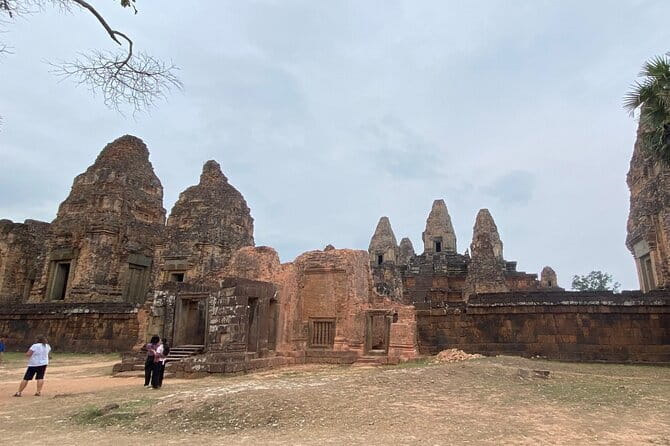
The schedule includes about 30 minutes at the Terrace of the Elephants, followed by another 30 minutes at the Terrace of the Leper King. These are shorter stops, but they help fill out the picture of Angkor Thom as a royal center.
The Terrace of the Elephants is a long ceremonial platform decorated with elephant imagery. It was connected with royal processions and public events, so it is best understood as part of the city’s ceremonial core rather than as a standalone temple.
The Terrace of the Leper King is known for its statue and detailed carvings. The name comes from the statue’s discolouration and moss, along with a Cambodian story connected to the figure. The stop is brief, but the terrace’s carved surfaces reward close attention if your guide points out what to look for.
These two visits are not the dramatic highlights of the day in the way Bayon or Ta Prohm can be. Their value is context. They show how the Khmer capital worked beyond its famous towers and help you see Angkor as a living royal city, not just a group of isolated ruins.
Ta Prohm, where jungle and stone meet
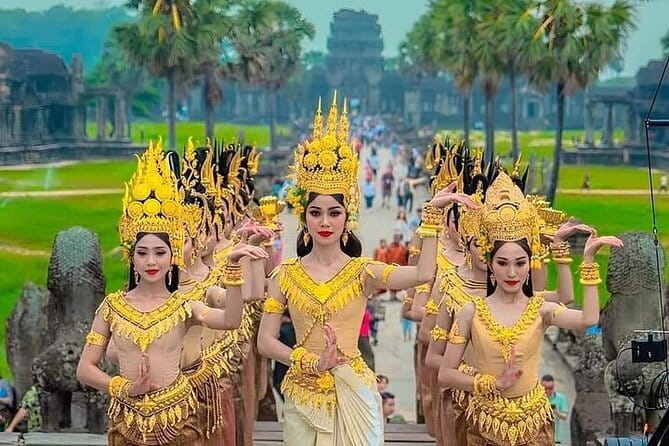
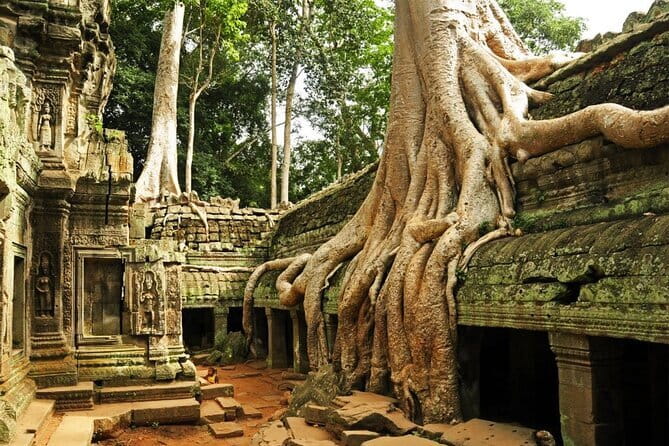
Ta Prohm receives about an hour and is likely to be one of your most atmospheric stops. King Jayavarman VII founded it as a Mahayana Buddhist monastery and university.
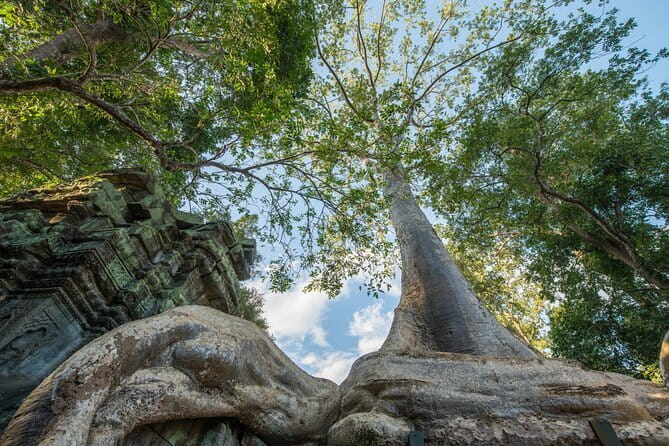
Unlike the more cleared and formal temple settings, Ta Prohm is known for the way trees and roots press against the stone buildings. The effect is powerful because you can see both the craftsmanship of the temple and the force of nature acting on it over time.
The site is also one of the easiest places to understand why Angkor captures the imagination. Corridors turn suddenly, doorways open into tangled courtyards, and massive roots frame the walls. Your guide can connect the visual drama to the temple’s original religious and educational purpose.
One hour is enough to experience the main route, but Ta Prohm can feel crowded and slow in places. The tour’s smaller vehicle and capped group help with the general pace, yet the temple itself remains a popular stop. Listen for the guide’s meeting point so you do not lose time finding the group after taking pictures.
Three hours at Angkor Wat
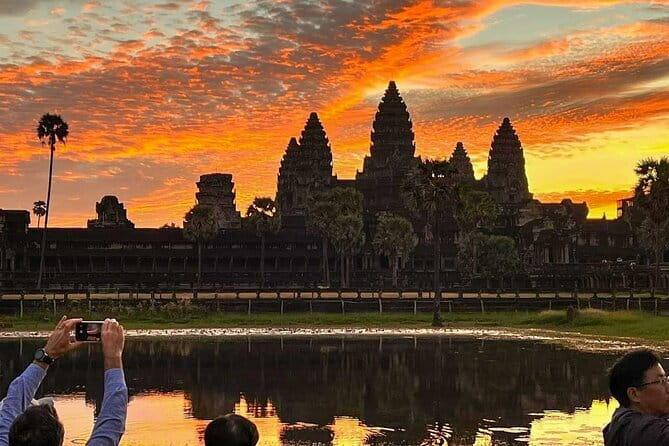
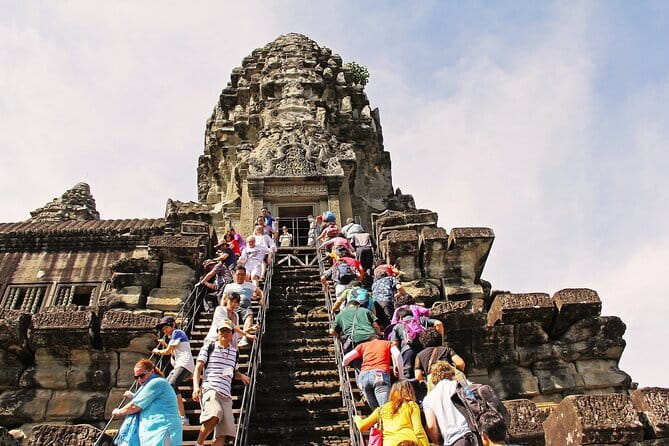
Angkor Wat gets the longest visit, about three hours, and that is appropriate. This enormous complex covers 162.6 hectares and is the largest religious monument in the world.
The scale can be difficult to grasp from photographs. You cross broad spaces, pass through galleries, and move toward the central towers, with carved details appearing at many levels. Three hours gives you a chance to see the main structure without treating it as a quick stop at the end of a busy circuit.
Angkor Wat was built as a major religious monument, and its design reflects careful planning, symmetry, and layers of symbolic meaning. An English-speaking local guide helps connect the architecture to the Khmer Empire and explains why this particular temple became Cambodia’s national symbol.
The long visit is a strength, but it also comes late in a demanding day. By this point, you may be hot and tired, so pace yourself. You do not need to examine every gallery at the same speed. Take short pauses, drink water, and save enough energy for the final sunset stop.
The tour description places sunset at Phnom Bakheng after the temple circuit. That means the day is not finished when you leave Angkor Wat. If your main goal is to spend a quiet morning at Angkor Wat, this schedule may feel too broad. If you want the major temples in a single day, the three-hour visit is the right kind of time allocation.
Phnom Bakheng and the sunset finish
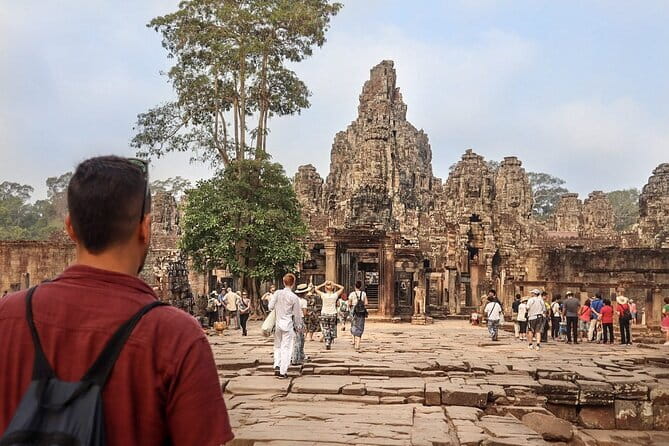
The final highlight is sunset at Phnom Bakheng, a mountain temple with both Hindu and Buddhist associations. Reaching the site closes the day on a different note from the enclosed temple interiors.
Phnom Bakheng offers a higher viewpoint over the Angkor area, making it a natural place to watch the light change after a long day among the ruins. The appeal is not another set of detailed galleries. It is the chance to step back and see the wider setting around the temples.
Sunset timing can make this part of the outing less predictable than the earlier stops. The tour lasts approximately 6 to 10 hours, and the finish depends on the day’s timing. You should expect to return to Siem Reap after sunset, followed by a direct transfer to your hotel.
This is also the point where the physical demands of the day matter most. You have already visited several large sites, so comfortable footwear and a reasonable pace are important. The itinerary does not promise a private sunset experience or a long period alone at the temple. The benefit is convenience: you do not need to arrange a separate ride back after dark.
The guide, driver, and photo help
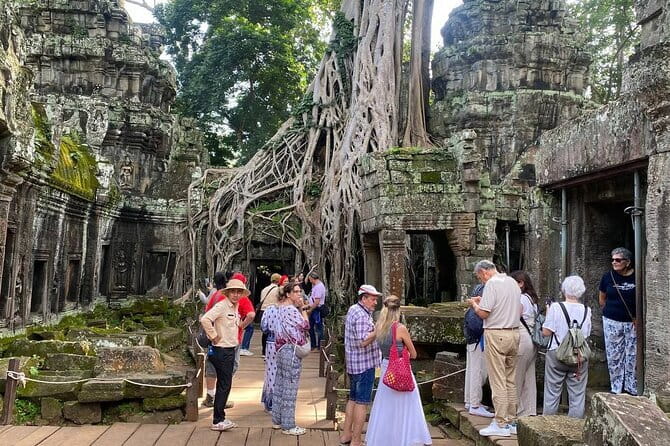
The strongest personal touch described for this experience is the work of the guide and driver. They are praised for being fun, helpful, and well informed, with special attention to good places to take photographs.
That practical help can make a real difference at Angkor. The best picture is not always taken from the first obvious viewpoint, and it is difficult to arrange a group photo when you are moving alone. A guide who suggests where to stand and takes pictures for you gives you a record of the day without needing to hand your phone to a stranger.
The guide also provides more than basic dates and names. The tour is built around the Khmer Empire, so the explanations should help you connect Angkor Thom’s royal planning, Bayon’s state role, Ta Prohm’s monastic purpose, and Angkor Wat’s religious importance.
No guide names are provided, so you cannot request a particular guide in advance based on the available details. What you can expect is an English-speaking guide, an assigned driver, and a group setting rather than a private historian at your side.
What the $19 price really covers
The $19 price is attractive, especially for a full-day route with hotel pickup and drop-off. It includes the guide, air-conditioned vehicle, mineral water during the tour, and transport from the hotel where you are staying.
The important extra is the $37 temple entrance fee per person. Meals are also excluded, including lunch and dinner. Your actual spending will therefore be at least $56 per person before food, assuming the quoted rates remain current.
That still compares well with arranging a private vehicle and guide separately, but you should not treat this as a $19 all-in day. The low base price works best for someone who values simple transport and a broad introduction to Angkor more than a private, highly flexible schedule.
The tour offers group discounts, though the exact discount is not specified. Ask for the current terms if you are booking for several people. Confirmation is provided at booking, and free cancellation is available if you cancel at least 24 hours before the local start time. Changes or cancellations inside that window are not accepted for a refund.
Who will get the most from this temple circuit
This outing suits a first visit to Siem Reap when you want to see the main Angkor sights without spending time arranging tuk-tuks, drivers, and route details. The direct hotel transfer is especially useful after sunset.
It is also a good fit if you prefer some explanation at each temple. Angkor is more rewarding when you understand the difference between a royal city, a state temple, a monastery, a ceremonial terrace, and a monumental religious complex.
You should think twice if you want a slow photographic study of one or two temples. Seven stops create variety, but they also require you to keep moving. The maximum group size of 25 is reasonable for a shared excursion, yet it cannot offer the freedom or quiet pace of a private tour.
The day is best for people who can manage a long outing in warm conditions. Most travelers can participate, but the combined walking, heat, uneven ruins, and late sunset finish may feel demanding if you prefer short sightseeing sessions.
Should you book this Angkor tour?
Book it if you want the main Angkor circuit, a sunset viewpoint, hotel transport, and an English-speaking guide at a modest base price. The strongest reasons are the broad temple coverage, three hours at Angkor Wat, air-conditioned transport, and hands-on photo help from the guide and driver.
Skip it if your priority is complete schedule control, a private guide, or an all-inclusive price with meals and admission already covered. Before booking, add the $37 temple pass and food to your budget, then decide if a full 6 to 10 hours on the road suits your pace.
For a first look at Angkor, this is a practical and well-focused choice. It gives you the essential monuments, adds Phnom Bakheng at sunset, and gets you back to your hotel without leaving the final transport problem to you.
FAQ
Is the $19 price the total cost of the tour?
No. The $19 tour price does not include the $37 temple entrance fee per person. Meals are also not included.
What temples and sites are visited?
The route includes Angkor Thom South Gate, Angkor Thom, Bayon Temple, the Terrace of the Elephants, the Terrace of the Leper King, Ta Prohm Temple, Angkor Wat, and sunset at Phnom Bakheng.
How long does the experience last?
The tour lasts approximately 6 to 10 hours, including the temple visits, sunset at Phnom Bakheng, and the return transfer to your hotel.
Is hotel pickup and drop-off included?
Yes. Pickup and drop-off are provided from the hotel where you are staying.
What type of transport is used?
Transport is provided in an air-conditioned van or bus. The tour has a maximum group size of 25 people.
Can I cancel for a full refund?
Yes, if you cancel at least 24 hours before the experience start time. Cancellations or changes made less than 24 hours before the start time are not accepted for a refund.
Just added around Siem Reap
- Ultimate Sunrise to Angkor Wat, Angkor Thom and Bayon Temple★ 5.0 · 3 reviews
- Twilight Tastes of Siem Reap Include Dinner★ 5.0 · 13 reviews
- Trekking Tour at Phnom Kulen National Park from Siem Reap★ 5.0 · 3 reviews
- Full-Day Private Tour of Angkor Wat with Pick Up★ 5.0 · 12 reviews
- Private Day Trip to Angkor Temples with Expert Guide★ 5.0 · 4 reviews
- Waterfall & River of 1000 Siva Linga- Kulen Mountain Private Tour★ 5.0 · 3 reviews
- Professional Photo Shoot in Angkor Archaeological Park, Siem Reap★ 5.0 · 42 reviews
- Ultimate Siem Reap Food Tour by Tuk Tuk – 20 Tastings, 8 Stops★ 5.0 · 13 reviews
Angkor Wat Tours, compared.

Angkor Wat Sunrise or Sunset Tour with Guide from Siem Reap
Read our review →
Angkor Wat: Small-Group Sunrise or Sunset Tour
Read our review →
Angkor Wat 2-Day Tour with Sunrise and Sunset
Read our review →

Angkor Wat Sunrise tour with Small – Group and Guide tours
Read our review →
Angkor Wat Highlights and Sunrise Guided Tour from Siem Reap
Read our review →
Angkor Wat Sunset Small Group Tour with Lunch Included
Read our review →