
Reviewed · TOURS
Cambodia 7 Days Tour from Siem Reap to Battambang and Phnom Penh
Angkor Wat is only the beginning here. This seven-day private journey links Cambodia’s great temple complex with Tonle Sap, rural villages, colonial Battambang, royal Oudong, and the difficult memorial sites of Phnom Penh. You get a much broader look at the country than a standard Siem Reap temple break.
I like the private transport and guide, which keep a demanding route manageable. I also like the mix of grand monuments and ordinary life, from a floating village and local crafts to the bamboo train and Cambodia’s famous evening bat flight. The drawback is pace: several days are long, and the schedule leaves little room for wandering alone.
Key points at a glance
- Angkor in one full day: Angkor Thom, Bayon, Ta Prohm, Angkor Wat, and Phnom Bakheng create a powerful, temple-heavy day.
- A real north-to-south route: You travel from Siem Reap through Battambang and Oudong before finishing in Phnom Penh.
- Private touring: Only your own group participates, with an English-speaking guide, driver, transport, water, and admission fees included.
- Tonle Sap beyond the postcard: Kampong Phluk adds a look at floating village life and its mangrove setting.
- Battambang’s best-known sights: The bamboo train, Ek Phnom, Phnom Sampeou, and the famous bat caves fill a memorable day.
- A serious final chapter: Tuol Sleng and Choeung Ek explain the Khmer Rouge period with direct, emotionally heavy visits.
What this seven-day route does well
At $1,025.05 per person, this is not a shoestring Cambodia trip. But the price covers six nights of accommodation, daily breakfast, private transport, an English-speaking guide, drinking water, and entrance fees. That matters on a route covering three major bases, where arranging separate cars, hotels, guides, and tickets would take time and create more chances for confusion.
The strongest feature is the range. Angkor provides the famous monuments, but the journey keeps going. You see Tonle Sap’s floating communities, rural Cambodia around Battambang, old Khmer and colonial-era sights, a former royal capital, and Phnom Penh’s museums and memorials. I would choose this route if you want Cambodia to feel like a country rather than a single archaeological park.
The route also suits people who prefer help with the practical work. Your guide and driver meet you at Siem Reap Angkor International Airport, transfer you into the city, and remain part of the trip as you move south. The tour is private, so your group can ask questions and manage small adjustments more easily than on a large coach tour.
Still, private does not mean slow. Day 2 is especially full, with close to a full day of temple visits. Day 6 combines memorial sites, royal buildings, city monuments, a pagoda, and a market. You will see a lot, but you should not expect long, unplanned breaks.
A few more Siem Reap trips to weigh up
- Cambodia 7 Days Private Tour from Angkor Temples to Coastline
★ 5.0 · 8 reviews
Arrival in Siem Reap and the first night
Your guide and driver meet you at Siem Reap Angkor International Airport. The arrival transfer takes about two hours, including the journey into Siem Reap and an introduction to the city’s culture.
Your Siem Reap hotel depends on the selected category. The options listed are Royal Crown Hotel & Spa in the three-star tier, Regency Angkor Hotel in the four-star tier, and Angkor Paradise Hotel in the five-star tier, or similar properties. Since the exact hotel can vary, check the confirmed accommodation before you book if location or room standard matters to you.
The first day is intentionally light on sightseeing. That is sensible after a flight, and it gives you time to settle in before the early and active temple day. The six included breakfasts begin during the stay, so confirm how the first morning’s meal is handled if you arrive late or depart on an unusual schedule.
Angkor Thom, Bayon, and Ta Prohm
Day 2 is the tour’s centerpiece. After breakfast, you enter the Angkor Archaeological Park through the South Gate of Angkor Thom. The gate is one of the most recognizable approaches in the park, with monumental figures lining the causeway and a broad entrance leading into the old royal city.
Bayon comes next, with its famous carved faces. The temple was built in the late 12th century, nearly a century after Angkor Wat, and its central position inside Angkor Thom gives it a different feel from the larger temple outside the city. Allow about an hour and ten minutes here. A guide adds real value because the plan and symbolism can be hard to read from the stone alone.
Baphuon follows, a tall sandstone temple built on a long base and approached along a raised path. Its shape is unlike the more familiar tiered forms at other Angkor sites. You have about 45 minutes here, enough to understand its scale without turning the day into a climb at every stop.
Phimeanakas, near the former Royal Palace area, receives a shorter visit. The temple once had a golden pinnacle, according to the account of the Chinese envoy Zhou Daguan. The Terrace of the Elephants then brings you back to ceremonial grandeur, with carved elephants and processional imagery along the royal platform.
The Terrace of the Leper King is smaller, but its enclosed bas-reliefs reward close attention. You have about 30 minutes, so listen carefully as your guide points out the carvings rather than trying to inspect every detail alone.
Ta Prohm and Angkor Wat in the same day
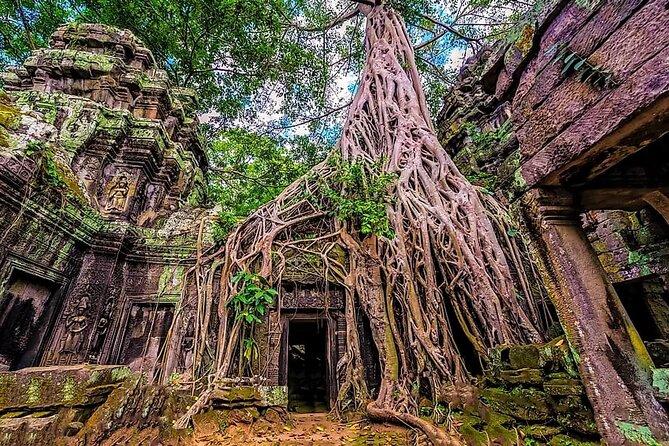
Ta Prohm gets a generous two-hour visit. Its partially cleared ruins, trees, galleries, and stonework make it one of Angkor’s most atmospheric stops. The site was left largely as found, apart from clearing paths and stabilizing dangerous sections. That gives you a clearer sense of how the jungle once pressed into the temples, though it also means uneven ground and some tight passages.
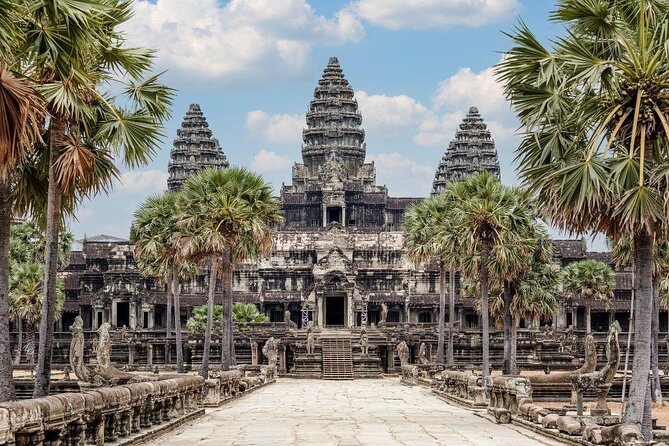
Angkor Wat follows, also with about two hours. This is the largest and best-preserved monument in the Angkor group, known for its balanced plan, galleries, reliefs, and enormous scale. Two hours lets you see the main structure, but it is not enough for every corridor and carving. If Angkor Wat is your main reason for coming to Cambodia, you may wish this itinerary offered a second temple morning.
The day ends at Phnom Bakheng, an early temple mountain dedicated to Shiva. It sits on a hill about 60 meters high and is associated with elevated views over the surrounding area. The visit lasts about an hour. Be prepared for a full day of walking, steps, heat, and repeated transitions between vehicle and temple.
This is where a private car earns its keep. You are not trying to find transport between each monument, and bottled water is included. Wear practical shoes and bring sun protection, since the schedule provides structure but not a slower pace.
Same country, a completely different kind of day:
- Angkor Wat Sunrise or Sunset Tour with Guide from Siem Reap
★ 5.0 · 12,109 reviews - Siem Reap: Angkor Wat: Small-Group Sunrise or Sunset Tour
★ 5.0 · 9,444 reviews - From Siem Reap: Kampong Phluk Floating Village Tour by Boat
★ 4.9 · 6,979 reviews - Sunset tour of Kampong Phluk stilts home village on the Tonle Sap
★ 5.0 · 4,865 reviews
Tonle Sap, Kampong Phluk, and local craft
Day 3 changes the mood. Tonle Sap is Southeast Asia’s largest freshwater lake and supports fishing communities, including carp breeding and harvesting. The lake’s water level changes greatly with the seasons, so the appearance of the villages and surrounding vegetation can vary.
Kampong Phluk takes about three hours. It is known for homes and daily life shaped by the lake, along with a mangrove forest that adds a natural side to the visit. This is not just a scenic boat outing. It helps explain how water, fishing, transport, and settlement patterns shape life around Siem Reap.
Conditions at a floating village can feel very different from a temple visit. Water levels, weather, and local activity affect what you see, so keep your expectations flexible. The tour gives you a guide and admission, but it does not list meals beyond breakfast, so plan for lunch separately.
Back in Siem Reap, Artisans Angkor introduces traditional Khmer craftsmanship and its work creating jobs for young people in rural areas. The organization began in 1992 and focuses on reviving local skills. This is a useful stop if you want context for Cambodian craft rather than only shopping in a market. Ask questions about how items are made and how the social business operates.
Wat Bo is one of Siem Reap’s oldest pagodas and has 19th-century wall paintings. Although it is a Buddhist temple, some paintings describe familiar scenes from the Hindu epic Ramayana. The Royal Residence completes the day with a brief exterior-oriented visit to the king’s official Siem Reap residence.
Battambang by bamboo train
Day 4 moves west to Battambang, Cambodia’s second-largest city. The city is known for colonial buildings and traditional Cambodian houses, including wooden homes more than a century old. The tour gives you a taste of the city, though the schedule is not designed for a long architectural walk.
The bamboo train is the day’s playful highlight. Called a norry in Cambodia, it is a simple rail platform used as transport on a railway system where regular passenger service was once limited. The ride lasts about two hours and offers a distinctly local experience, although it is basic rather than polished. If you are looking for luxury, this is not it. If you want a memorable ride tied to everyday Cambodian ingenuity, it fits the route well.
You also visit Battambang Central Market. The schedule displays an unusually long duration for this stop, so confirm the actual timing with your guide. Markets are best approached with curiosity rather than a checklist. You can look at produce, household goods, and the rhythm of local trade, but the tour information does not promise a cooking class or a meal.
Wat Tahm-rai-saw, known as the White Elephant Pagoda, adds a religious and architectural stop. The Peace Gallery then offers a different view of Cambodia’s past and present. Its focus is recovery and Cambodian involvement in peace efforts around the world, not only war. That makes it an important counterpoint to the memorial visits in Phnom Penh.
Ek Phnom, Phnom Sampeou, and the bat flight
Outside Battambang, Ek Phnom is an atmospheric, partly collapsed 11th-century temple about 11 kilometers north of the city. The ancient structure is surrounded by laterite walls and the remains of a baray, an old reservoir. It has less visual polish than Angkor Wat, but the broken stone and quieter setting help you see how much of Cambodia’s temple heritage lies beyond the headline sites.
Phnom Sampeou, or Ship Mountain, is a roughly 100-meter-high hill with several points of interest. The visit lasts about two hours, making it one of the day’s more active stops. The site also carries painful associations with Cambodia’s modern past, so your guide’s explanation is important.
Near sunset, you go to the Battambang Bat Caves. Millions of bats can pour from the cave entrance and stream across the sky as evening falls. This is a natural spectacle rather than a formal performance, so timing and patience matter. The tour allows about 45 minutes, but the exact length of the flight can vary.
The Ta Dumbong Kro Aung statue ties the day to Battambang’s founding legend. The figure, also called Lok Ta Dambong Kra Nhoung, is linked to the story of a cow herder who found a magical black stick and used it to overthrow a king. The town’s name is connected to this tale, giving the statue more meaning than a quick photo stop.
Your Battambang hotel is listed in three categories: Classy Hotel & Spa, Cambana La Riviere Hotel, and Maisons Wat Kor, or similar properties. As in Siem Reap, confirm the exact room and hotel before paying if accommodation quality is central to your decision.
Oudong and the road to Phnom Penh
Day 5 is mainly a transfer day from Battambang to Phnom Penh, with stops along the way. Road time is part of the experience, since you see the countryside between Cambodia’s main destinations instead of flying over it.
The main stop is Udong Mountain, the former royal capital from the 17th to the 19th centuries. The two mounds are joined by a ridge, and the site gives you a look at Cambodia before the royal center moved permanently to Phnom Penh. You have about an hour, but the stop can feel more strenuous in hot weather.
Another visit is listed at a meditation center where Vipassana techniques are taught. You are welcome to walk through the grounds and enter the main temple. This is a quieter pause after the road journey and temple-heavy days, though the provided details do not give the center’s full name.
In Phnom Penh, accommodation ranges from Mahasakor Inn in the three-star category to Sun & Moon Urban Hotel in the four-star category and Sun & Moon Riverside in the five-star category, or similar. The move from rural roads to the capital is noticeable, and having the evening free at the hotel gives you a chance to reset before a demanding final sightseeing day.
Phnom Penh’s royal quarter and city landmarks
Day 6 begins with Cambodia’s Khmer Rouge sites, then moves through the capital’s royal and civic landmarks. The order can make for an emotionally heavy morning, so do not plan a carefree afternoon immediately afterward.
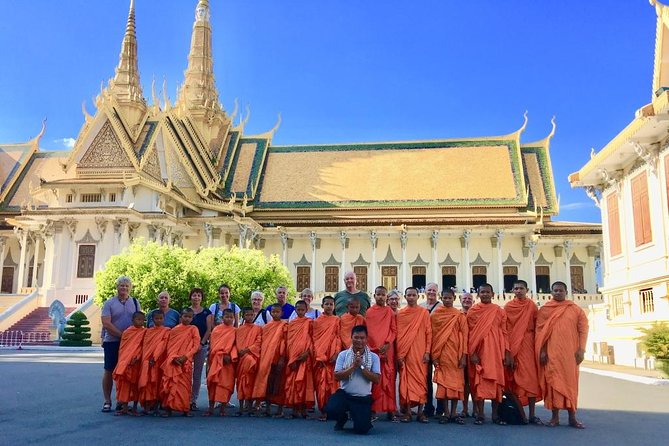
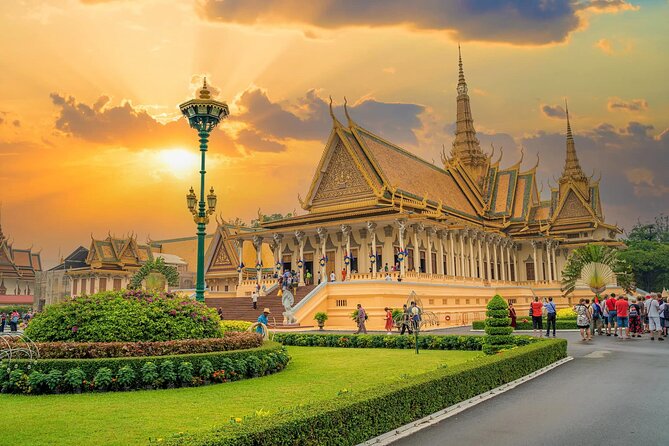
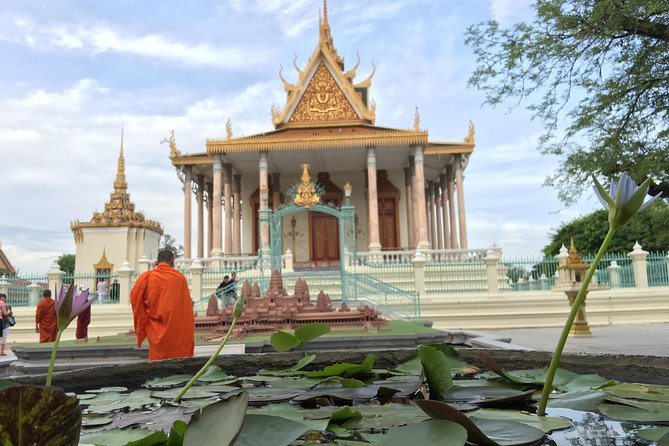
The Royal Palace was built after King Norodom moved the capital to Phnom Penh in 1886. The complex remains one of the city’s defining sights. The adjoining Silver Pagoda is known for its decorative interior and garden setting. Together, the two visits show the continuing role of monarchy and Buddhism in Cambodia.
Wat Phnom sits on the city’s only hill, a tree-covered knoll about 27 meters high. According to local legend, a woman named Penh found four Buddha statues and had a pagoda built for them in 1373. The story is tied to the city’s name and gives this compact stop a useful piece of local tradition.
The Independence Monument commemorates independence from France in 1953, while the bronze statue of King Father Norodom Sihanouk recalls a major figure in modern Cambodian politics. Wat Ounalom, one of Phnom Penh’s five original monasteries, sits near the river and dates to 1422. These stops are brief, but together they give structure to the capital’s religious, royal, and national story.
Tuol Sleng and Choeung Ek
Tuol Sleng Genocide Museum occupies a former secondary school that became Security Prison 21 during the Khmer Rouge regime. The buildings and displays are difficult, direct, and not suitable for every visitor. Give yourself permission to move slowly and quietly.
Choeung Ek, about 17 kilometers south of Phnom Penh, was once an orchard and became a mass grave site between 1975 and 1979. The visit lasts about an hour and a half. Taken together, Tuol Sleng and Choeung Ek explain the scale of the Khmer Rouge period through two very different places: one an urban prison, the other a killing field outside the capital.
The tour’s inclusion of both sites is valuable, but it also demands emotional preparation. This is not a light sightseeing day. The English-speaking guide can supply context, yet you may want private time afterward rather than another tightly packed activity.
Central Market closes the day with a change of tone. The 1937 building has a large dome and four arms filled with stalls. It is a practical place to browse local goods and get a final sense of Phnom Penh’s everyday commercial life.
Guide quality, transport, and hotel value
Several guide names connected with this service include Mr Sara, Vany, Chany, and Meng. Mr Sara is paired with driver Mr Art in one account, with particular praise for careful driving and clear explanations. Vany is described as fluent in English, calm, flexible, and strong on temple and Khmer cultural context. Chany and Meng are also named as friendly and helpful guides.
You should not assume a particular guide will be assigned. It is sensible to ask the operator before booking if a named guide matters to you. The important point is that the tour is built around a guide and driver rather than a self-guided route, which is especially useful at Angkor and the Khmer Rouge sites.
The accommodation structure gives you some control over the budget. Double or twin rooms are included, while a single room adds 40 percent to the total tour price per person. Six breakfasts are covered, but tipping for the guide and driver is not, and other meals are not listed as included.
One practical shopping note is worth keeping in mind. If you buy a long traditional Cambodian trol, described in one account as a Cambodian guitar, it may not fit in checked luggage or hand luggage. You may need to send it home as a parcel, so ask about shipping before handing over money.
Who should book this Cambodia route?
I would choose this tour if you want a private, guided introduction that reaches beyond Angkor Wat. It suits couples, families, solo participants who prefer organized support, and anyone who values a driver on long transfers.
It is less suitable if you want a slow holiday based in one place. The itinerary changes focus often, includes long sightseeing days, and gives you limited free time. The final day is also emotionally demanding because of Tuol Sleng and Choeung Ek.
A 93 percent recommendation rate and a 4.9 rating from 15 listed reviews point to strong satisfaction, especially with guide service, driving, organization, hotels, and the breadth of the route. That is a small sample, so I would treat it as encouraging rather than conclusive.
You can cancel for a full refund up to six full days before the local start time. Cancellation two to six days before the start allows a 50 percent refund, while cancellation less than two days before the start receives no refund. The booking confirmation is provided at the time of purchase, and most people can participate.
Should you book it?
Book this Cambodia tour if you want the major sights handled in one private package and like the idea of seeing Cambodia through temples, waterways, countryside, royal sites, markets, and modern history. The strongest value is not any single stop. It is the connection between them, with transport, hotels, breakfast, admissions, water, guide, and driver bundled into one seven-day plan.
Skip it if your priority is freedom, slow mornings, or extensive time at each temple. For most first-time visitors with limited time, though, this is a well-rounded route. Just arrive ready for early starts, long days, hot conditions, and a serious final look at Cambodia’s past.
FAQ
Where does the tour start?
The tour starts with pickup at Siem Reap Angkor International Airport in Siem Reap, Cambodia.
Where does the tour end?
The tour ends with a transfer to Techo International Airport, also known as KTI, on Day 7.
How long is the tour?
The experience lasts approximately seven days and includes six nights of accommodation.
Is this a private tour?
Yes. Only your own group participates in the private tour or activity.
What is included in the price?
The price includes double or twin accommodation, transport, an English-speaking tour guide, entrance fees, drinking water, and six breakfasts.
Is a single room included?
A single room is not included at the standard shared-room rate. A 40 percent supplement is added to the total tour price per person for single-room accommodation.
Are guide and driver tips included?
No. Tipping for the guide and driver is not included.
Just added around Siem Reap
- Ultimate Sunrise to Angkor Wat, Angkor Thom and Bayon Temple★ 5.0 · 3 reviews
- Twilight Tastes of Siem Reap Include Dinner★ 5.0 · 13 reviews
- Trekking Tour at Phnom Kulen National Park from Siem Reap★ 5.0 · 3 reviews
- Full-Day Private Tour of Angkor Wat with Pick Up★ 5.0 · 12 reviews
- Private Day Trip to Angkor Temples with Expert Guide★ 5.0 · 4 reviews
- Waterfall & River of 1000 Siva Linga- Kulen Mountain Private Tour★ 5.0 · 3 reviews
- Professional Photo Shoot in Angkor Archaeological Park, Siem Reap★ 5.0 · 42 reviews
- Ultimate Siem Reap Food Tour by Tuk Tuk – 20 Tastings, 8 Stops★ 5.0 · 13 reviews
Tours, compared.

Angkor Wat Sunrise or Sunset Tour with Guide from Siem Reap
Read our review →
Angkor Wat: Small-Group Sunrise or Sunset Tour
Read our review →
Sunset tour of Kampong Phluk stilts home village on the Tonle Sap
Read our review →
Angkor Wat 2-Day Tour with Sunrise and Sunset
Read our review →
Kampong Phluk Floating Village Tour with Boat
Read our review →
