
Reviewed · ANGKOR WAT TOURS
Angkor Wat & Bayon: the Smiling Temple
Angkor Wat is magnificent, but seeing it by bicycle gives you more than a quick temple stop. This five-hour ride links Angkor Wat, Angkor Thom, and Bayon with quiet tracks, trees, flowers, and the occasional butterfly along the way. You get time to notice the setting, not just race from one monument to the next.
I like the small maximum of 10 people, which keeps the ride manageable and makes it easier to hear your English-speaking guide. I also like that the price includes a Trek mountain bike, helmet, lunch, coconut water, and drinking water. The main catch is that the $50 price does not include the $37 Angkor pass or hotel transport, and the off-road sections can feel harder than the easygoing description suggests.
Key points to know before booking
- A bicycle changes the temple day: You travel through quieter tracks and wooded areas instead of spending the whole morning in a vehicle.
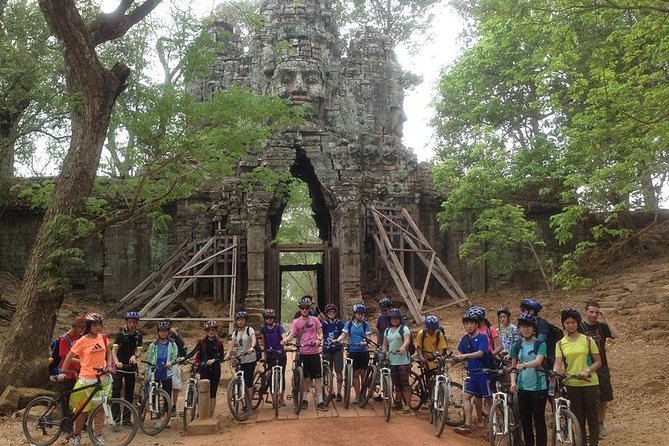
- The route covers Angkor Wat and Bayon: You also see Angkor Thom’s south and west gates and reach Prasat Chrung by way of the defensive wall.
- The group is capped at 10: That is a useful size for a guide-led ride and a much more personal setup than a large coach tour.
- The ride is aimed at ordinary riders: It is described as leisurely and non-adventurous, but some off-road biking and hot weather can still test younger riders or anyone unused to cycling.
- The package is practical: Bike, helmet, guide, lunch, coconut water, and drinking water are included.
- Plan for extra costs: The one-day temple pass costs $37, and you must reach the Taphul Road meeting point yourself.
Why cycling makes Angkor feel different
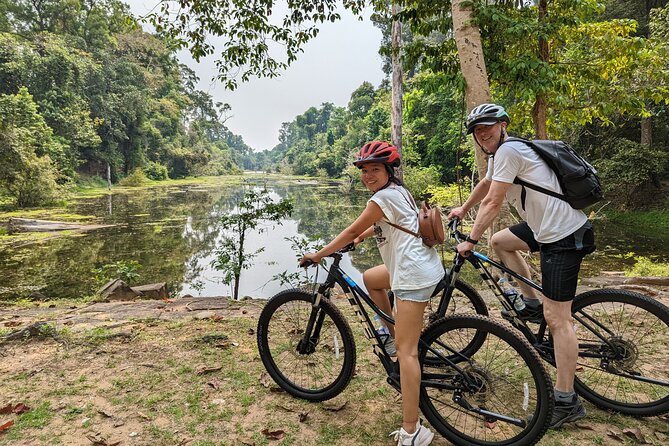
A standard temple visit can become a series of car rides, parking lots, stairways, and crowded courtyards. This tour puts the bicycle between those pieces. You pedal through the grounds and along less direct paths, with the sound of nature replacing some of the road noise.
That slower movement matters at Angkor. The monuments are enormous, yet the spaces between them are part of the experience. You can see flowers, butterflies, trees, and stretches of greenery that are easy to miss when you are focused only on the next temple entrance.
The ride is not presented as a sporting challenge. You do not need to be a professional cyclist, and the stated goal is an easy, fun outing for ordinary riders. Still, you should be comfortable spending several hours on a bike. The route includes some off-road riding, and Cambodia’s heat can change the feel of an otherwise gentle morning.
The small group helps here. With no more than 10 people, the guide can keep an eye on the pace and explain what you are seeing without shouting across a crowd. It also gives the outing a more relaxed rhythm than a large group cycling line.
More Angkor Wat Tours in Siem Reap:
- Angkor Wat Sunrise or Sunset Tour with Guide from Siem Reap
★ 5.0 · 12,109 reviews - Siem Reap: Angkor Wat: Small-Group Sunrise or Sunset Tour
★ 5.0 · 9,444 reviews - Siem Reap: Angkor Wat 2-Day Tour with Sunrise and Sunset
★ 4.9 · 4,429 reviews
Starting at 7:30 on Taphul Road
The meeting point is Angkor Cycling Tour on Taphul Road in Siem Reap. The start time is 7:30 a.m., and the tour ends back at the same place after about five hours.
You need to arrange your own way to the starting point because hotel pickup and drop-off are not included. That is easy to overlook when comparing prices. If you are staying elsewhere in Siem Reap, allow enough time to arrive with water, sunscreen, and suitable clothing already sorted.
The operator provides a premium Trek mountain bike and helmet. You also receive pure drinking water, coconut water, and lunch. Those inclusions make the $50 fee more reasonable, especially since bike hire and refreshments are already handled.
The separate temple pass is the major extra. A one-day Angkor entry costs $37, bringing the basic outing to $87 before any transport to or from Taphul Road. That is not a bargain-basement temple visit, but it is fair if you value a guide, a good bicycle, food, and a route that avoids making the whole day a vehicle transfer.
You should also have a camera, sunglasses, and sunscreen. Angkor is an active Buddhist site, not simply an open-air museum. Wear clothing that covers your shoulders and knees, since revealing tops, short shorts, and skirts above the knees are not suitable in sacred areas.
Angkor Wat by bicycle and on foot
The first major focus is Angkor Wat, the best-known monument in Cambodia and the largest of the temples included here. The bicycle helps you approach it as part of a wider setting rather than as a single photo stop.
Your guide provides the historical explanation as you ride and walk through the temple area. That support is valuable at Angkor because the carvings, towers, galleries, and ceremonial spaces can otherwise blur together. A guide can give the buildings a sequence and explain why Angkor Wat remains the central stop on the route.
The bicycle itself will not take you through every interior space. You will park and explore the temple on foot, so expect a mix of riding, walking, and standing. The tour description does not give a detailed amount of free time inside Angkor Wat, so anyone wanting a long, highly detailed study of every gallery should ask the guide about timing at the start.
What you gain is variety. Rather than spending the entire five hours inside one complex, you see Angkor Wat, Angkor Thom, its defensive structures, and Bayon in one connected outing. I think that works well for a first look at the area, especially if you prefer a day with movement.
The south gate of Angkor Thom
From Angkor Wat, the route continues toward Angkor Thom, the old royal city. The south gate is one of the most recognizable approaches in the area, with a broad entrance and sculpted figures lining the causeway.
This is a good place to understand the scale of Angkor Thom. The gate is not an isolated ruin. It forms part of a larger defensive plan, and the surrounding walls help you picture the city as a protected capital rather than a loose collection of temples.
The tour calls this the most appealing defensive wall section of Angkor Thom. You do not simply pause at the gate for a photograph. The route includes riding along the protection wall toward Prasat Chrung, adding a viewpoint and a bit of exploration to the usual temple circuit.
This section is also where the ride may feel less polished under your tires. Some off-road biking is part of the experience. If you expect smooth pavement from start to finish, adjust your expectations. The rougher sections are part of the reason to choose a bike tour, but they still require attention and a reasonable level of comfort on a bicycle.
Same country, a completely different kind of day:
- From Siem Reap: Kampong Phluk Floating Village Tour by Boat
★ 4.9 · 6,979 reviews - Sunset tour of Kampong Phluk stilts home village on the Tonle Sap
★ 5.0 · 4,865 reviews - Siem Reap: Kampong Phluk Floating Village Tour with Boat
★ 4.9 · 3,843 reviews - Siem Reap: Full-Day Angkor Wat Guided Tour with Sunset
★ 4.9 · 3,803 reviews
Prasat Chrung and the wall route
The ride up and along the Angkor Thom wall leads to Prasat Chrung. The appeal here is the route itself as much as the small temple. You get a view across the surrounding area from an elevated defensive structure, with a different sense of distance from the major temple courtyards.
This part gives the outing a quieter feel. Angkor Wat and Bayon are the headline stops, but the wall ride supplies the space between them. It also shows how the ancient city used walls and controlled entrances to shape movement.
You should not read the word climb as a promise of a strenuous mountain-bike ascent. The tour is described as leisurely, and the ride is intended for non-professional cyclists. Even so, heat, uneven ground, and the need to dismount or walk in places can make this segment feel more demanding than a flat road ride.
If you are bringing children, think about stamina rather than cycling skill alone. One family had children who could not manage the ride back from the temples, and the company arranged a tuk-tuk home. That is a helpful sign of practical support, but it also tells you to discuss family needs before setting out instead of assuming every rider will finish the full route.
The west gate and its unfinished character
The west gate of Angkor Thom adds another useful contrast. It is described as the never-restored gate, so it offers a less polished view of the old city than the more familiar entrances.
For me, this is the kind of stop that gives context to the grand monuments. Restored or heavily photographed sites can make Angkor feel too neat and complete. A less-restored gate helps you see age, weathering, and the slow changes that affect a vast archaeological area.
The itinerary does not promise a long stop here, so you should treat it as one part of the connected ride, not a separate major visit. The strength of the tour is the sequence: pedal, pause, hear the explanation, then continue through the trees and old walls.
Bayon and its 216 smiling faces
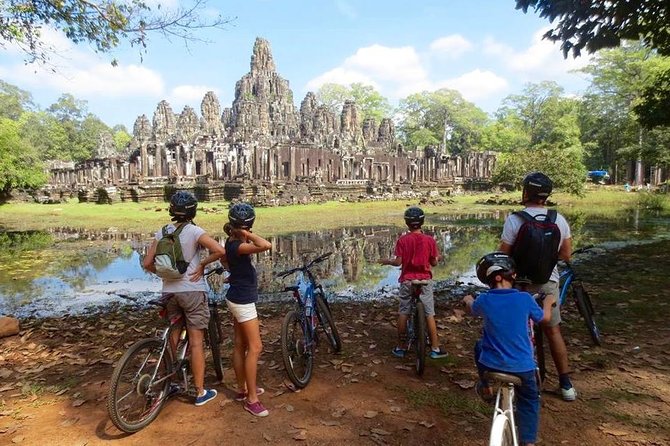
Bayon is the final major temple named in the route and the second most important monument after Angkor Wat in the tour’s presentation. Its most famous feature is the collection of giant stone faces looking out from its towers.
The figures are often called smiling faces, though their expressions can seem calm, watchful, or mysterious depending on the light and angle. The temple is said to have 54 towers and 216 faces, numbers that help explain why Bayon feels so different from the long galleries and central towers of Angkor Wat.
Bayon rewards slow movement. You need to look up, around corners, and across narrow passages to understand how the faces appear and disappear among the stone towers. A guide is especially useful here because the temple can feel confusing at first. The structure is compact, layered, and visually busy.
You should also expect uneven footing and steps at temple sites. The supplied information says most people can participate, but it does not promise a fully accessible route. If you have specific mobility needs, contact the operator before booking and ask what parts can be adjusted.
Heat, food, and the five-hour pace
The stated duration is about five hours, which is long enough to see the main sights without turning this into a full-day cycling expedition. The early 7:30 start helps place the ride before the day becomes hottest, but Cambodia’s weather can still be intense.
One outing had to be shortened because of high heat, and the company sent a car to collect the group. That kind of backup is worth knowing about, particularly if you are cycling with children, older family members, or anyone who does not handle heat well.
Lunch, coconut water, and drinking water are included. These are not decorative extras. On a bicycle tour, regular drinking matters, and the coconut water is a welcome change from plain water. You should still arrive prepared with sunscreen and sunglasses, since the included supplies do not replace basic sun protection.
Tell the operator about dietary requirements when booking. The information provided confirms that they can take specific food needs into account, but it does not spell out the exact lunch menu.
Who will get the most from this tour
I would choose this experience if you want to see the major Angkor landmarks but dislike spending every transfer inside a vehicle. It suits people who enjoy gentle exercise, outdoor scenery, and a guide-led route with enough structure to keep the day moving.
Families can also consider it, but I would be cautious with young children. The ride is called easy, yet the distance back, the heat, and off-road sections may be too much for small riders. The company has helped when children could not continue, but a tuk-tuk rescue should be a backup, not the family plan.
This is less suitable for someone who wants a hard mountain-bike challenge. It is intentionally non-adventurous and leisurely. It is also not ideal if your main goal is an exhaustive archaeological study of every monument, since the route covers several sites within one half-day.
The maximum group size of 10 is one of the strongest reasons to book it. You receive the social feel of a group outing without the scale of a bus tour. At the same time, the group size does not guarantee a private guide or a custom route.
Is the $50 price good value?
At first glance, $50 may look like a moderate price for a half-day activity. Add the $37 temple pass and the total rises to $87 per person, before getting to the meeting point. That full figure is the one to use when comparing this outing with a tuk-tuk, car, or longer Angkor tour.
The value comes from the complete setup. You do not need to arrange a bike, helmet, guide, lunch, coconut water, or drinking water separately. You also get a route that includes more than the two famous temples, with Angkor Thom’s gates, its wall, and Prasat Chrung folded into the morning.
I would not book it purely to save money. A basic temple visit can cost less once transport and entry are separated. I would book it for the way you move through Angkor, the small group, and the chance to replace some vehicle time with a quiet ride through the grounds.
Free cancellation is available if you cancel at least 24 hours before the 7:30 start. Changes or cancellations inside that window are not refundable, so check the forecast and your group’s plans early.
Should you book the Angkor cycling tour?
Book this tour if you want Angkor Wat and Bayon with a bicycle between them, plus a guide, food, and a small group. It is a particularly good choice for active couples, friends, and families with older children who can handle several hours outdoors.
Think twice if you are uncomfortable on uneven tracks, highly sensitive to heat, or determined to spend most of the morning inside Angkor Wat alone. The route is easygoing, not effortless, and the temple pass and transport are extra.
For most reasonably fit visitors, I see the appeal. You get the famous monuments, but you also get the walls, gates, flowers, trees, and quieter stretches that make Angkor feel like a place rather than a checklist. Just budget the $37 entry fee, dress for a sacred site, and arrive ready for both cycling and walking.
FAQ
How long does the Angkor cycling tour last?
The tour lasts approximately five hours.
What time does the tour start?
The tour starts at 7:30 a.m.
Where does the tour begin and end?
It begins at Angkor Cycling Tour on Taphul Road in Siem Reap and ends back at the same meeting point.
Is the Angkor entry ticket included?
No. The temple pass is separate and costs $37 for one day of entry.
What equipment is provided?
A premium Trek mountain bike and helmet are included.
Are food and drinks included?
Yes. Lunch, coconut water, and pure drinking water are included.
How many people can join the tour?
The group has a maximum of 10 people.
Is hotel pickup included?
No. You must arrange your own transport to and from the Taphul Road meeting point.
Just added around Siem Reap
- Ultimate Sunrise to Angkor Wat, Angkor Thom and Bayon Temple★ 5.0 · 3 reviews
- Twilight Tastes of Siem Reap Include Dinner★ 5.0 · 13 reviews
- Trekking Tour at Phnom Kulen National Park from Siem Reap★ 5.0 · 3 reviews
- Full-Day Private Tour of Angkor Wat with Pick Up★ 5.0 · 12 reviews
- Professional Photo Shoot in Angkor Archaeological Park, Siem Reap★ 5.0 · 42 reviews
- Private Day Trip to Angkor Temples with Expert Guide★ 5.0 · 4 reviews
- Waterfall & River of 1000 Siva Linga- Kulen Mountain Private Tour★ 5.0 · 3 reviews
- Ultimate Siem Reap Food Tour by Tuk Tuk – 20 Tastings, 8 Stops★ 5.0 · 13 reviews
Angkor Wat Tours, compared.

Angkor Wat Sunrise or Sunset Tour with Guide from Siem Reap
Read our review →
Angkor Wat: Small-Group Sunrise or Sunset Tour
Read our review →
Angkor Wat 2-Day Tour with Sunrise and Sunset
Read our review →

Angkor Wat Sunrise tour with Small – Group and Guide tours
Read our review →
Angkor Wat Highlights and Sunrise Guided Tour from Siem Reap
Read our review →
Angkor Wat Sunset Small Group Tour with Lunch Included
Read our review →