
Reviewed · TOURS
Angkor Grand Circuit Temples Tour
The best part of this tour is the chance to see eight Angkor-era sites in one private day, including quieter Banteay Prei and the striking island temple of Neak Pean. You get hotel pickup, an air-conditioned car or minivan, cold water, and a guide who can shape the pace around your group.
I like the personal guide and vehicle, especially because the route covers a lot of ground. I also like the early 8:00 am start and the mix of large temples, smaller ruins, reservoirs, terraces, and peaceful viewpoints. The main drawback is the packed schedule: several stops are allotted an hour, so temple lovers may wish for more time at Preah Khan or Pre Rup.
Key points at a glance
- Eight stops beyond Angkor Wat: The route covers Preah Khan, Banteay Prei, Neak Pean, Ta Som, Eastern Mebon, Banteay Samre, Pre Rup, and Srah Srang.
- Private sightseeing: Your group travels with its own English-speaking guide and air-conditioned vehicle.
- Strong guide praise: Bunpheng is noted for finding the best photo stops, while Pal Chen is praised for clear English, temple knowledge, and helpful photos.
- Angkor Pass required: The $37 one-day pass is not included in the $52 tour price.
- Quiet corners are built in: Banteay Prei is presented as a place where you might find very few people.
- Covered clothing matters: Your shoulders and knees must be covered for temple access.
Why this Grand Circuit route is worth your day
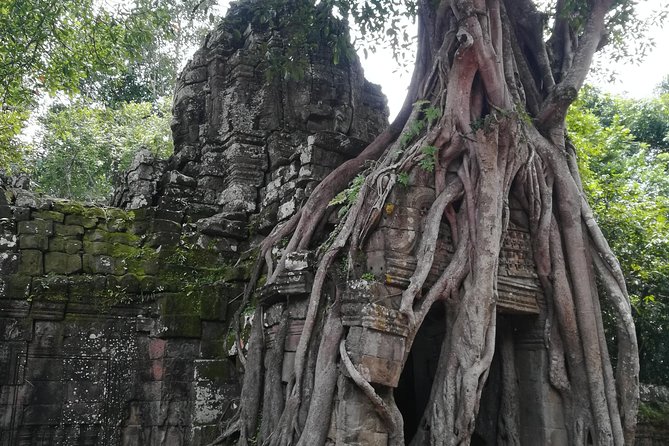
Many first-time visitors focus on Angkor Wat and Angkor Thom, then stop. This tour gives you a broader look at the old Khmer capital and its surrounding monuments. You move from a large fortified temple to small jungle-framed ruins, waterworks, brick towers, and a broad reservoir.
That variety is the real appeal. This is not eight versions of the same temple. Preah Khan feels expansive and layered, Neak Pean is tied to water and healing, Ta Som is compact and atmospheric, and Srah Srang offers a quiet finish by the water.
A private format matters here. You are not tied to a large bus group or a fixed commentary style. Your guide can point out a carving, pause at a photo stop, or help you move along if the heat starts to wear you down. Guides Bunpheng and Pal Chen received especially strong praise for route choices, English, temple explanations, and photography help.
The tour costs $52 per person, but that is not the full admission cost. Add the $37 one-day Angkor Pass, and the basic total becomes $89 per person before food. For a private vehicle, English-speaking guide, hotel transport, and a seven to eight-hour day, that can be fair value for couples, families, or small groups who want convenience.
The calculation changes if you are a solo visitor on a tight budget. The private setup costs more than joining a large group, and the entrance fee is still separate. Group discounts are offered, so the per-person value may improve when several people share the vehicle and guide.
Other Siem Reap days people book alongside this one:
- Angkor Wat Sunrise or Sunset Tour with Guide from Siem Reap
★ 5.0 · 12,109 reviews - Siem Reap: Angkor Wat: Small-Group Sunrise or Sunset Tour
★ 5.0 · 9,444 reviews - From Siem Reap: Kampong Phluk Floating Village Tour by Boat
★ 4.9 · 6,979 reviews
Starting at 8:00 am with your Angkor Pass
Pickup begins at your Siem Reap hotel lobby at 8:00 am, after breakfast. The first practical stop is the ticket office, where you buy the required Angkor Pass before heading north toward the ancient city.
The one-day pass costs $37 per person and is not included in the tour price. Keep that figure in mind when comparing this outing with other temple tours. Food, drinks beyond the supplied water, and accommodation are also your responsibility.
The early start is sensible. You have a long route ahead, and Cambodia’s heat can make open temple terraces tiring later in the day. You receive bottled cold drinking water, but bring any extra drinks or snacks you know you will want. The tour lasts about seven to eight hours, so breakfast should be substantial.
Wear clothing that covers your shoulders and knees. This is not just a polite cultural choice: uncovered clothing can prevent access to the temples. Light, breathable clothes that meet the rule will make the day easier.
Preah Khan, two hours of corridors and carvings
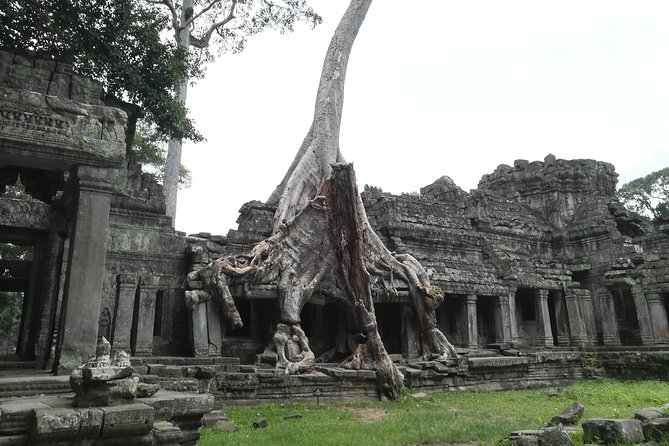
Preah Khan gets the longest scheduled visit, at about two hours, and that makes sense. It is one of the most substantial stops on the route, with plenty to inspect rather than a single central tower to photograph and leave.
Your guide leads you through the temple complex and explains its role in the wider Angkor area. The important benefit of a guide here is orientation. Large temple sites can feel like a maze of galleries, courtyards, doorways, and fallen stones. A good guide helps you notice what belongs to the main design and what makes this place different from the next stop.
Bunpheng is praised for knowing the best routes and photo points at each temple, including details unique to individual sites. That kind of help is valuable at Preah Khan, where wandering without context can turn into a hunt for the exit.
Two hours is generous compared with most later stops, but you should still tell your guide if Preah Khan is a priority. With a private tour, your interests can carry more weight than they would in a large group. The tradeoff is that spending extra time here could shorten later visits.
Banteay Prei, the quieter pause
The next stop is Banteay Prei, scheduled for about 30 minutes. Its small size and lower profile make it a useful contrast with Preah Khan.
The appeal is not a long checklist of grand buildings. It is the chance to see a less crowded temple setting and have a shorter, calmer walk. The tour description specifically highlights that there are often no other tourists there, though you should treat that as a possibility rather than a promise.
Half an hour is enough for a look around and photographs, but not for a slow architectural study. If your main goal is to escape the busiest temple paths, this is one of the most appealing stops on the day. If you prefer major monuments with long explanations, the brief visit may feel too short.
Same country, a completely different kind of day:
- Sunset tour of Kampong Phluk stilts home village on the Tonle Sap
★ 5.0 · 4,865 reviews - Siem Reap: Angkor Wat 2-Day Tour with Sunrise and Sunset
★ 4.9 · 4,429 reviews - Siem Reap: Kampong Phluk Floating Village Tour with Boat
★ 4.9 · 3,843 reviews - Siem Reap: Full-Day Angkor Wat Guided Tour with Sunset
★ 4.9 · 3,803 reviews
Neak Pean and its unusual water setting
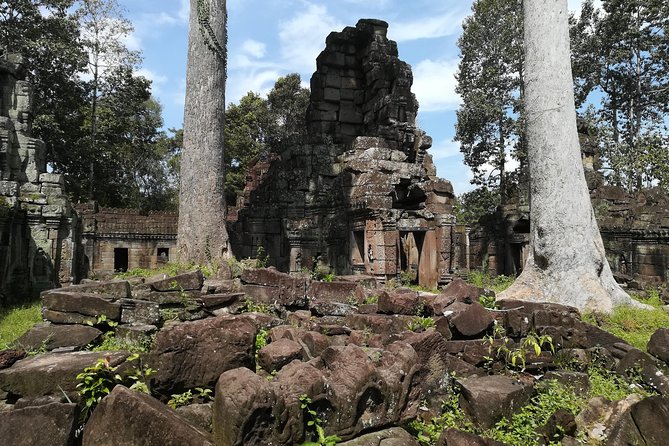
Neak Pean receives about an hour. This temple is known for its unusual setting on a small island within a larger water complex, which gives the stop a different mood from the enclosed galleries at Preah Khan.
Your guide can explain the purpose and symbolism of the site while you take in the layout. The approach and water setting are as important to the experience as the central shrine itself. It is a place where you pause to understand how temples, reservoirs, and sacred ideas fit together.
An hour should give you time to reach the temple, hear the main explanation, and take photographs. The route is not simply a parade of towers. Neak Pean reminds you that water management was central to Angkor’s design and daily life.
Ta Som, a compact temple with a strong finish
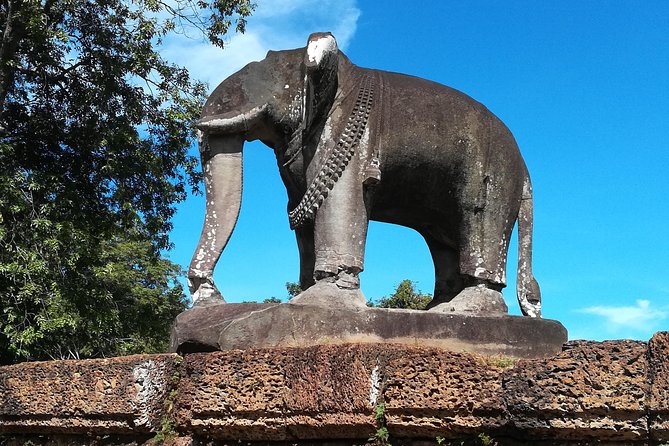
Ta Som follows Neak Pean, with another hour scheduled. This is a smaller, more intimate stop, and its appeal comes from the combination of carved stone, narrow passages, and tree growth around the ruins.
The site works well after Neak Pean because it changes the scale again. Instead of a broad complex, you get a more concentrated temple visit. Your guide can help you spot the details that are easy to miss when you are focused only on the best-known temples.
An hour is enough for a measured visit, though it may feel long if you move quickly through smaller ruins. A private guide can use the time for explanation rather than rushing your group from one photo stop to another.
Eastern Mebon, brick towers above the old reservoir
Eastern Mebon is the next one-hour stop. It was built on an island in the middle of a large reservoir, though the water has gone and the temple now sits on dry ground. That setting helps you picture how different the site would have looked when the reservoir was functioning.
The temple has a strong, symmetrical layout with towers and guardian figures. It is a good place to focus on construction details and the way Angkor rulers used monuments to mark power and devotion.
The one-hour schedule gives you room for a guide explanation and a walk around the main structure. If you are drawn to the engineering side of Angkor, pay attention here. Eastern Mebon is not just a collection of old stones. Its original setting shows how closely religion, royal planning, and water control were connected.
Banteay Samre, a change in scale and style
Banteay Samre receives about an hour and gives the route another shift in atmosphere. The temple is enclosed and formal, with a layout that can feel more compact than Preah Khan or the large central Angkor sites.
This stop is useful for comparing architectural styles across the circuit. Rather than rushing through only the most famous monuments, you get time to look at a site that many visitors might otherwise skip.
A guide is particularly helpful if you want more than photographs. Ask for comparisons with the temples you have already seen. Since the tour is private, you can make those links as you go instead of listening to a general speech designed for a mixed group.
Pre Rup, the high point of the afternoon
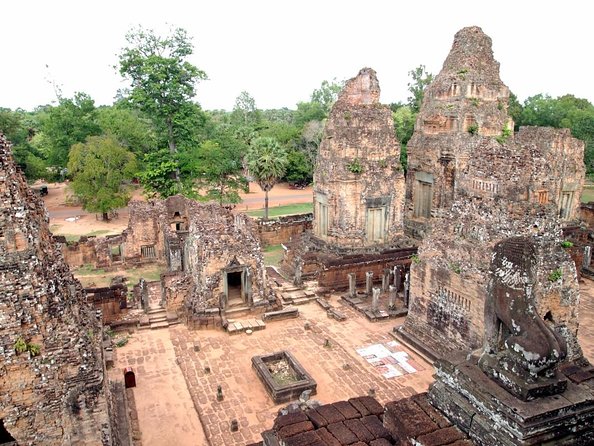
Pre Rup is scheduled for an hour and is one of the more dramatic places on the route because of its tall, stepped structure. The climb and open upper levels can make this stop feel more exposed than the enclosed temples earlier in the day.
This is a good point to slow down. Look back at the temple’s layered shape, study the brickwork, and take in the broad views from the upper levels where access allows. The heat may be more noticeable by now, so water and sensible footwear matter.
The one-hour timing is reasonable for most people, but visitors fascinated by temple architecture may want longer. Pre Rup can be one of the day’s most memorable stops, yet the itinerary still has one final destination.
Srah Srang, a quiet ending by the water
The tour ends at Srah Srang, with about 20 minutes for relaxation. The sandstone terrace is decorated with Naga and lion statues, and the water gives you a softer finish after a full day of stone corridors and stairways.
Do not expect a long temple visit here. This is a viewpoint and rest stop, not another large complex to explore. It works well at the end because you can pause, take photographs, and let the day settle before returning to Siem Reap.
The short timing is enough for the main view, but it is not designed for a leisurely lakeside stay. If you particularly want a longer break, mention it to your guide, though the total route already runs seven to eight hours.
How the private vehicle changes the experience
Transport is provided by air-conditioned car, minivan, or minibus, depending on the group. Hotel pickup and drop-off remove the need to arrange separate transport for a day that covers several sites spread around the Angkor area.
The private arrangement is the tour’s clearest comfort advantage. You travel only with your own group, and the guide can explain the route at a level that suits you. That is especially useful if one person wants detailed temple history while another mainly wants photographs and a manageable pace.
Bunpheng’s ability to find good photo locations is a practical strength, not a minor extra. At major temple sites, the best picture is often a matter of angle, timing, and knowing which path to take. Pal Chen is also praised for clear English, long experience, useful explanations, and help taking photographs.
Still, private does not mean unhurried. Eight stops in one day require regular movement. If you want to sit with one temple for hours, a shorter custom route may suit you better.
Price, extra costs, and who gets the best value
At $52 per person, the tour includes the guide, transport, hotel pickup and drop-off, and bottled cold water. The $37 Angkor Pass is extra, bringing the basic cost to $89 per person.
That price is easier to justify if you are traveling with family or friends and value a private vehicle. You are paying for time saved, transport arranged in advance, and a guide who can help you make sense of a large temple area.
The tour is less attractive if you want only Angkor Wat or Angkor Thom. This is a full Grand Circuit day, and much of its value comes from seeing the less familiar sites. You should also budget for lunch and any drinks or food you buy during the day.
Free cancellation is available if you cancel at least 24 hours before the start time. Changes or cancellations inside that window are not accepted for a refund.
Who should book this Angkor Grand Circuit tour
I would choose this tour if you want a private day with broad coverage and do not want to arrange temple transport yourself. It fits couples, families, and small groups who like having an English-speaking guide and the freedom to ask questions.
It is also a good second temple day after Angkor Wat. The route gives you different settings and styles rather than repeating the same famous view.
I would think twice if your priority is a slow, scholarly visit to only two or three temples. The schedule is active, and several stops have one-hour slots. The $37 admission cost also needs to be added to the advertised price.
Should you book it?
Book this tour if you want to cover the Grand Circuit in one organized day, with private transport, hotel pickup, cold water, and a guide who can improve both the explanations and the photo stops. The strongest case is the combination of quiet Banteay Prei, water-centered Neak Pean, atmospheric Ta Som, and the larger sites at Preah Khan and Pre Rup.
Skip it if you dislike full-day sightseeing or want to spend most of your time inside one major temple. For everyone else, the route offers a useful balance of famous structures and quieter corners, with a clear price once you add the Angkor Pass.
FAQ
What is included in the Angkor Grand Circuit tour?
The tour includes an English-speaking guide, transportation in an air-conditioned car, minivan, or minibus, hotel pickup and drop-off, and bottles of cold drinking water.
How much does the Angkor Pass cost?
The one-day Angkor Pass costs $37 per person. It is not included in the $52 tour price.
How long does the tour last?
The experience lasts approximately seven to eight hours.
What time does pickup begin?
Pickup begins at 8:00 am from your hotel lobby in Siem Reap.
Which temples and sites are included?
The route includes Preah Khan, Banteay Prei, Neak Pean, Ta Som, Eastern Mebon, Banteay Samre, Pre Rup, and Srah Srang.
Is this a private tour?
Yes. Only your group participates in the activity, with a private guide and vehicle.
Is food included?
No. Food and drinks other than the supplied bottled water are not included.
What should I wear?
Your clothing must cover your shoulders and knees. Otherwise, you may not be allowed access to the temples.
Can I cancel for a full refund?
Yes, if you cancel at least 24 hours before the experience start time. Cancellations or changes made less than 24 hours before the start time are not accepted for a refund.
Just added around Siem Reap
- Ultimate Sunrise to Angkor Wat, Angkor Thom and Bayon Temple★ 5.0 · 3 reviews
- Twilight Tastes of Siem Reap Include Dinner★ 5.0 · 13 reviews
- Trekking Tour at Phnom Kulen National Park from Siem Reap★ 5.0 · 3 reviews
- Full-Day Private Tour of Angkor Wat with Pick Up★ 5.0 · 12 reviews
- Private Day Trip to Angkor Temples with Expert Guide★ 5.0 · 4 reviews
- Waterfall & River of 1000 Siva Linga- Kulen Mountain Private Tour★ 5.0 · 3 reviews
- Professional Photo Shoot in Angkor Archaeological Park, Siem Reap★ 5.0 · 42 reviews
- Ultimate Siem Reap Food Tour by Tuk Tuk – 20 Tastings, 8 Stops★ 5.0 · 13 reviews
Tours, compared.

Angkor Wat Sunrise or Sunset Tour with Guide from Siem Reap
Read our review →
Angkor Wat: Small-Group Sunrise or Sunset Tour
Read our review →
Sunset tour of Kampong Phluk stilts home village on the Tonle Sap
Read our review →
Angkor Wat 2-Day Tour with Sunrise and Sunset
Read our review →
Kampong Phluk Floating Village Tour with Boat
Read our review →
