
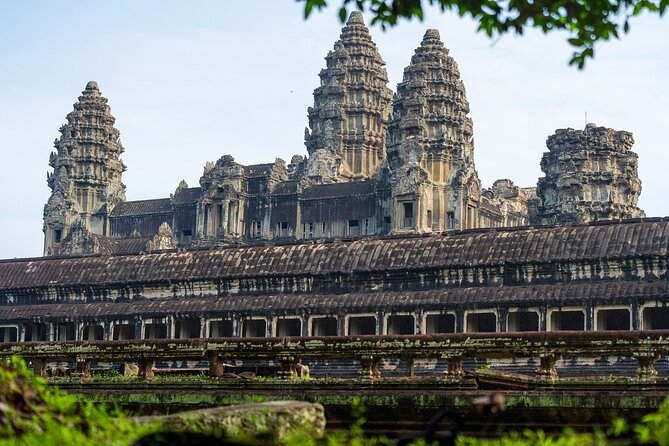
Reviewed · ANGKOR WAT SUNRISE TOURS
Angkor Wat Sunrise Tour
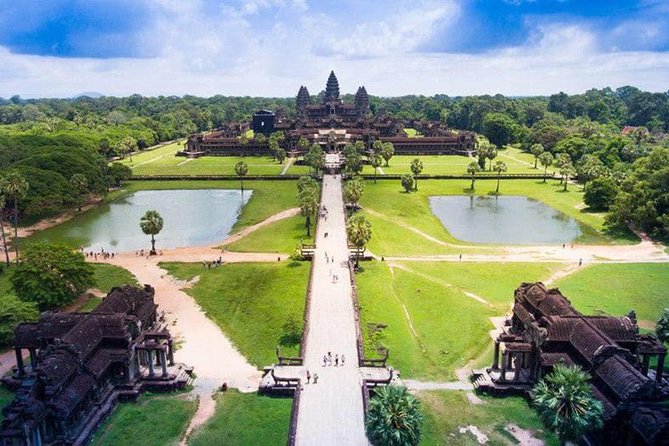
The best part of this tour happens before most of Siem Reap is awake. You enter Angkor Wat in the dark, walk its long stone corridors, and wait for daylight to reveal the temple’s towers. Later, the route moves to Bayon’s giant carved faces and Ta Prohm’s tree-wrapped ruins.
I like the private format, which lets your own group move at a more comfortable pace, and I like the thoughtful service: an air-conditioned vehicle, bottled water, and cold towels after walks in the heat. The main drawback is cost planning. The tour is $26 per person, but the Angkor temple pass costs another $37, and the 4:30 to 4:45am pickup makes for a very early start.
Key points at a glance
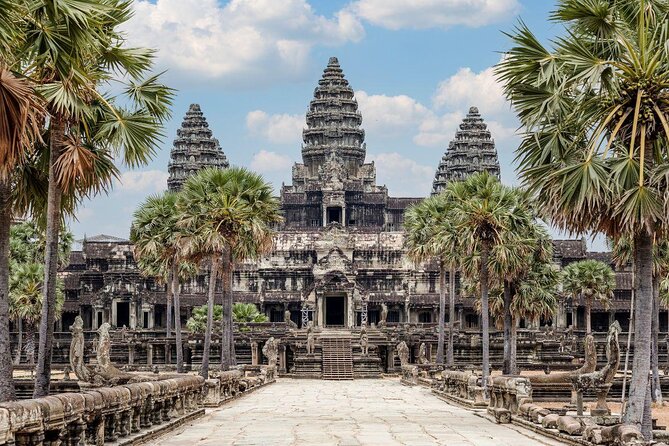
- Sunrise from Angkor Wat: Enter before dawn through the quieter eastern side and watch the sky brighten behind the famous temple.
- Four major Angkor sights: The day covers Angkor Wat, Angkor Thom, Bayon, the Terrace of the Elephants, and Ta Prohm.
- Private experience: Only your group takes part, with hotel pickup and drop-off by air-conditioned vehicle.
- Strong guide service: Guides including Bun, Pi, Setha, Samnang, Sokpee, and Nimol are praised for temple knowledge, Cambodian culture, photography, and personal stories.
- Extra costs to budget: The $26 tour price does not include the $37 temple pass, meals, or drinks beyond the supplied water.
- Practical clothing matters: Your shoulders and knees must be covered. A scarf alone is not accepted for covering the shoulders.
Before dawn at Angkor Wat
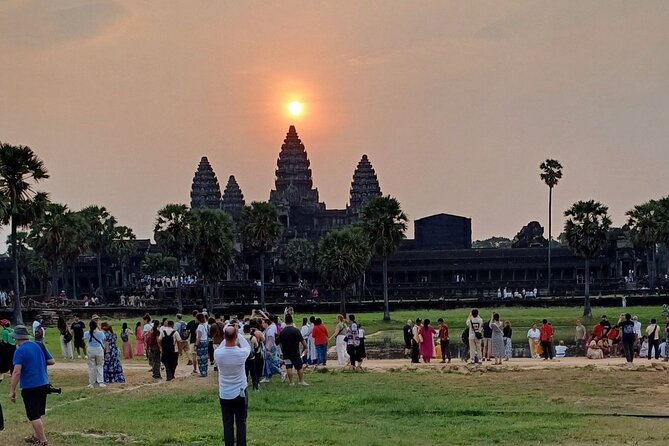
Your day starts with hotel pickup around 4:30 to 4:45am, depending on the time of year. That hour is not easy, especially if you have just arrived in Siem Reap, but it is the price of seeing Angkor Wat in its most dramatic light.
The guide takes you to the temple before sunrise and enters from the eastern side. This approach is useful because it begins away from the most familiar front view and leads you into the great complex while it is still dark. The long corridors and carved stone walls feel different without the full heat and glare of midday.
You should request a breakfast pack from your hotel if breakfast is included with your room. The tour information specifically recommends eating after sunrise at Angkor Wat, which is a sensible plan. You will be out for hours, and the supplied bottled water and cool towel are welcome additions, not decorative extras.
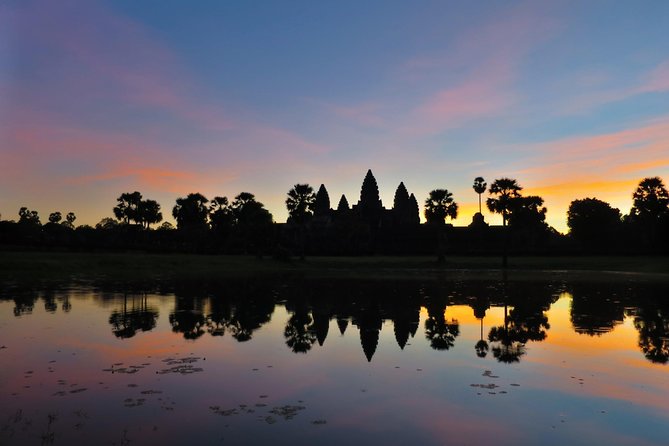
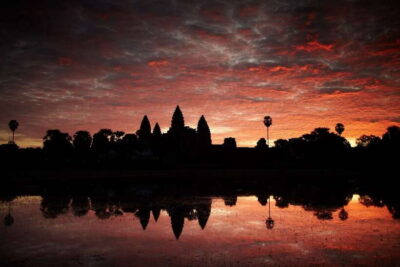
Sunrise itself is never guaranteed to produce a perfect sky. Clouds, haze, and the season shape the view. Still, Angkor Wat at first light gives you a strong start because you see the temple change from a dark silhouette to a detailed monument.
More Angkor Wat Tours in Siem Reap:
- Angkor Wat Sunrise or Sunset Tour with Guide from Siem Reap
★ 5.0 · 12,109 reviews - Siem Reap: Angkor Wat: Small-Group Sunrise or Sunset Tour
★ 5.0 · 9,444 reviews - Siem Reap: Angkor Wat 2-Day Tour with Sunrise and Sunset
★ 4.9 · 4,429 reviews
Angkor Wat: three hours with the Khmer Empire’s great temple
The first stop lasts about three hours, giving you more than a quick photo stop. Angkor Wat is famous for its towers and reflection pool, but the interior deserves equal attention. Your guide can point out the corridors, galleries, carvings, and the way the temple’s design expresses Khmer religious ideas.
This is where guide quality matters most. A good guide does not simply name buildings. Guides such as Sok and Pi have been praised for explaining the social, political, economic, and spiritual life connected to Angkor. Bun is also noted for mixing temple history with stories about living in Cambodia, while Sokpee brings particular insight into religion from his earlier life as a monk.
That broader setting helps you read the stones. Angkor Wat is not just an old temple with attractive carvings. It was part of the Khmer Empire’s royal and religious world, and its scale makes more sense when your guide explains how the temple related to power, belief, and the ancient capitals around it.
The early arrival also affects your comfort. You avoid the worst of the afternoon heat at the day’s largest site, though you still need to walk on uneven surfaces and remain alert in low light. Comfortable walking shoes are essential, and you should not expect a slow, seated sightseeing experience.
One practical point: the entry pass is not included. You pay $37 per person directly at the site, and Visa cards are accepted. The pass can be purchased on the day just before sunrise, so you do not need to arrange it far in advance according to the supplied information.
South Gate and Angkor Thom: entering an ancient capital
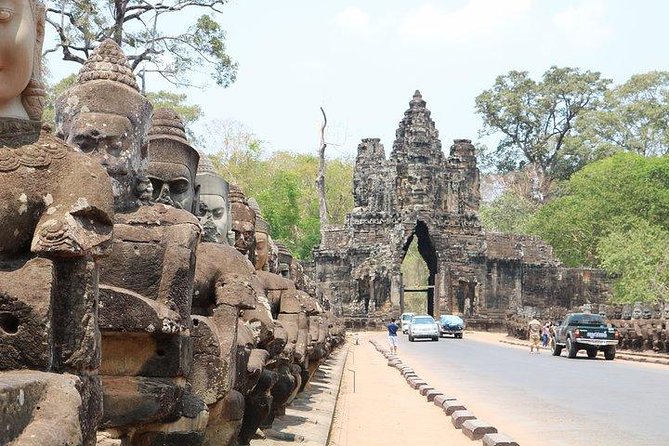
After Angkor Wat, the route continues to Angkor Thom, the vast former capital of the Khmer Empire. The south gate is described as the best-preserved entrance, reached by a causeway about 50 meters across a moat.
The causeway is more than a way into the site. Its stone railings feature 54 figures on each side, creating a symbolic entrance that your guide can help you understand. Take a moment here before rushing through the gate. The scale of the approach gives you a better sense of how grand the capital once was.
Angkor Thom is spread out, so this portion involves more riding between major points and more walking once you arrive. The benefit is variety. You are not seeing one isolated monument, but a planned royal center with ceremonial spaces and temples.
The tour gives roughly two hours to Angkor Thom and Bayon together. That is enough for the key sights, but not enough for every corner of the enormous complex. If you want an exhaustive visit to every structure inside Angkor Thom, this one-day route may feel brisk.
Bayon’s carved faces and the Terrace of the Elephants
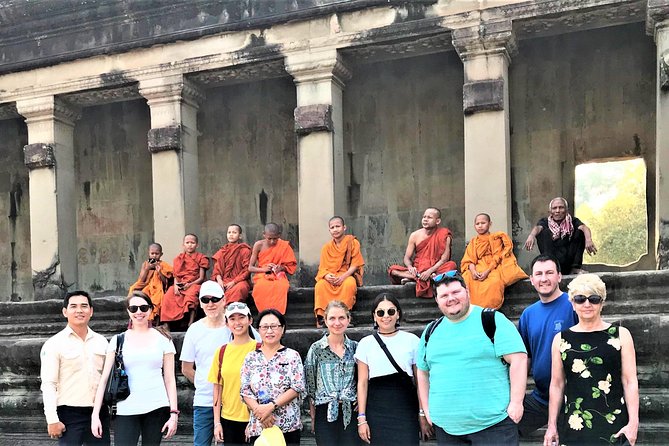
Bayon is the emotional center of the Angkor Thom stop. Its towers carry the famous serene faces, which appear from different angles as you move around the temple. In the changing morning light, the faces can look calm, watchful, or almost mysterious.
A guide can make the crowded stonework easier to understand. Bayon is not an easy temple to read alone. Towers, galleries, passages, and bas reliefs overlap in a way that can feel confusing without some direction. Your guide can also connect the temple to the former capital rather than treating it as a separate attraction.
The Terrace of the Elephants adds a different kind of experience. This 350-meter-long platform served as a giant reviewing stand for public ceremonies and as a base for the king’s audience hall. Its elephant carvings and projecting sections make more sense when you understand that this was a place of royal display.
I like this contrast: Bayon gives you intimate carved faces and tight stone spaces, while the terrace opens onto the grand ceremonial scale of Angkor Thom. You get both the sacred and public sides of the old capital in a short time.
More Angkor Wat Sunrise Tours in Siem Reap:
- Angkor Wat Sunrise tour with Small – Group and Guide tours
★ 5.0 · 3,655 reviews - Full-Day Angkor Wat Sunrise Private Tour with Guide from Siem Reap
★ 5.0 · 2,920 reviews - Angkor Wat Sunrise & 3 Main Temples with Breakfast – Small Group
★ 5.0 · 2,857 reviews - Siem Reap: Angkor Wat Sunrise and Full-Day Sightseeing Tour
★ 4.9 · 2,828 reviews
Ta Prohm: trees, ruins, and atmosphere
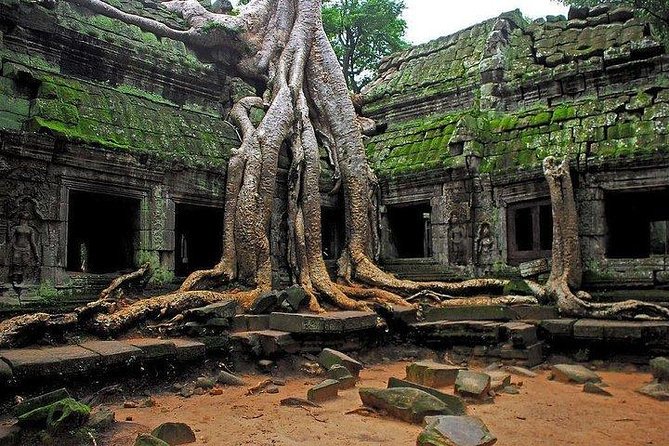
Ta Prohm is the final major temple stop and receives about two hours. It is one of the most atmospheric places in the park because trees grow over walls and roots weave around carved stone. The setting has a powerful visual pull, but the site is more than a backdrop for photographs.
Ta Prohm was once home to 2,740 monks. Today, its partly collapsed buildings and tree-covered galleries show how the temple looked when French explorer Henri Mouhot encountered it in the early 1850s. That comparison gives the ruins a human time scale. This is not simply a place abandoned last year or last century. It has been changing for generations.
Your guide can also point out details that are easy to miss. One example from the tour experience is the echo in one of the buildings, made by leaning against a wall and tapping your chest. Small moments like this can bring the site to life more effectively than a long lecture.
Ta Prohm is also where the route can feel most crowded or physically awkward, though no fixed crowd level is provided. Tree roots, uneven stones, and narrow passages require care. Wear shoes with good support, keep your hands free where possible, and give yourself time to look instead of trying to photograph every opening.
What the private format changes
This is described as a private activity, so only your group participates. That matters at a site as large and busy as Angkor. You can ask questions as they occur, hear the guide clearly, and move without waiting for a large group to gather.
The private format does not mean the day is completely flexible. The listed route is built around sunrise and the main temples, and the total duration is about eight hours. Still, a small party makes the experience calmer than standing among a large cluster of people.
Several guides receive particular praise for their personal approach. Nimol is noted for taking photographs and helping position couples for memorable pictures. Samnang is described as prompt, professional, engaging, and willing to create a fun photo session. Minamol also helped with photographs while adding context about Cambodian life.
Those details are useful if photography matters to you. You should still ask your guide what is possible on the day, but the service clearly goes beyond driving from temple to temple. Guides such as Setha, Pi, Bunpheng, and Horn are also praised for clear explanations, friendly manner, and strong English.
The vehicle, heat, and small comforts
Hotel pickup and drop-off are included, along with an air-conditioned vehicle. That is important in Siem Reap, where a full day of temple walking can be tiring even before the temperature climbs.
Bottled water and a cool towel are provided. Several guides and drivers are specifically praised for keeping water available and offering cold cloths when groups return to the vehicle. You should still dress lightly while meeting the temple rules and carry any personal needs you have for an eight-hour outing.
The tour does not include food or other beverages. Your hotel breakfast pack is the best arrangement if your accommodation offers breakfast. Since the first stop begins in darkness and the route continues for most of the day, do not assume you will have a leisurely café break built into the schedule.
Price, temple pass, and overall value
The tour costs $26 per person. The separate temple pass costs $37 per person, bringing the basic combined expense to $63 before food or additional drinks. That distinction is easy to miss, so include the pass when comparing this tour with other Angkor options.
At $26, the tour portion offers practical value if you want a guide, transport, and a carefully timed sunrise visit without arranging each piece yourself. The air-conditioned vehicle is especially useful because the route lasts about eight hours and includes several walking-heavy stops.
You are also paying for interpretation. Angkor can be beautiful without a guide, but the political, spiritual, and social context helps explain why the temples look and function as they do. The strongest guide experiences described here include Cambodia-specific stories, religious knowledge, temple details, and help with photos.
The value is less clear if you already have transport, a temple pass, and strong knowledge of Angkor. In that case, the main reason to book is the early timing and the guide’s service rather than simple transportation.
Who should book this sunrise tour
I would recommend this experience to a first-time visitor who wants the major Angkor sights in one day. You get the park’s most recognizable places without having to plan the dawn departure, route, entry process, and transport yourself.
It also suits couples and small private groups. The guides may help with photographs, and the private setup lets you enjoy the temples without being folded into a large party.
This tour is a good fit if you want history explained in plain terms and also want insight into present-day Cambodia. Several guides are noted for discussing Cambodian life, religion, and culture alongside the monuments.
You should think twice if you dislike early mornings, have difficulty with extensive walking, or want long stretches of quiet time at each temple. The schedule covers a lot of ground, and the first pickup can be as early as 4:30am.
Dress carefully. Shoulders and knees must be covered, and a scarf used alone to cover the shoulders is not accepted. Pack comfortable shoes, bring any breakfast arranged by your hotel, and remember that the $37 pass is extra.
Should you book it?
Book this tour if you want a well-organized first day at Angkor with sunrise, a private vehicle, and a licensed English-speaking guide. Its strongest points are the early eastern entrance into Angkor Wat, the complete route through Bayon and Ta Prohm, and the personal service offered by guides such as Pi, Bun, Setha, Nimol, and Sokpee.
Skip it if you want to explore at your own unstructured pace or if a 4:30am start sounds miserable. For most first-time visitors, though, the $26 tour price is reasonable once you understand the separate $37 temple pass. Free cancellation is available up to 24 hours before the start time, which gives you some useful flexibility when planning.
FAQ
What time does the Angkor Wat Sunrise Tour start?
Pickup begins at about 4:30 to 4:45am, depending on the time of year.
How long does the tour last?
The full experience lasts approximately eight hours.
Which temples and sites does the tour visit?
The route includes Angkor Wat, the south gate of Angkor Thom, Bayon Temple, the Terrace of the Elephants, and Ta Prohm Temple.
Is the Angkor temple pass included?
No. The temple pass costs $37 per person and must be paid directly to the site. Visa cards are accepted, and the pass can be purchased on the day just before sunrise.
What is included in the tour price?
The price includes a licensed English-speaking guide, an air-conditioned vehicle, bottled water, a cool towel, and hotel pickup and drop-off.
What should I wear?
You must cover your shoulders and knees. A scarf alone is not accepted as shoulder coverage. Comfortable walking shoes are recommended.
Is this a private tour?
Yes. Only your group participates in the activity.
More Morning in Siem Reap
- Angkor Wat Highlights and Sunrise Guided Tour from Siem Reap
★ 5.0 · 3,213 reviews - Angkor 2-Day Sunset & Sunrise Small-Group Tour
★ 5.0 · 2,567 reviews - Siem Reap: Angkor Wat Sunrise or Sunset Guided Tour
★ 4.9 · 2,123 reviews - Angkor Wat: Highlights and Sunrise Guided Tour
★ 4.9 · 1,586 reviews
Just added around Siem Reap
- Ultimate Sunrise to Angkor Wat, Angkor Thom and Bayon Temple★ 5.0 · 3 reviews
- Twilight Tastes of Siem Reap Include Dinner★ 5.0 · 13 reviews
- Trekking Tour at Phnom Kulen National Park from Siem Reap★ 5.0 · 3 reviews
- Full-Day Private Tour of Angkor Wat with Pick Up★ 5.0 · 12 reviews
- Waterfall & River of 1000 Siva Linga- Kulen Mountain Private Tour★ 5.0 · 3 reviews
- Professional Photo Shoot in Angkor Archaeological Park, Siem Reap★ 5.0 · 42 reviews
- Private Day Trip to Angkor Temples with Expert Guide★ 5.0 · 4 reviews
- Ultimate Siem Reap Food Tour by Tuk Tuk – 20 Tastings, 8 Stops★ 5.0 · 13 reviews
Angkor Wat Sunrise Tours, compared.

Angkor Wat Sunrise or Sunset Tour with Guide from Siem Reap
Read our review →
Angkor Wat Sunrise tour with Small – Group and Guide tours
Read our review →
Full-Day Angkor Wat Sunrise Private Tour with Guide from Siem Reap
Read our review →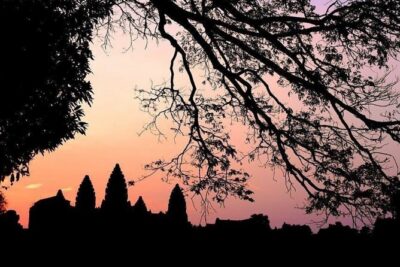
Angkor Wat Sunrise & 3 Main Temples with Breakfast – Small Group
Read our review →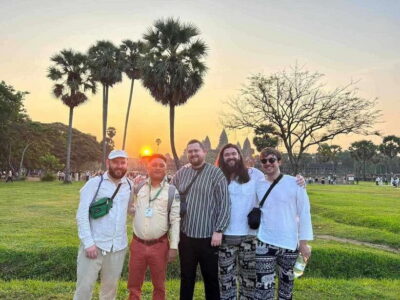
Angkor Wat Sunrise and Full-Day Sightseeing Tour
Read our review →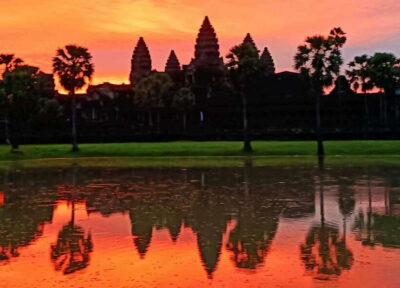
Angkor Sunrise 1- or 2-Day Guided Temples Tour
Read our review →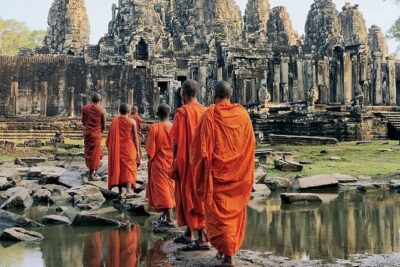
Siem Reap Tour: Angkor Wat Sunrise, Bayon, Ta Prohm, Banteay Srei
Read our review →Browse the lists this tour appears in