
Reviewed · ANGKOR WAT SUNRISE TOURS
1 Day | Angkor Wat Sunrise with Small Tour
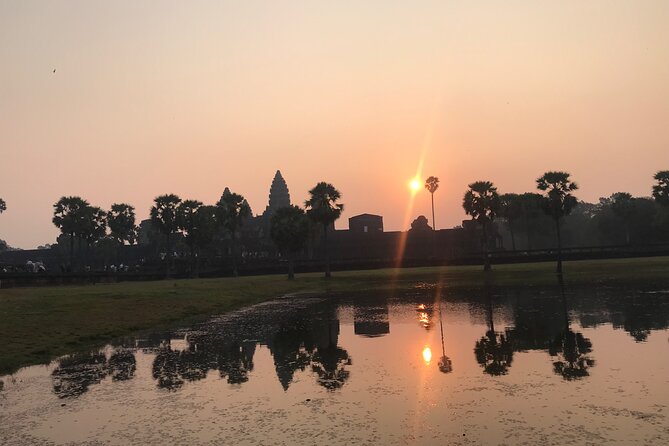
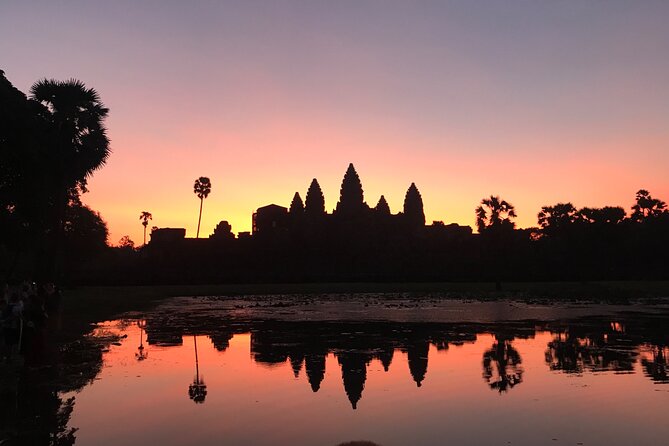
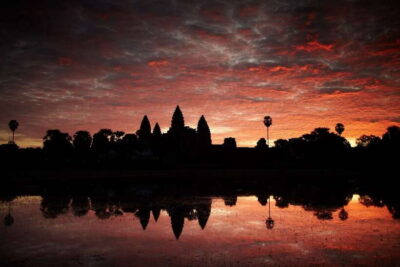
Angkor Wat before breakfast is the main event here. You leave your hotel at 4:30 AM, claim a place near the reflection pool, and watch the sky brighten behind the temple’s famous towers. On the spring and autumn equinoxes, the sunrise alignment can be especially striking, though clouds always get the final vote.
I like the private air-conditioned vehicle, which keeps the early start comfortable and lets your group move at its own pace. I also like the guide service. Hok, the guide named in the tour details and guest feedback, is praised for patient care, strong explanations, photography skills, and attention to safety. The drawback is simple: this is a very early morning, and the $66 price does not include the $37 Angkor temple pass.
Key points at a glance
- 4:30 AM hotel pickup: You reach Angkor Wat before the day heats up and before the main temple visits begin.
- Private experience: Only your own group joins the activity, despite the small-tour wording.
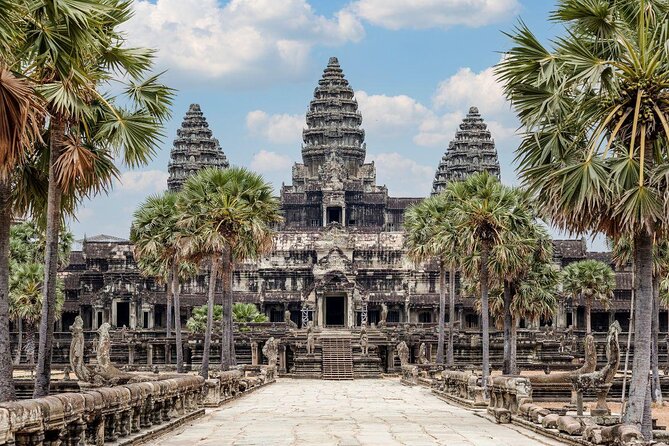
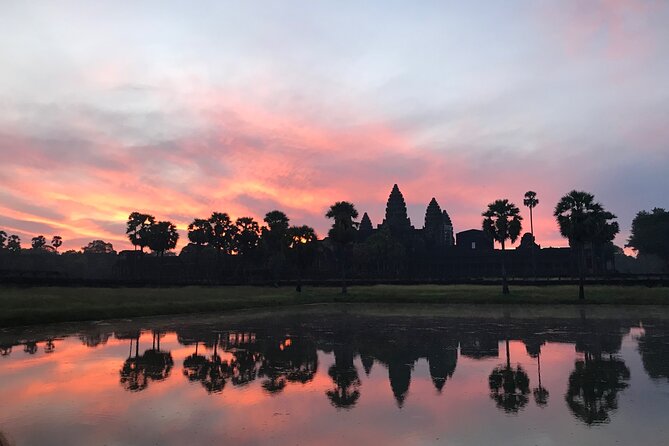
- Reflection-pool sunrise: The classic view places Angkor Wat’s towers against the changing morning sky and water.
- Four major temple stops: You see Angkor Wat, Angkor Thom, Bayon, and Ta Prohm in about six hours.
- Hok may guide your visit: He is praised for patient service, clear history explanations, safety checks, and photography.
- Extra temple pass cost: The listed price is $66 per person, but the Angkor pass costs another $37 per person.
Why the 4:30 AM start matters
The early pickup is not a gimmick. Angkor Wat is Cambodia’s most popular sunrise stop, and arriving early gives you time to reach the reflection pool before the main temple visit begins.
You should expect darkness at the start. The reward comes slowly: first the outline of the towers, then the color behind them, then the full shape of the monument as the light strengthens. The reflection pool creates the classic composition, but the exact view depends on water conditions, weather, and how many people are gathered there.
The equinox sunrise is the special astronomical event connected with Angkor Wat. It occurs twice each year, during the spring and autumn equinoxes, when the sun appears aligned with the temple towers. The temple’s careful orientation to the cardinal points is part of what makes the site so impressive. Still, do not book this tour expecting a guaranteed glowing sky. Sunrise photography always depends on clouds and haze.
After the sunrise, the guide takes you into the main building and around the wider complex. This order works well. You see the temple first as a silhouette and postcard view, then get time to examine the stonework, galleries, towers, and religious design with the morning light improving.
More Angkor Wat Tours in Siem Reap:
- Angkor Wat Sunrise or Sunset Tour with Guide from Siem Reap
★ 5.0 · 12,109 reviews - Siem Reap: Angkor Wat: Small-Group Sunrise or Sunset Tour
★ 5.0 · 9,444 reviews - Siem Reap: Angkor Wat 2-Day Tour with Sunrise and Sunset
★ 4.9 · 4,429 reviews
Angkor Wat: more than a sunrise photograph
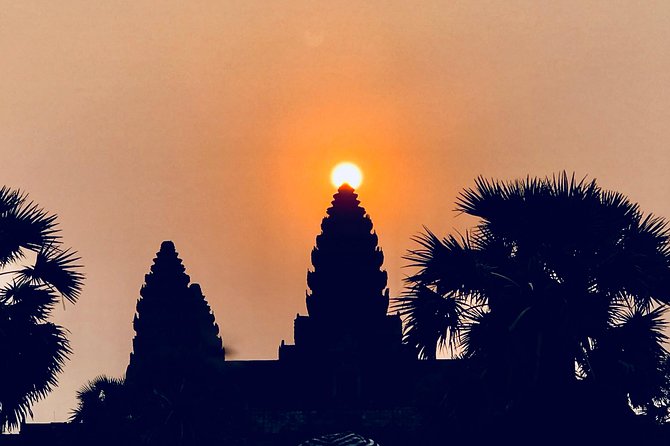
Angkor Wat is the largest religious monument in the world and one of the best-preserved major temples in the Angkor area. Its scale can be hard to grasp from the reflection pool. The towers are the part you recognize, but the larger experience is the long approach, the enormous layout, and the carefully ordered architecture.
The temple is aligned with the cardinal points, a detail that adds meaning to the sunrise beyond simple scenery. Its design reflects Khmer engineering and Hindu influence, with a strong sense of balance and order. Your guide’s role matters here because a quick photo stop can make Angkor Wat feel like a backdrop. A good explanation helps you see why the alignment, towers, galleries, and central structure were planned as one sacred setting.
The scheduled visit lasts about two hours. That gives you more than a brief look, though the time also includes the sunrise period. If you want a slow study of every carving or a long photography session, six hours for the whole outing may feel tight.
The included water and cool towels are useful at this point, especially once the sun rises. Local snacks are also included, giving you a small lift after the early start. Accommodation is not included, but pickup is offered from your hotel.
Angkor Thom and the road to Bayon
After Angkor Wat, the tour moves to Angkor Thom, the fortified capital of the Khmer Empire. The name means Great City, and the scale of the old urban center gives you a useful contrast with Angkor Wat’s single monumental temple.
The city has gates aligned with the cardinal directions. Each gate is decorated with large figures of gods and demons, presenting a symbolic struggle between opposing forces. These entrances help you understand that Angkor Thom was not just a collection of temples. It was a planned capital with walls, gates, sanctuaries, and royal buildings.
The listed visit to Angkor Thom is about 30 minutes. That is enough for an introduction and a look at the monumental approach, but it is not a full exploration of every part of the ancient city. You should treat this as a bridge to Bayon rather than the main stop.
The short timing is one reason the guide’s explanations are valuable. You need help connecting the gate statues, city plan, royal center, and religious buildings without losing time. If you prefer a leisurely archaeological tour, ask about the pace before booking.
Bayon’s smiling stone faces
Bayon sits at the heart of Angkor Thom and is the central temple stop inside the old capital. Its most famous feature is the repeated set of large smiling faces carved into the towers. As you move closer, the faces seem to appear from different angles, giving the temple a more personal and mysterious mood than the broad symmetry of Angkor Wat.
The temple is linked with King Jayavarman VII and reflects both Hindu and Buddhist influences. The period is important because the temple’s art and religious ideas do not fit neatly into one narrow category. Your guide can help explain how the site reflects the mixture of beliefs and political ideas under the king.
The visit lasts about 45 minutes. That is a sensible amount of time for the main faces, the narrow spaces, and the overall structure. Bayon can feel confusing at first because towers, corridors, and carved faces overlap. A guide who knows the layout can save you from simply wandering through stone passages without understanding what you are seeing.
The site also rewards patience. The famous faces are easy to photograph, but the best part is noticing how they change as you walk. Light and shadow can make one face seem calm and another more watchful. You do not need a long lecture to enjoy Bayon, but clear historical context makes the stop much more memorable.
More Angkor Wat Sunrise Tours in Siem Reap:
- Angkor Wat Sunrise tour with Small – Group and Guide tours
★ 5.0 · 3,655 reviews - Full-Day Angkor Wat Sunrise Private Tour with Guide from Siem Reap
★ 5.0 · 2,920 reviews - Angkor Wat Sunrise & 3 Main Temples with Breakfast – Small Group
★ 5.0 · 2,857 reviews - Siem Reap: Angkor Wat Sunrise and Full-Day Sightseeing Tour
★ 4.9 · 2,828 reviews
Ta Prohm and the trees over the ruins
Ta Prohm is the final major temple stop and lasts about one hour. It is the temple most closely associated with jungle-covered ruins and the film Tomb Raider. Its original name was Rajavihara, meaning Royal Monastery, and it was built by King Jayavarman VII in 1186 for his mother.
The temple was dedicated to Prajnaparamita, a Buddhist figure connected with wisdom and mercy. The name Ta Prohm means Brahma God. Those details give the site more substance than its film connection alone.
The roots and trees around the ruins are the main visual draw. Stone walls, doorways, and roots press against one another, creating a setting that feels less controlled than Angkor Wat. You can see how nature has become part of the way the temple is experienced, even though the site remains a constructed religious complex.
Ta Prohm is also a practical place to have a guide. The famous tree-covered views tend to attract attention, but the temple has a wider story involving royal devotion, Buddhism, and the role of a monastery. With one hour, you can see the principal areas without turning the whole morning into a race.
The film connection may bring you here, but it should not define the visit. Ta Prohm is best understood as a working part of the Angkor religious world that later became famous on screen. The roots are memorable, but the carved stone and original purpose are just as important.
A private vehicle and a personal guide
The tour includes a private air-conditioned vehicle, a senior English-speaking guide, cool water, towels, and local snacks. Since only your group participates, you are not placed into a large shared coach with strangers. That makes the early start easier to manage and gives you a better chance to ask questions.
The private setup is especially useful if your group has different energy levels. You can discuss the pace with the guide, although the published schedule still covers four stops in roughly six hours. The vehicle also matters in Siem Reap’s heat. After walking through large temple areas, air conditioning and water are practical comforts, not fancy extras.
The guide named most clearly in the supplied information is Hok, also identified as Heng Seng Hok. His strongest qualities are patience, kindness, safety checks, and care for personal needs. He is also described as a professional photographer, so you may be able to ask for help with framing and photos. Because guides can vary by date, confirm the assigned guide if Hok is important to your decision.
The tour is described as suitable for most people and located near public transportation. No special fitness requirement is stated. Even so, you should be ready for an early start, walking around large temple grounds, and uneven historic surfaces. That is practical preparation rather than a formal restriction.
Is $66 a good value?
The listed price is $66 per person. That covers the private vehicle, senior English-speaking guide, water, towels, and snacks. The Angkor temple pass costs an additional $37 per person, bringing the known total to $103 per person before any other personal expenses.
That is not the cheapest way to see Angkor Wat, but the price buys more than transport. You are paying for a private outing, a guide who can explain the temples, and a planned route covering four major sites in one morning. For a first visit, that structure has real value because the complex is large and the history can be hard to organize on your own.
The value is strongest for couples, families, and small groups that want direct attention. A group discount is offered, though the exact amount is not provided. If you are traveling alone, the per-person cost may feel high once the temple pass is added.
The six-hour duration also makes the cost easier to judge. You are not paying for a full-day program, but you do get the most important sunrise view and three major follow-up stops. If you want additional temples or a full afternoon, you will need another arrangement.
Who should book this sunrise tour?
I would consider this tour a good match for a first visit to Angkor Wat, especially if you want someone else to handle the early transport and temple sequence. The private format suits families and groups who value flexibility and personal attention.
It is also a good fit if you care about photographs. The reflection pool, Angkor Wat towers, Bayon faces, and Ta Prohm roots give you four very different subjects in one morning. A guide with photography experience can be useful, particularly before the light becomes harsh.
Parents arranging the visit for older family members may appreciate the personal care described for Hok’s guiding style. The guide is praised for checking on comfort and safety, which is important during a pre-dawn start and a long morning of walking.
You may want a different plan if you dislike early mornings, want a slow and highly detailed study of every temple, or prefer to avoid the extra pass cost. The tour is efficient, but efficiency means some stops are brief. Angkor Thom, in particular, receives only about 30 minutes.
The weather policy also matters. The experience requires good weather. If poor weather forces cancellation, you are offered another date or a full refund. You can cancel for a full refund up to 24 hours before the start time, but changes or cancellations inside that window are not accepted.
Should you book it?
Book this tour if you want the classic Angkor Wat sunrise, private transport, and a guide-led morning that also includes Bayon and Ta Prohm. The combination gives you the essential visual highlights without making you plan every transfer yourself.
Before paying, budget for the separate $37 temple pass and confirm the pickup details and guide assignment. If you can handle a 4:30 AM departure and accept a brisk six-hour route, this is a practical, well-focused introduction to Angkor. If you want a slower temple study, use this as a starting point and arrange more time on a second day.
FAQ
What time does the tour begin?
The tour begins with hotel pickup at 4:30 AM.
How long does the experience last?
The experience lasts approximately six hours.
Is the Angkor temple pass included?
No. The Angkor Temple Pass costs $37 per person and is not included in the tour price.
Is this a private tour?
Yes. Only your own group participates in the activity.
What is included in the tour price?
The price includes a private air-conditioned vehicle, a senior English-speaking guide, cool water, towels, and local snacks.
Which temples are visited?
The route includes Angkor Wat, Angkor Thom, Bayon Temple, and Ta Prohm.
What happens if the weather is poor?
The experience requires good weather. If it is canceled because of poor weather, you are offered a different date or a full refund.
More 1-Day Tours in Siem Reap
- 1-Day Amazing Angkor Wat Tour with Sunset & All Interesting Major Temples
★ 5.0 · 308 reviews - Angkor Wat one Day Private Tour for All Highlight Angkor Temples
★ 5.0 · 199 reviews - 1-Day private Angkor Temple Tour from Siem Reap
★ 4.9 · 178 reviews - 1-Day Angkor Wat Sunrise & All Interesting Temples Private Tour
★ 5.0 · 174 reviews
More Morning in Siem Reap
- Angkor Wat Highlights and Sunrise Guided Tour from Siem Reap
★ 5.0 · 3,213 reviews - Angkor 2-Day Sunset & Sunrise Small-Group Tour
★ 5.0 · 2,567 reviews - Siem Reap: Angkor Wat Sunrise or Sunset Guided Tour
★ 4.9 · 2,123 reviews - Angkor Wat: Highlights and Sunrise Guided Tour
★ 4.9 · 1,586 reviews
Just added around Siem Reap
- Ultimate Sunrise to Angkor Wat, Angkor Thom and Bayon Temple★ 5.0 · 3 reviews
- Twilight Tastes of Siem Reap Include Dinner★ 5.0 · 13 reviews
- Trekking Tour at Phnom Kulen National Park from Siem Reap★ 5.0 · 3 reviews
- Full-Day Private Tour of Angkor Wat with Pick Up★ 5.0 · 12 reviews
- Private Day Trip to Angkor Temples with Expert Guide★ 5.0 · 4 reviews
- Waterfall & River of 1000 Siva Linga- Kulen Mountain Private Tour★ 5.0 · 3 reviews
- Professional Photo Shoot in Angkor Archaeological Park, Siem Reap★ 5.0 · 42 reviews
- Ultimate Siem Reap Food Tour by Tuk Tuk – 20 Tastings, 8 Stops★ 5.0 · 13 reviews
Angkor Wat Sunrise Tours, compared.

Angkor Wat Sunrise or Sunset Tour with Guide from Siem Reap
Read our review →
Angkor Wat Sunrise tour with Small – Group and Guide tours
Read our review →
Full-Day Angkor Wat Sunrise Private Tour with Guide from Siem Reap
Read our review →
Angkor Wat Sunrise & 3 Main Temples with Breakfast – Small Group
Read our review →
Angkor Wat Sunrise and Full-Day Sightseeing Tour
Read our review →
Angkor Sunrise 1- or 2-Day Guided Temples Tour
Read our review →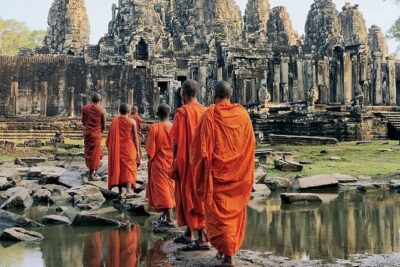
Siem Reap Tour: Angkor Wat Sunrise, Bayon, Ta Prohm, Banteay Srei
Read our review →Browse the lists this tour appears in