
Reviewed · ANGKOR WAT TOURS
Private Day Angkor Wat Temple and Banteay Srei Temple Tour
Angkor Wat is only the headline here. This private day also takes you to Banteay Srei’s fine pink sandstone carvings, the tree-covered ruins of Ta Prohm, and the huge stone faces of Bayon. You get a full circuit of Angkor’s major sights without being tied to a large group’s pace.
I especially like the private format and the chance to shape the day with your guide. Chanra has been praised for clear WhatsApp communication and for adding useful suggestions to a custom plan. I also like that the tour includes an air-conditioned vehicle, cold water, and towels, which matter during eight and a half hours in Cambodia’s heat.
The main catch is cost: the $43 tour price does not include the one-day temple pass, which adds $37 per person. You should also expect a lot of walking, stairs, and uneven stone surfaces, even though the guide may be able to arrange closer vehicle access or other help when needed.
Key points to know before booking
- Four major Angkor highlights in one day: Ta Prohm, Banteay Srei, Bayon, and Angkor Wat anchor a packed route through the temple complex.
- Private touring gives you control: You can discuss priorities with the guide instead of following a fixed large-group schedule.
- Chanra handles communication well: WhatsApp contact makes it easier to discuss what you want to see before the day begins.
- The total basic cost is $80 per person: That combines the $43 tour price with the $37 one-day temple pass.
- The day involves serious walking: Baphuon, Phimeanakas, terraces, and Angkor Wat all add distance and stone steps.
- Useful comfort touches are included: Air conditioning, parking and road tolls, cool water, and towels are covered.
What the $43 price really buys you
At $43 per person, this is not an admission-inclusive Angkor package. Add the required one-day pass of $37, and the basic total reaches $80 per person.
That price pays for a private experience rather than a seat on a shared bus. You receive an air-conditioned vehicle, an English-speaking guide, parking fees, road tolls, water, towels, and pickup and drop-off at the airport. Group discounts are offered, although the exact saving is not specified.
I see the value in this setup if you care about comfort and control. You are covering a large area, including Banteay Srei, which sits well away from the central Angkor group. A private vehicle saves time between sites and gives you somewhere cool to recover between long walks.
The price is less attractive if you only want Angkor Wat and one nearby temple. In that case, a shorter outing may suit you better. This tour is designed for someone who wants a broad first look at the area in one long day.
The booking pattern, with reservations often made around 81 days ahead, suggests that you should not leave planning until the last minute if your dates are fixed. Confirmation comes at booking, and free cancellation is available until 24 hours before the start time. Changes or cancellations inside that 24-hour window are not accepted for a refund.
More Angkor Wat Tours in Siem Reap:
- Angkor Wat Sunrise or Sunset Tour with Guide from Siem Reap
★ 5.0 · 12,109 reviews - Siem Reap: Angkor Wat: Small-Group Sunrise or Sunset Tour
★ 5.0 · 9,444 reviews - Siem Reap: Angkor Wat 2-Day Tour with Sunrise and Sunset
★ 4.9 · 4,429 reviews
Ta Prohm begins the day among tree roots
Ta Prohm is a strong opening stop because it feels unlike the broad, formal spaces at Angkor Wat. Its original name was Rajavihara, or monastery of the King, and it was built in 1186 as a Mahayana Buddhist monastery and university.
The temple is set amid jungle growth, with large roots running over walls and through the remains of the structure. The appeal is not simply that trees have grown beside old stone. The roots and ruins now form one memorable scene, showing how quickly nature can press into abandoned buildings.
You have about an hour here. That gives you time to look beyond the most photographed corners, though the day’s full schedule means your guide will need to keep an eye on the clock.
Ta Prohm is also one of the more demanding stops underfoot. Broken paving, narrow passages, and uneven ground are part of the experience. Wear shoes with a firm sole, and do not treat this as a quick photo stop. The carvings and layout reward patient looking.
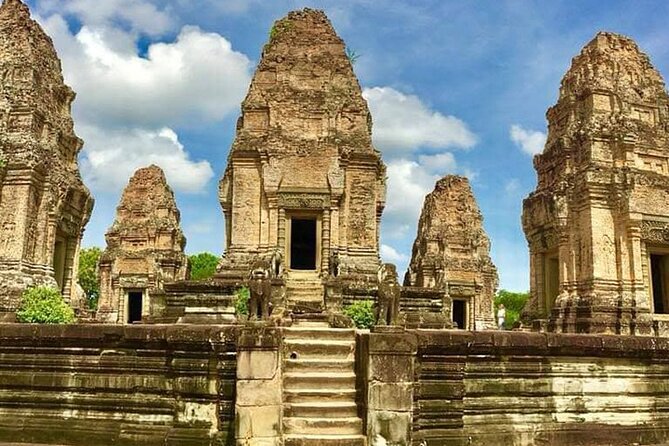
Pre Rup offers a short, high stone stop
Pre Rup receives only 20 minutes, so this is a brief visit rather than a full exploration. King Rajendravarman built it as a state temple in 961 or 962, nine years after East Mebon, which lies about 1.3 kilometers north.
Its name and design are linked with a funerary function, and the temple has the strong brick-and-stone form often associated with older Angkor monuments. The raised structure gives you a different sense of scale from Ta Prohm’s enclosed corridors.
Twenty minutes is enough to get a look at the main form and hear the basic story. It is not enough for a slow study of every detail. If Pre Rup matters greatly to you, mention that to the guide when planning the day, although the listed schedule leaves limited room for extra time.
Banteay Srei rewards close attention
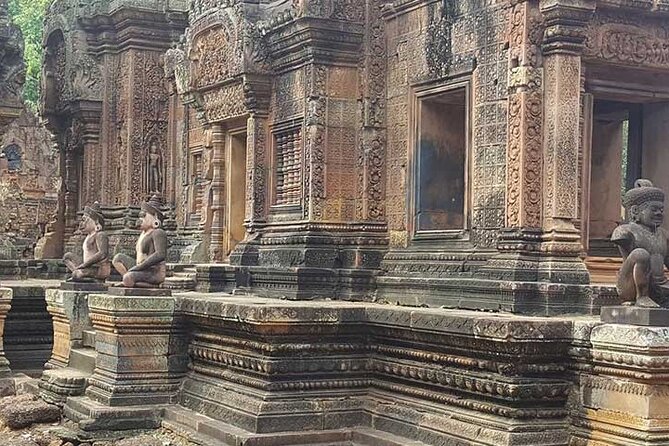
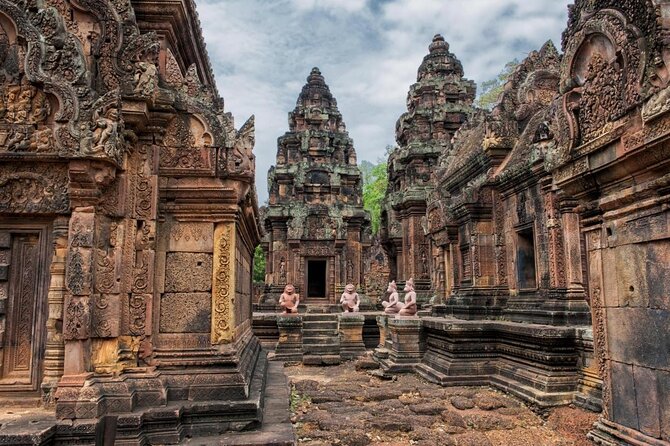
Banteay Srei is one of the best reasons to choose this route. The 10th-century Hindu temple is dedicated to Shiva and sits near Phnom Dei, about 25 kilometers northeast of the main Angkor area.
It is smaller than Angkor Wat, Bayon, or Baphuon, but its scale is part of its charm. The pink sandstone carries especially fine carvings, including motifs and figures of gods. You can stand close to the walls and see details that would be easy to miss on a much larger monument.
The name is often translated as Temple of Women, and it is also called the Pink Ladies Temple. The nickname points to its color and delicate carving, not to a separate style of temple visit.
You have one hour here. That is a useful amount of time for a focused visit, but the extra drive makes the day feel full. I would choose Banteay Srei if you value artistry and detailed stonework more than simply collecting another large ruin.
Because the tour is private, you can ask the guide to explain particular carvings or adjust the emphasis. Chanra has been praised for discussing plans through WhatsApp and adding suggestions, so this is the right point in the itinerary to make your interests clear.
More Banteay Srei Tours in Siem Reap:
- Full-Day Banteay Srei & 4 Temples – Grand Tours Join-in Tour
★ 5.0 · 1,155 reviews - Siem Reap Tour: Angkor Wat Sunrise, Bayon, Ta Prohm, Banteay Srei
★ 5.0 · 931 reviews - 2-Day Angkor Wat With Small, Big Circuit and Banteay Srei Tour
★ 5.0 · 545 reviews - From Siem Reap: Banteay Srei Temple & Grand 5 Temple Tour
★ 4.8 · 262 reviews
Angkor Thom begins at the South Gate
The South Gate gives you a grand approach to Angkor Thom. A causeway crosses a moat about 100 meters wide, with naga balustrades lining both sides. Massive stone figures frame the entrance and make the arrival feel ceremonial.
You have 20 minutes here. That is enough to pause at the causeway, examine the gate, and take in the scale before moving toward the monuments inside Angkor Thom.
This stop works best as an introduction to the city rather than a full monument visit. You will see more of the wider complex later, especially at Bayon, Baphuon, Phimeanakas, and the royal terraces.
Bayon is Angkor Thom’s unforgettable face
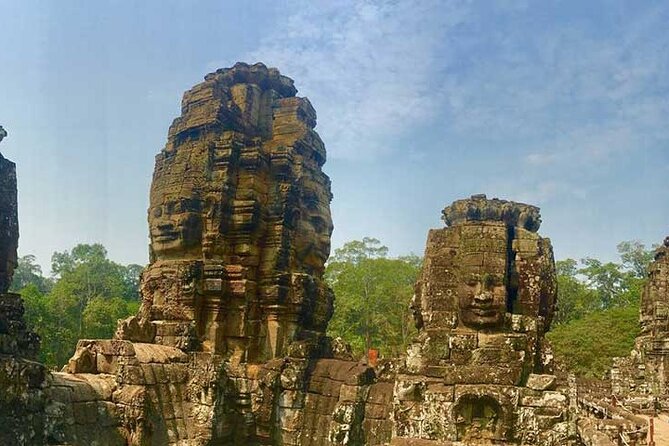
Bayon is the emotional center of the Angkor Thom portion of the day. Its towers carry enormous carved faces, with 173 still remaining. Their identity remains debated, while local Khmer tradition connects them with the four faces of Prohm.
The faces appear from different angles as you move through the temple. That changing view is what makes Bayon more than a single grand facade. You look up, turn a corner, and meet another calm expression above the galleries.
The schedule allows 50 minutes. Use it wisely. Spend time in the galleries as well as outside, since the bas-reliefs and enclosed passages help explain how the temple was arranged.
Bayon can feel confusing without guidance. Its towers, corridors, and levels do not present themselves in a simple straight line. An English-speaking guide adds real value here by giving you a basic plan and pointing out what deserves your attention.
Baphuon brings steep climbs and a giant scale
Baphuon was the state temple of King Udayadityavarman II. It sits inside Angkor Thom between the royal enclosure and Bayon, and its sandstone mass gives you a clear sense of Khmer ambition.
The visit lasts about 40 minutes. Expect stairs and uneven stone, with the higher areas offering a stronger view of the temple’s structure. This is one of the stops where the physical side of the day becomes more obvious.
If you have a sore foot, limited balance, or trouble with stairs, say so at the start. One guide has helped a guest using crutches by arranging closer access and alternative transport, including a moped and tuk tuk. That does not mean every arrangement is guaranteed, but it shows why you should explain your needs before setting out.
Phimeanakas sits inside the royal enclosure
Phimeanakas is a smaller temple within the royal enclosure, surrounded by the remains of the royal area. The stop lasts 30 minutes and adds a different kind of interest from Bayon’s faces or Banteay Srei’s carvings.
The value here is the setting. You are not only looking at a temple, but also moving through the space associated with the Khmer royal court. The site has a story tied to the royal enclosure, and the guide can help connect the monument with the surrounding grounds.
Do not expect the same visual impact as Angkor Wat or Bayon. Phimeanakas works as part of the Angkor Thom sequence, giving you context for the city’s ceremonial and royal spaces.
The royal terraces reveal Angkor Thom’s public side
The Terrace of the Elephants runs for more than 300 meters from Baphuon in the south to the Terrace of the Leper King in the north. King Jayavarman VII built it at the end of the 12th century.
You have 30 minutes at the Terrace of the Elephants. Look for the elephant carvings and the long raised platform facing the parade grounds. Its length is the main impression. This was not a private corner, but a formal edge to a large public area.
The Terrace of the Leper King follows for 15 minutes. It forms part of the eastern boundary of the royal palace grounds, beside the Terrace of the Elephants. The shorter stop is enough to see the sculpted walls and understand how the two terraces relate to the royal enclosure.
These stops are less intimate than Ta Prohm and less immediately dramatic than Bayon. They matter because they show Angkor Thom as a planned capital with processions, ceremonies, and royal space, not just a collection of temples scattered in the forest.
Angkor Wat deserves the final three hours
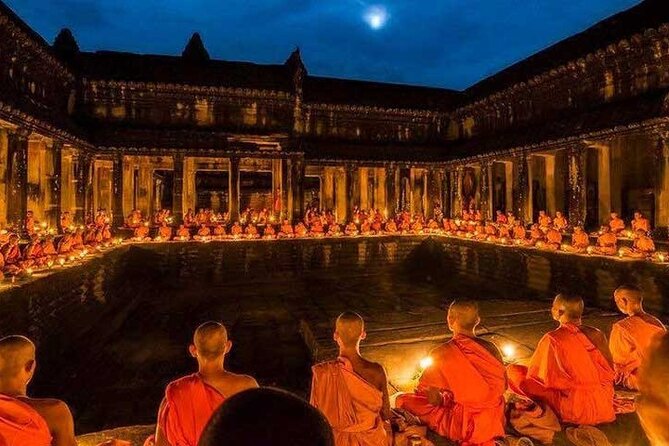
The tour leaves three hours for Angkor Wat, and that is sensible. This is the largest and most famous monument in the complex, with five concentric rectangular walls and moats representing cosmic mountains and ocean.
The central tower represents Mount Meru, the center of the Hindu and Buddhist universe. That design gives the complex a clear religious structure: you move inward through layers toward the central sanctuary.
Three hours allows you to see more than the main approach. You can take in the causeway, galleries, towers, courtyards, carvings, and overall plan without reducing the visit to a quick photograph. It is still a long day, so your energy may be lower by this point. The air-conditioned vehicle and bottled water help, but they cannot replace sensible pacing.
Ask your guide to balance the grand view with small details. Angkor Wat is so large that it is easy to remember only the towers. The carved galleries and the relationship between the moat, walls, and central sanctuary explain why the temple feels like an entire sacred world.
The tour does not include the temple pass, so buy or arrange the $37 one-day admission separately as part of your budget. Every listed temple stop requires admission, and there is no separate attraction fee included in the $43 tour price.
Transport and timing shape the experience
This is an 8-hour-30-minute day, with the listed stops adding up to about 8 hours and 25 minutes. That leaves very little spare time for delays, long meals, or adding extra temples.
The route covers a wide area. Banteay Srei is far from the central Angkor group, while the Angkor Thom stops cluster together. A private air-conditioned vehicle is useful both for the distance and for short periods of rest between monuments.
Parking fees and road tolls are included. Cool water and towels are also supplied, small details that become practical comforts after repeated walks in the heat.
Pickup and drop-off at the airport are included, and pickup is offered. Confirm the exact pickup plan when booking, especially if you are arriving or departing on the same day as the tour.
The experience is private, so only your group participates. That makes it easier to pause for photographs, ask questions, or shorten a stop if someone is tired. It also means the guide’s quality matters more than it would on a large group outing. Chanra is the named guide associated with strong communication and flexible planning, but you should confirm your assigned guide if that matters to you.
Who should choose this temple day
I would recommend this tour to a first-time Angkor visitor who wants the major monuments in one organized day. It suits couples, families, and small groups that prefer their own vehicle and do not want to match the pace of strangers.
It is also a good option if Banteay Srei is high on your list. Many shorter Angkor visits focus only on the central temples, while this route makes room for the smaller temple’s detailed carving.
The tour may also work for someone with limited mobility, but do not assume that every site will be easy. Ta Prohm, Baphuon, and Angkor Wat involve uneven ground or steps. Tell the operator about your needs before the day begins, and ask what closer access or alternative transport can be arranged.
I would hesitate to choose it if you dislike early starts, long temple days, or a tightly timed schedule. The route is full, and each stop has a purpose. You will see a lot, but you will not have unlimited time at every monument.
Small choices that make the day better
Wear shoes that can handle uneven stone. Sandals may be comfortable in the heat, but secure footwear is a safer choice around steps and broken paving.
Carry only what you need. A light bag, water, sun protection, and a phone or camera are easier to manage than a heavy pack during repeated climbs.
Use the private format actively. Tell the guide whether you care most about architecture, religious symbolism, carvings, photography, or royal history. A flexible plan is useful only if you speak up about your priorities.
Keep the admission cost separate in your mental budget. The advertised $43 is for the tour service, not the temples. With the one-day pass, plan on $80 per person before any other personal spending.
Finally, protect your energy for Angkor Wat. Ta Prohm and Angkor Thom come first, and the walking adds up. Take the short breaks in the vehicle, use the cool water, and avoid treating every stop as a race.
Should you book this private Angkor tour?
Book it if you want a private, well-covered first day at Angkor, especially if you want both the major central temples and Banteay Srei. The strongest reasons are the flexible format, air-conditioned transport, long three-hour visit at Angkor Wat, and practical support from the guide.
The total cost is not bargain admission, since the temple pass is extra. Still, the private vehicle, English guide, airport pickup and drop-off, road costs, water, and ability to discuss a custom route make the price fair for a full day.
Choose another plan if you want a slow, highly focused visit to only two or three monuments. Choose this one if you want a broad introduction, appreciate help with logistics, and are ready for a long day on foot.
FAQ
How long does the tour last?
The tour lasts approximately 8 hours and 30 minutes.
What temples and sites are included in the route?
The route includes Ta Prohm, Pre Rup, Banteay Srei, Angkor Thom South Gate, Bayon, Baphuon, Phimeanakas, the Terrace of the Elephants, the Terrace of the Leper King, and Angkor Wat.
Is the temple admission fee included?
No. The one-day temple pass costs $37 per person and is not included in the $43 tour price.
What is included in the tour price?
The price includes an air-conditioned vehicle, an English-speaking guide, parking fees, road tolls, cool water, towels, and pickup and drop-off at the airport.
Is this a private tour?
Yes. Only your group participates in the activity.
Can the tour be customized?
The private format allows you to discuss what you want to see with the guide. Chanra has communicated through WhatsApp and helped customize plans, but confirm your preferences before the tour.
Can I cancel for a full refund?
Yes, if you cancel at least 24 hours before the experience start time. Cancellations or changes made less than 24 hours before the start time are not eligible for a refund.
Just added around Siem Reap
- Ultimate Sunrise to Angkor Wat, Angkor Thom and Bayon Temple★ 5.0 · 3 reviews
- Twilight Tastes of Siem Reap Include Dinner★ 5.0 · 13 reviews
- Trekking Tour at Phnom Kulen National Park from Siem Reap★ 5.0 · 3 reviews
- Full-Day Private Tour of Angkor Wat with Pick Up★ 5.0 · 12 reviews
- Private Day Trip to Angkor Temples with Expert Guide★ 5.0 · 4 reviews
- Waterfall & River of 1000 Siva Linga- Kulen Mountain Private Tour★ 5.0 · 3 reviews
- Professional Photo Shoot in Angkor Archaeological Park, Siem Reap★ 5.0 · 42 reviews
- Siem Reap City Tour with War Museum and Killing Field★ 5.0 · 27 reviews
Angkor Wat Tours, compared.

Angkor Wat Sunrise or Sunset Tour with Guide from Siem Reap
Read our review →
Angkor Wat: Small-Group Sunrise or Sunset Tour
Read our review →
Angkor Wat 2-Day Tour with Sunrise and Sunset
Read our review →

Angkor Wat Sunrise tour with Small – Group and Guide tours
Read our review →
Angkor Wat Highlights and Sunrise Guided Tour from Siem Reap
Read our review →
Angkor Wat Sunset Small Group Tour with Lunch Included
Read our review →
Full-Day Angkor Wat Sunrise Private Tour with Guide from Siem Reap
Read our review →Browse the lists this tour appears in