
Reviewed · MUSEUMS
Chiso temple, Neang khmao, and Taprum temple historical site Tour
Phnom Chisor gives this day its best opening: climb to an 11th-century temple, then look east across rice fields and countryside from the rear terrace. The view also reveals a carefully planned ancient avenue linking temples and a moat. I especially like the mix of big rural views and close-up stone carving, plus the chance to see lesser-visited sites south of Phnom Penh. The main drawback is the long road day, with about eight hours devoted to transport and sightseeing.
I also like that this is a private trip for up to five people, so you can keep the pace within your own group. Guide Soapheak has been singled out for explaining pagoda life and nearby structures in detail. Be aware that the published route names both Ta Prohm and Yeay Pov, while the timed itinerary lists Tonle Bati as the third stop, so confirm the exact final sequence before departure.
Key points before you book
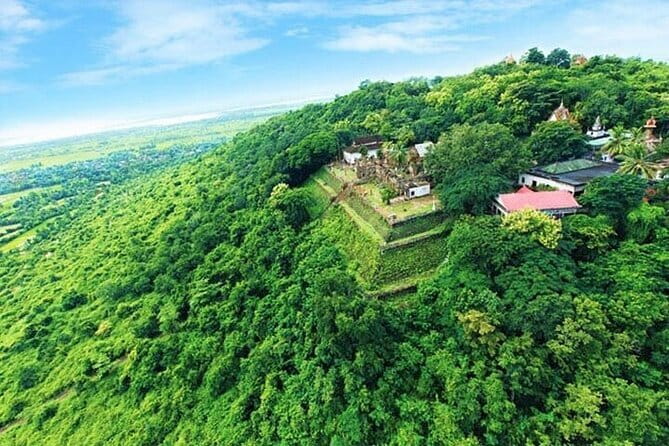
- Phnom Chisor’s hilltop view: See rice fields, countryside, and an ancient eastward axis from behind the temple.
- Neang Khmau’s two brick towers: Visit deteriorating 10th-century prasats beside an active pagoda.
- A smaller Ta Prohm: Expect a temple from the reign of Jayavarman VII, with distinctive art and a quieter scale than Angkor’s famous Ta Prohm.
- Private transport for up to five: Air-conditioning, a driver, cool water, and a guide are included.
- A full day from Phnom Penh: The tour begins at 8 a.m. and lasts about eight hours, returning to the starting point.
- Route detail to confirm: The description includes Yeay Pov, while the timed itinerary includes Tonle Bati.
Why this southern temple day is worth your time
Most visitors in Phnom Penh focus on the capital’s museums and the well-known Killing Fields route. This trip takes you in a different direction, toward older temple sites south of the city and into the countryside around Takeo.
That change matters. You are not spending the day moving between major city attractions. You are seeing temples in smaller settings, including one beside an active pagoda and another reached by a climb to an open view. The sites are not presented as a substitute for Angkor Wat. Their appeal is their scale, setting, and connection to the road network and religious life of southern Cambodia.
The tour costs $190 per private group of up to five people. At the full group size, that works out to $38 per person before food, drinks, tips, insurance, and personal spending. For one or two people, the price is less attractive, but the private vehicle, driver, guide, and long day of transport still make the arrangement easy compared with organizing several separate rides.
You should think of this as a private regional temple excursion, not a quick half-day outing. The eight-hour duration includes travel time, so the day gives you several substantial stops rather than a long stay at one site.
A few more Phnom Penh trips to weigh up
- The Killing Field and Toul Sleng Genocide Museum (S21) Tour
★ 5.0 · 1,977 reviews - Killing field and Toul Sleng genocide museum Tour
★ 5.0 · 610 reviews - Private Half Day To Killing Field & S21 Genocidal Museum in Phnom Penh
★ 5.0 · 137 reviews
Starting at 8 a.m. from Phnom Penh
The meeting point is River Crown Restaurant at 357 Street 178, Preah Sisovath Quay, Phnom Penh. The stated start time is 8 a.m., and the activity ends back at this same meeting point.
Transport is by clean, air-conditioned vehicle with a driver described as safe and friendly. That is useful here because the route covers several sites outside Phnom Penh. You also receive cool water, a small but welcome touch during a warm temple day.
An English-speaking guide accompanies you. Soapheak is the one guide specifically named in the available information, and the strongest praise focuses on the way he explains pagoda life, nearby structures, and their features. If Soapheak is assigned to your group, ask him to point out how the active religious setting around Neang Khmau relates to the older brick towers.
Because this is a private activity, only your group takes part. That gives you room to ask questions, spend more time on a sculpture, or move on when the heat starts to win. The tour is listed as suitable for most people and near public transportation, though the Phnom Chisor visit includes walking through the temple galleries and reaching the hilltop site.
Phnom Chisor: carvings, galleries, and a wide view
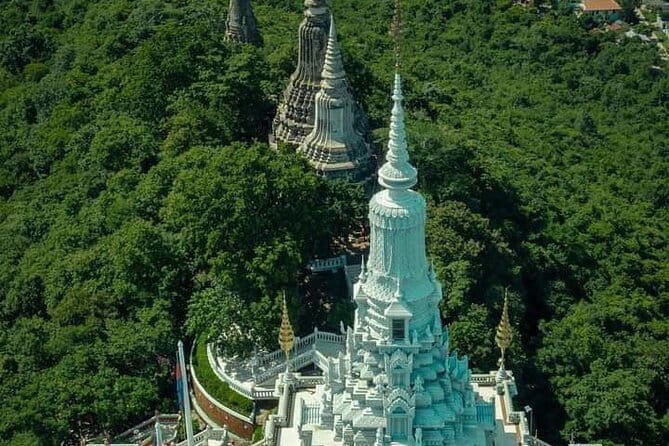
Your first major stop is Phnom Chisor, an 11th-century temple built on a hill. The visit is scheduled for about two hours, and admission is included at no extra charge.
The temple is known for its sculptures, which remain visible today. You can walk through its different galleries and enter the place of worship. That makes the visit more than a photo stop. The layout gives you a chance to look at the structure from inside, examine its decorative work, and understand how the temple was arranged for worship.
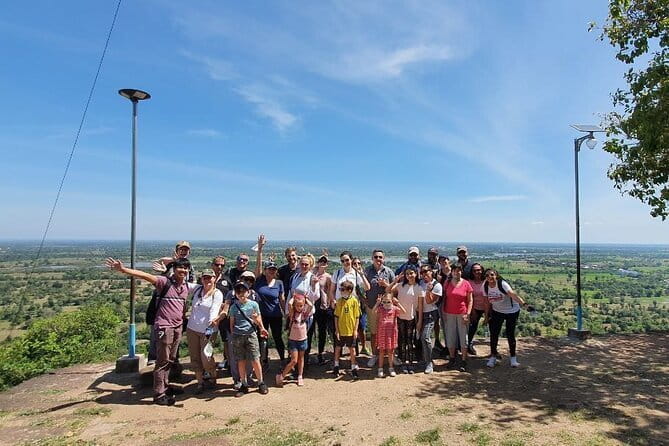
The best point comes at the back of the temple. From there, you can look across a broad plain of rice fields and countryside. The view is especially useful because it shows why the temple was placed where it was, rather than simply giving you another stone monument in isolation.
Look east from the hill and you can see an avenue forming a straight line toward three important features. The route includes two outer temples with cruciform ground plans and a moat. Even if you are not an architecture specialist, this is a good place to ask your guide to explain the old planning scheme. The straight axis makes the site easier to read than a pile of disconnected ruins.
Allow yourself time for the view as well as the carvings. The two-hour stop should provide a reasonable balance, but the hill setting means this is not a fully effortless walk. Wear practical shoes and keep water close. The tour supplies cool water, but you should still use it.
Neang Khmau: two brick prasats beside an active pagoda
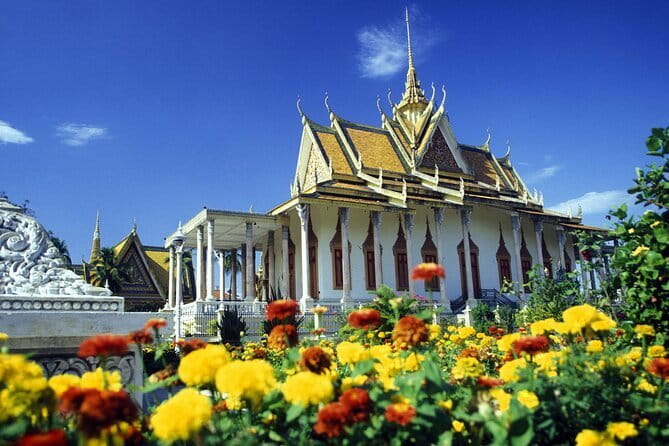
The next stop is Prasat Neang Khmau, with about one hour set aside. The temple is in Rovieng commune, Samrong district, off National Road 2, about 27 kilometers north of Takeo provincial town and roughly 52 kilometers south of Phnom Penh.
Neang Khmau consists of two deteriorating brick prasats, or towers, built in the Angkorian era during the 10th century under King Jayavarman IV. The site may once have had at least one more prasat, and perhaps as many as three additional towers. That missing or ruined portion is part of what you are seeing: not a polished monument, but an incomplete ancient complex.
The towers were originally dedicated to Shiva, a Hindu god. Their brick construction gives them a different look from the larger sandstone temples many people picture when they think of Cambodia. Pay attention to the surface and shape of the towers, and ask the guide about the original religious purpose before you move on.
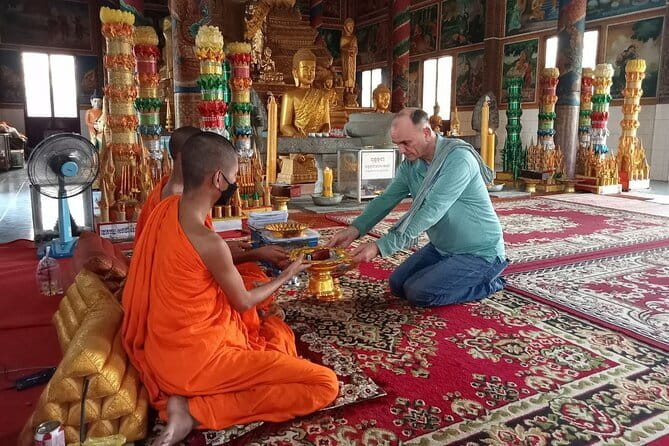
One especially useful feature is the setting beside an active pagoda. The older prasats are not cut off from present-day religious life. You are looking at a place where ancient Hindu architecture and current Buddhist practice occupy the same area. That contrast gives the stop more meaning than a visit to abandoned ruins alone.
The one-hour schedule is short, but it suits the scale of the site. Do not expect the same number of galleries or carvings as at a major Angkor complex. Neang Khmau works best as a focused stop where you compare the brick towers with Phnom Chisor and then notice the living pagoda next door.
Same country, a completely different kind of day:
- Phnom Penh: Sunset Cruise with Unlimited Beers & BBQ Buffet
★ 4.5 · 727 reviews - Aroma Therapy Massage, Relaxation therapeutic aromatherapy oil massages.
★ 5.0 · 645 reviews - Phnom Penh Full Day Private Tour Included All Admission Tickets
★ 5.0 · 585 reviews - Phnom Penh: Sunset Cruise with Unlimited Beer &Fruit platter
★ 4.7 · 515 reviews
Ta Prohm: smaller than Angkor’s famous temple
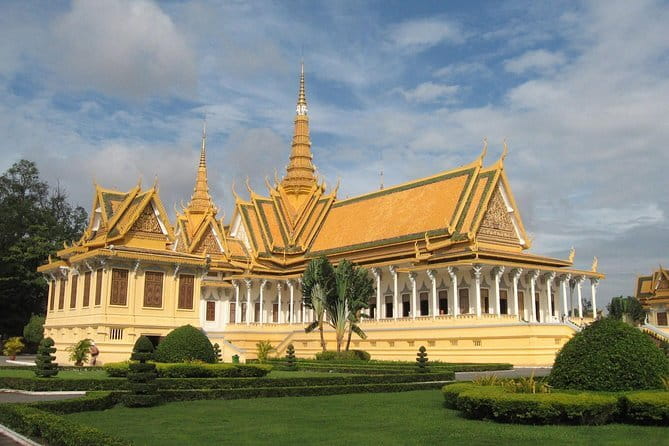
The tour description includes Ta Prohm as another destination. This temple was built during the reign of King Jayavarman VII in the late 12th or early 13th century.
It is smaller than the Ta Prohm at Angkor, so set your expectations accordingly. The value here is not size. The temple is noted for distinctive art, making it a useful part of a day that already shows several building styles and periods.
You may find the smaller scale easier to appreciate. At a huge complex, it is easy to rush past details because there is too much to cover. A more compact temple can give you time to look at individual carvings and ask what they represent. The provided information does not give a separate duration for this stop, so the amount of time may depend on the final route and the day’s conditions.
The name can cause confusion. This is not the same Ta Prohm that many people visit at Angkor, even though both carry the name. If you want a quieter southern temple with its own artwork, it adds variety. If your main goal is the famous Angkor site, this tour does not replace a visit to Angkor Archaeological Park.
Tonle Bati and the route’s final-stop question
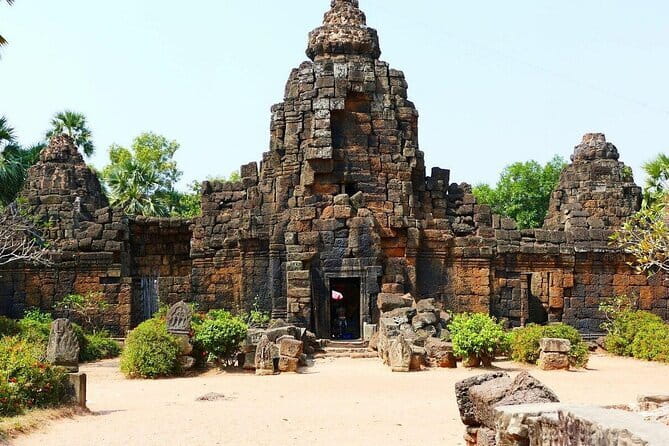
The timed itinerary lists Tonle Bati as Stop 3, with about one hour planned. Tonle Bati is a small lake around 30 kilometers south of Phnom Penh. It is a weekend destination for local people and a fishing spot for both tourists and local residents.
This stop changes the rhythm of the day. After temples, galleries, and brick towers, you get water and an open setting. The information supplied does not specify a meal, boat ride, or other organized lake activity, so treat Tonle Bati as a scenic and local-life stop rather than assuming extra activities are included.
There is an important route detail to settle before you go. The broader tour description names Yeay Pov Temple as the final destination, while the timed schedule names Tonle Bati as the third stop. Yeay Pov is also mentioned in the overall description but without a visit duration or further site details.
That mismatch does not necessarily mean the trip is poorly planned. It may reflect a route variation or an updated stop list. Still, you should ask the provider to confirm whether your day includes Ta Prohm, Yeay Pov, Tonle Bati, or some combination of them. This is the most useful practical question to ask before booking.
What the $190 group price really buys
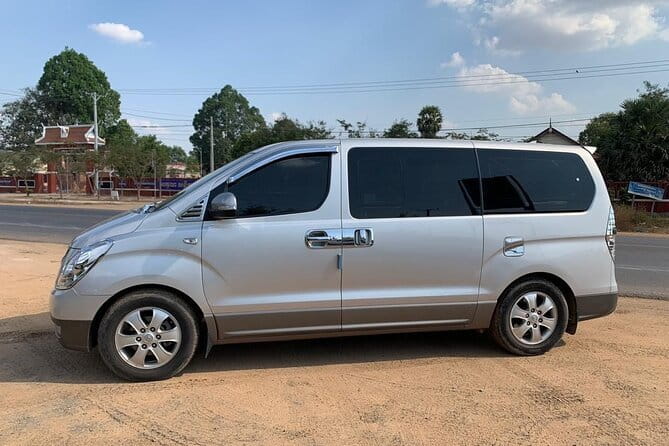
The $190 price is easiest to justify when five people share the vehicle. At that size, the cost is $38 each, and the package includes an English-speaking guide, air-conditioned transportation, a driver, cool water, and all fees and taxes.
Admission is listed as free for Phnom Chisor, Neang Khmau, and Tonle Bati. Food and beverages are not included, so plan for your own meals and any drinks beyond the supplied water. Travel insurance, tips for the guide and driver, and personal expenses are also outside the price.
For a small private group, the strongest value is control. You are not joining a large coach, and you can discuss the sites directly with the guide. That matters most at Neang Khmau, where the active pagoda and ancient towers invite questions that a rushed group visit might not allow.
For solo visitors or couples, the price requires more thought. The private format remains convenient, but the per-person cost rises sharply. I would favor it for a family or group of friends that wants a dedicated vehicle and a full day outside Phnom Penh. If you are traveling alone and mainly want one temple, a shorter shared excursion may offer better value.
Who should choose this temple tour
I would choose this experience if you want more than the standard Phnom Penh circuit and are interested in smaller Cambodian temple sites. It suits people who enjoy comparing periods, materials, and religious settings rather than checking off only the largest monuments.
It is also a good fit for a group of up to five. The private setup gives you a calmer day, and the air-conditioned vehicle helps with the long road portion. The tour may suit families and mixed-age groups, provided everyone is comfortable with walking at Phnom Chisor.
You may want to skip it if you have only one free day in Phnom Penh and want the city’s main museums and memorial sites. You should also think twice if you dislike long drives or prefer a slow visit to one large archaeological complex. The tour covers several places, so its strength is variety, not an unhurried stay at each temple.
The single strongest reason to book is the combination of Phnom Chisor’s view and the living religious setting at Neang Khmau. Those two experiences give the day a clear identity. The most important reason to pause is the uncertainty over the final stop.
Practical details that make the day easier
Confirmation is provided when you book, and free cancellation is available if you cancel at least 24 hours before the start time. Changes or cancellations made less than 24 hours before departure are not accepted for a refund, with cut-off times based on local time.
Start at River Crown Restaurant at 8 a.m. Since the activity returns there, keep the meeting point in mind when planning the rest of your evening. The tour is listed as near public transportation, but the supplied details do not state exact pickup times from other addresses, so use the stated meeting point unless the provider confirms another arrangement.
Admission and taxes are covered, but meals are not. Tipping is also excluded. Carry comfortable footwear and be ready for a warm outdoor day, especially at the hilltop temple. The tour provides cool water, but food planning remains your responsibility.
Ask one direct question before booking: which sites are scheduled on your date? The published information refers to Phnom Chisor, Neang Khmau, Ta Prohm, Yeay Pov, and Tonle Bati, but only three stops have stated time blocks. Getting that clarified will help you judge the pace and avoid surprises.
Should you book it?
Book this tour if you have a full day, a small group, and an interest in southern Cambodia’s lesser-known temple sites. The $190 price makes the most sense for four or five people, when the private transport and guide become good value.
I would especially recommend it for the hilltop view at Phnom Chisor, the two brick towers at Neang Khmau, and the chance to connect ancient ruins with an active pagoda. Before paying, confirm the Yeay Pov and Tonle Bati question. If the final route matches what you want, this is a worthwhile way to trade Phnom Penh traffic for temples, rice fields, and a more local southern setting.
FAQ
Where does the tour start?
It starts at River Crown Restaurant, 357 Street 178, Preah Sisovath Quay, Phnom Penh 12206, Cambodia.
What time does the tour begin?
The scheduled start time is 8 a.m.
How long does the experience last?
The tour lasts about eight hours, including travel time.
Does the tour return to Phnom Penh?
Yes. The activity ends back at the starting meeting point.
Is this a private tour?
Yes. Only your group participates, and the booking can include up to five people.
What transportation is included?
Transportation is provided in a clean, air-conditioned vehicle with a driver.
Is an English-speaking guide included?
Yes. An English-speaking tour guide is included. Soapheak is the guide specifically named in the available information.
Are admission fees included?
All fees and taxes are included. The listed stops at Phnom Chisor, Prasat Neang Khmau, and Tonle Bati show no separate admission charge.
Is food included?
No. Food and beverages are not included. Travel insurance, tips for the guide and driver, and personal expenses are also excluded.
Just added around Phnom Penh
- The killing field and Toul Sleng Genocide museum (S21) Tour★ 4.5 · 19 reviews
- Watch Live Khmer Traditional boxing in Phnom Penh★ 5.0 · 46 reviews
- Watch Khmer Kickboxing with Free Beers by Ringside Seats★ 5.0 · 11 reviews
- Udong Old Capital Tour★ 4.5 · 3 reviews
- Udong Historical Site Tour★ 5.0 · 8 reviews
- Warm Stone Massage★ 5.0 · 23 reviews
- Killing Fields & Toul Sleng Genocide Museum Tickets With Tuk Tuk★ 5.0 · 6 reviews
- S-21 Prison and Killing Fields★ 5.0 · 8 reviews
Museums, compared.
The Killing Field and Toul Sleng Genocide Museum (S21) Tour
Read our review →
Killing field and Toul Sleng genocide museum Tour
Read our review →
Private Half Day To Killing Field & S21 Genocidal Museum in Phnom Penh
Read our review →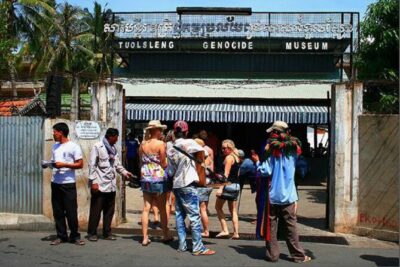
Tuol Sleng Genocide Museum (S-21) and Choeung Ek Killing Fields Tour
Read our review →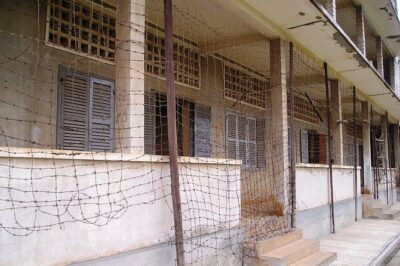
Phnom Penh City Tour, Silver Pagoda, Genocide Museum, Killing Fields
Read our review →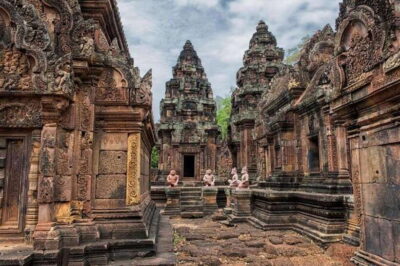
Bantey Srei, Kbal Spean and Landmine museum Private Tuk-Tuk
Read our review →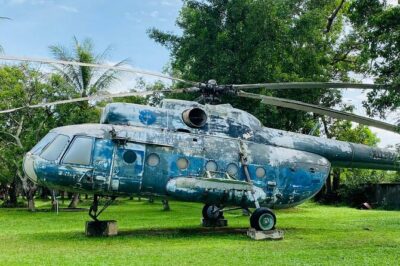
Siem Reap City Tour with War Museum and Killing Field
Read our review →The killing field and Toul Sleng Genocide museum (S21) Tour
Read our review →Browse the lists this tour appears in