
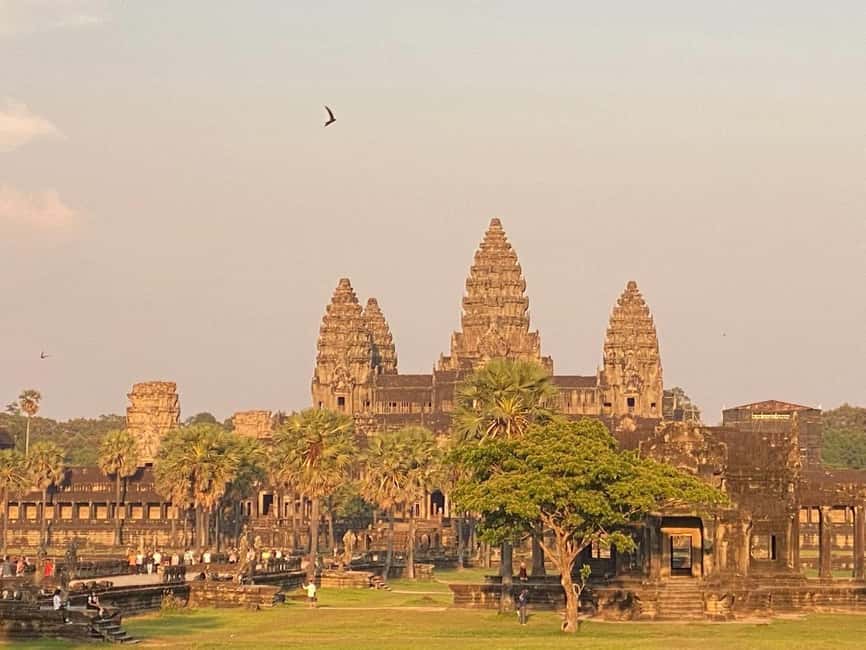
Reviewed · ANGKOR WAT TOURS
Siem Reap: Angkor Wat Tour with Italian-Speaking Guide
Angkor is easier to understand when someone can explain the carvings, legends, and Khmer customs in your own language. This private tour pairs an Italian-speaking guide with hotel pickup, flexible transport, and a route through the temples that can be adjusted to your pace.
I like the thoughtful touches: cold water and chilled towels after temple walks, plus guides who help with photographs and often steer you toward quieter entrances. I also like the choice between a focused one-day visit and a fuller two-day circuit. The main drawback is cost: at $140 for up to two people, you must still pay the Angkor ticket and lunch.
Key points to know
- Italian guidance from local guides: Matteo, Caro or Karo, Chhoure, and Alex have led recent tours, with language ability varying by guide.
- One-day route: See Ta Prohm, Angkor Thom, Bayon, and Angkor Wat in one long temple day.
- Two-day choice: Add the Grand Circuit and Banteay Srei, with more time and less rushing.
- Private transport: One or two people ride by tuk-tuk on Day 1, while larger groups use an air-conditioned van or bus.
- Useful comfort touches: Hotel pickup, cold water, fresh towels, and photo help are included.
- Extra costs: The park ticket is $37 per person for one day or $62 for two to three days, and meals are not included.
Why Italian guidance changes an Angkor visit
Angkor Wat is not a place you simply stroll through and understand at once. Its temples are vast, its carvings are dense, and the stories behind the stone figures are tied to Hindu and Buddhist beliefs. A guide who can explain these details in Italian lets you spend less time translating and more time looking.
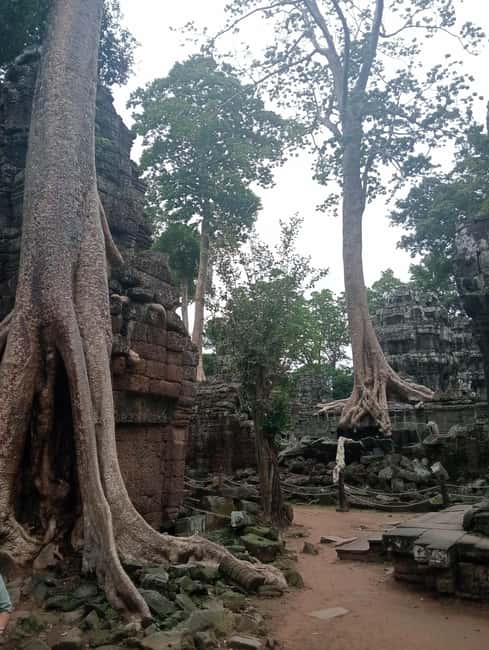
The guide also gives the ruins a human scale. At Bayon, for example, you may notice the famous smiling faces, but an explanation helps you see how the towers, galleries, and reliefs fit together. At Ta Prohm, the tree roots make for striking photographs, yet the temple was also a functioning religious center with a planned layout.
The guides are local, and the names assigned to the tour can vary. Matteo has been praised for using several languages, telling amusing stories, and taking photographs. Caro, also written as Karo, has been described as speaking good Italian and planning routes around busy periods. Chhoure has a warm, lively approach, while Alex is known for answering questions and adapting the pace.
You should keep one practical point in mind: Italian fluency may not be identical from one guide to another. One recent account found Caro’s answers clear but brief, suggesting that the language barrier sometimes limited longer explanations. If detailed interpretation is your top priority, ask about the assigned guide when booking.
More Angkor Wat Tours in Siem Reap:
- Angkor Wat Sunrise or Sunset Tour with Guide from Siem Reap
★ 5.0 · 12,109 reviews - Siem Reap: Angkor Wat: Small-Group Sunrise or Sunset Tour
★ 5.0 · 9,444 reviews - Siem Reap: Angkor Wat 2-Day Tour with Sunrise and Sunset
★ 4.9 · 4,429 reviews
Starting at 8:30 AM in Siem Reap
The guide meets you in your hotel lobby at 8:30 AM for the regular one-day departure. You then travel together to the ticket booth, unless you buy your pass online ahead of time. The ticket is not part of the $140 tour price.
For two adults, the real one-day total is $214 before lunch, assuming the published $37 park fee for each person. That makes the tour more expensive than simply hiring transport, but you are paying for a private guide, hotel transfers, route planning, Italian explanations, and the convenience of having the day organized around you.
The park ticket costs $37 per person for one day and $62 per person for two to three days. Children under 12 do not need a ticket if they show a passport as proof of age, and they can join the tour free of charge. Adults aged 12 to 90 pay the standard tour rate.
Transport depends on group size and option. A couple generally uses a tuk-tuk on the first day of the one-day tour. For the two-day plan, the first day uses a tuk-tuk and the second day uses a private car. Groups of three or more use an air-conditioned van or bus. The tuk-tuk is part of the classic Siem Reap feel, but a closed vehicle may be more comfortable if heat, dust, or sudden rain is a concern.
Ta Prohm and the famous tree roots
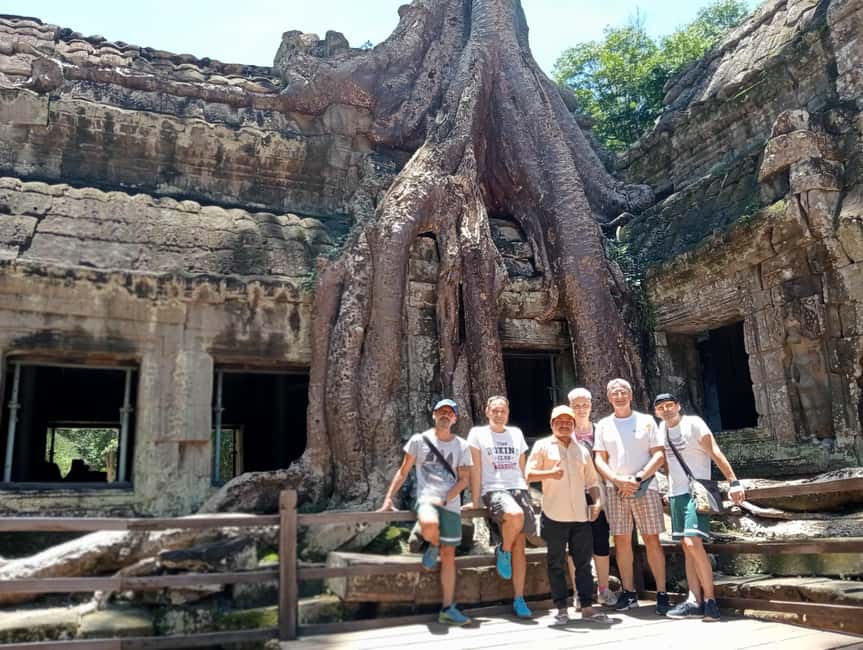
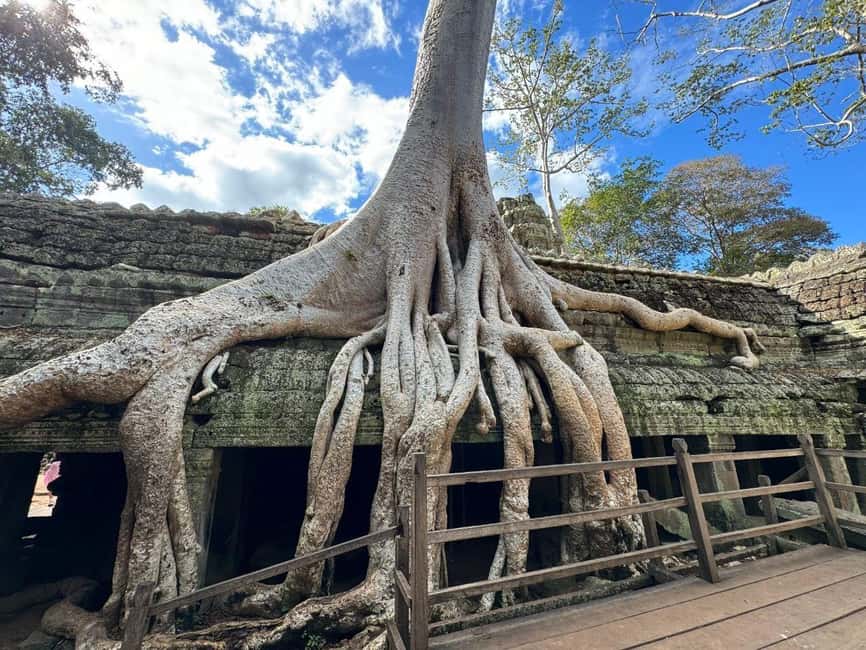
Ta Prohm is usually the first major temple on the route, with about an hour for a guided visit. This is one of Angkor’s most atmospheric stops, thanks to huge roots that wind over walls and doorways.
The roots are not the whole story. Your guide can point out the temple’s galleries, carved figures, and the way nature and stone now share the site. The movie connection makes Ta Prohm familiar, but the real pleasure is walking through a place that feels less formal and more mysterious than Angkor Wat.
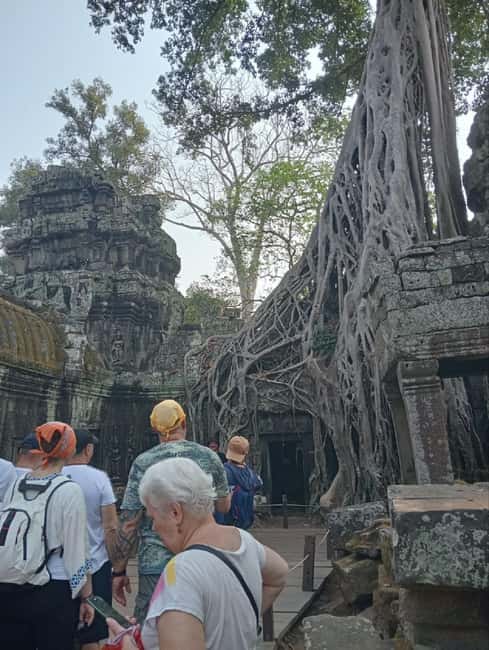
Expect uneven ground, steps, and shade mixed with strong sun. Comfortable shoes matter here. If you want photographs without spending the whole visit waiting for a clear frame, listen when your guide suggests a less-used path or entrance. Several guides have made a point of routing the visit away from the thickest crowds.
Angkor Thom, Victory Gate, and the smiling Bayon
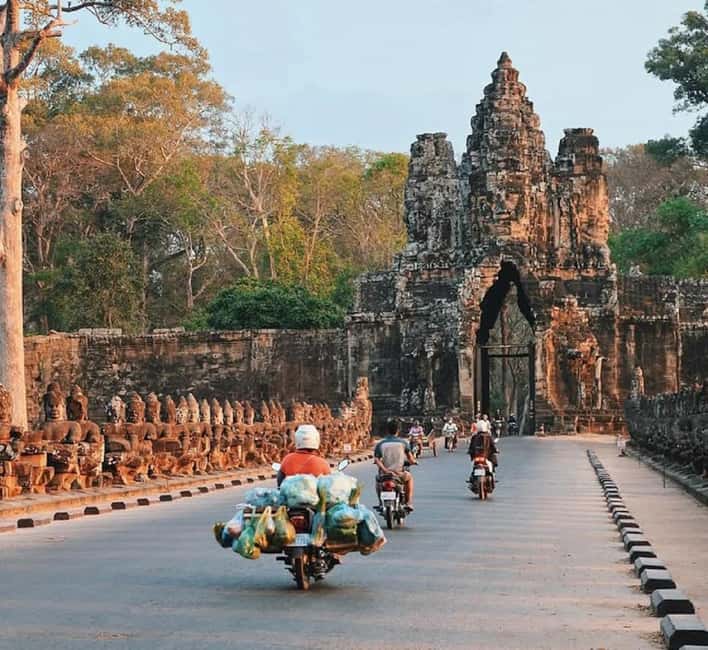
The route then reaches Angkor Thom, the great walled city, through the South Gate. The entrance is marked by rows of figures and the enormous stone faces that give the approach its power. The itinerary also includes a short photo stop at Victory Gate, a useful chance to see another entrance without turning the day into a long formal visit.
Inside Angkor Thom, the Terrace of the Elephants takes about 20 minutes. Its long carved platform once served as a ceremonial viewing area, and its elephants and other figures are easy to appreciate with a guide beside you. Nearby Baphuon receives about 45 minutes and gives you a different temple shape, with a long raised approach and steep upper levels.
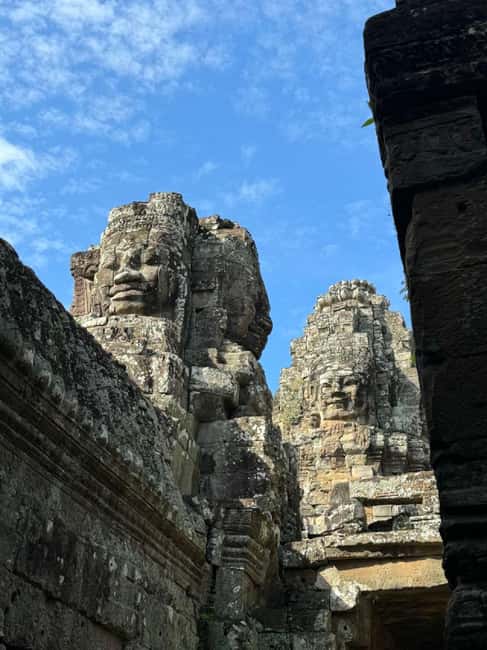
Bayon gets another 45-minute guided visit. Its towers carry the calm faces associated with Angkor, and the close-packed layout rewards patient looking. I would not rush this temple. The faces are the obvious attraction, but the lower galleries contain scenes of warfare, daily life, and courtly activity.
These stops also show why a private tour can help. You can ask your guide to pause when a carving catches your eye, rather than keeping to a fixed group schedule. On the other hand, the morning contains several major sites, so you will spend much of the day walking and climbing.
A few more Siem Reap trips to weigh up
- Siem Reap: Full-Day Angkor Wat Guided Tour with Sunset
★ 4.9 · 3,803 reviews - Angkor Wat Sunrise tour with Small – Group and Guide tours
★ 5.0 · 3,655 reviews - Angkor Wat Highlights and Sunrise Guided Tour from Siem Reap
★ 5.0 · 3,213 reviews - Full-Day Angkor Wat Sunrise Private Tour with Guide from Siem Reap
★ 5.0 · 2,920 reviews
Lunch beside Srah Srang
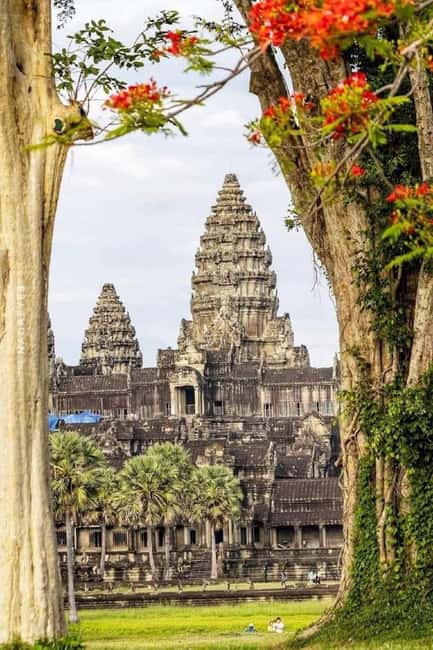
Srah Srang is the planned break and lunch area, with about an hour set aside. The meal is not included, so you should budget separately for a Cambodian lunch at a nearby restaurant.
This pause matters more than it may seem. Angkor days are hot, and the combination of stone paths, stairs, and humidity can wear you down. Use the hour to eat, drink, and cool off rather than treating it as another sightseeing sprint.
The driver provides cold water and a cold towel during the visits. One especially useful detail is that the towels may be freshly chilled and scented, offered when you return to the vehicle. That small service can feel remarkably welcome after a walk through the temples.
Two hours inside Angkor Wat
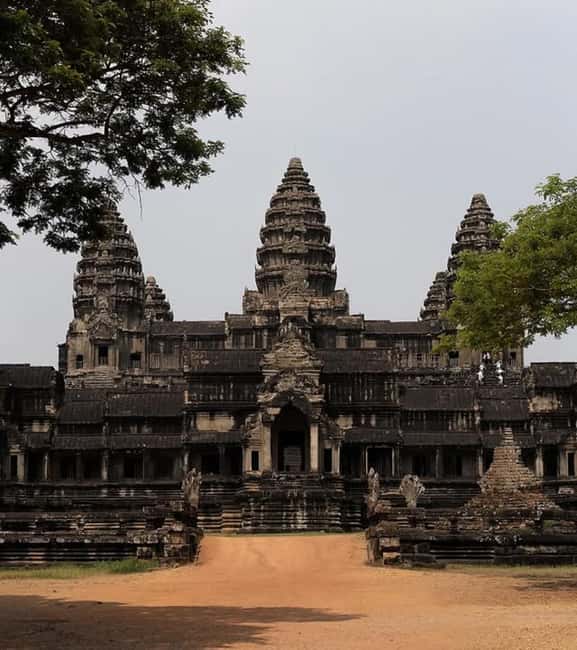
The afternoon is reserved for Angkor Wat, with about two hours for the main visit. This is the longest stop because the complex needs time. You have the outer galleries, the central towers, long bas-reliefs, courtyards, and the chance to consider how the monument was designed as a sacred model of the universe.
A guide is particularly useful here. Without context, the reliefs can look like a long series of beautiful scenes. With an explanation, you can follow episodes from Hindu mythology, recognize repeated symbols, and understand how the temple’s structure guided worshippers toward the center.
Dress carefully. Shorts, short skirts, sleeveless shirts, tank tops, and other revealing clothing are not permitted. A scarf may cover your knees and shoulders at most temples, but Angkor Wat requires pants or a skirt that covers the knees and a shirt covering the shoulders. I would wear light, loose clothing that meets the rules from the start.
The standard one-day tour finishes around 5:00 PM and returns you to your hotel. Actual timing can shift. Rain has shortened one Angkor Wat visit, and a recent one-day outing finished around 3:30 PM. That is a reminder not to plan a fixed evening activity too tightly.
The two-day route adds space and variety
Choose two days if you want more than the headline temples. The second day covers the Grand Circuit and Banteay Srei, usually finishing around 4:00 PM. If you select the sunrise option, the morning begins at 5:00 AM and finishes around noon, so check the exact option and timing carefully before paying.
The extra day changes the mood. Instead of packing every major stop into one long outing, you get time for temples that are more spread out and less similar to the central Angkor Thom group. For two adults, the tour and two to three-day park passes come to $264 before meals, based on the published prices.
Preah Khan
Preah Khan begins the Grand Circuit. It is a large former monastic complex with long corridors, courtyards, and carved stonework. The scale can be confusing without help, and an Italian-speaking guide can explain how the rooms and passageways relate to one another.
I like Preah Khan for its sense of movement. You pass from narrow corridors into wider spaces, with carvings appearing at different heights. The drawback is that the route can feel tiring after the previous day, especially in humid weather.
Neak Pean
Neak Pean is smaller and calmer, surrounded by pools. Its design makes it unlike the enclosed temple compounds, and the water gives the visit a quieter rhythm.
This stop is best treated as a short visual pause rather than a major climbing site. Your guide can explain the symbolism of the pools and the religious purpose of the complex while you take in the setting.
Ta Som
Ta Som is known for its tree-covered gate. Like Ta Prohm, it shows nature pressing into the old stone, but on a more modest scale. The smaller size makes it easier to appreciate the details without the sense of a monumental march through endless galleries.
If photography is important to you, this is another place to ask your guide for the best angle. The guide may also choose a path that avoids the busiest approach.
East Mebon
East Mebon once occupied an island in a large reservoir. The water is no longer the central part of the visit, but the elevated temple still helps you picture how Angkor’s water system shaped its religious buildings.
The temple has a more structured, symmetrical feel than Ta Prohm or Ta Som. It is a good contrast within the second-day route, though the open stone can offer less shade.
Pre Rup
Pre Rup is a mountain-style temple with broad views toward the Cambodian countryside. Its upper levels and strong geometry make it an impressive final stop before lunch or the onward drive, but the steep steps can be difficult for anyone unsteady on their feet.
You should treat the climb as optional if needed. This tour is not suitable for wheelchair users, and the operator also lists it as unsuitable for people over 95.
Banteay Srei and its fine carvings
The two-day program finishes at Banteay Srei, often called the Citadel of Women. It is admired for pink sandstone and unusually fine carving, with small details that reward a slower look.
Banteay Srei is different from Angkor Wat in scale and texture. The carvings feel delicate and precise, and the temple’s smaller size makes the artistry easier to take in as a whole. The trip out adds driving time, but this is exactly the sort of reason to choose two days rather than trying to squeeze every temple into one.
Lunch is again at your own expense. Bring sunscreen, insect repellent, sunglasses, and a hat. The park can be hot, and you will appreciate having water close by between stops.
Private pacing, family needs, and photographs
A private group gives you more control than a large shared departure. The guide can adjust the rhythm for children, answer individual questions, and choose which temple deserves extra time.
This can matter greatly for families. Alex adapted the route for children aged five and one, advising which temples worked better with a stroller and which were easier with a baby carrier. The tour is free for children under 12, which improves the value for a family, although the adult price still applies to adults aged 12 and over.
The guide may also act as your photographer. Matteo, Caro, Chhoure, and Alex have all been associated with helping visitors take photographs, and that can save you from relying on hurried selfies. Still, photo help should be seen as a pleasant service, not a professional photography session.
The transport rating is high, and the chilled towels are a practical feature rather than decoration. After every temple, you can return to a waiting vehicle, drink cold water, wipe away sweat, and continue. That makes the long day easier.
What to pack and what to wear
Wear shoes that can handle uneven paths and stairs. Add sunglasses, a sun hat, sunscreen, and insect repellent.
For clothing, cover your shoulders and knees from the beginning. Do not rely on a short skirt, shorts, or a sleeveless top with the plan to improvise later. A light scarf can help at some temples, but Angkor Wat has stricter requirements.
Alcohol and drugs are not allowed. The tour includes water and towels, but lunch and any other item not named in the inclusions are yours to pay for.
Free cancellation is available up to 24 hours before departure, and you can reserve now and pay later. Pickup and drop-off are included, but you need to provide the hotel name or address and a contact number.
Should you book the one-day or two-day option?
I would choose the one-day tour if you have limited time and want the essential sequence: Ta Prohm, Angkor Thom, Bayon, and Angkor Wat. It is a full day, not a gentle introduction, but it gives you the major sights with an Italian-speaking guide and private transport.
I would choose two days if you care about temple detail, prefer a slower pace, or want Banteay Srei and the Grand Circuit. The extra cost is reasonable for the added temples and second vehicle arrangement, especially for a couple who values convenience.
This tour suits Italian-speaking couples, families, and small private groups who want interpretation without arranging several separate services. It is less suitable if you want to explore alone, avoid a fixed schedule, use a wheelchair, or keep costs as low as possible.
The strongest reasons to book are the language support, personal pacing, route planning, and thoughtful transport service. Ask about your guide’s Italian level, confirm the vehicle for your group, and buy the correct park pass. If those details fit your plans, this is a practical way to see Angkor with more understanding and less logistical strain.
FAQ
Where does the tour begin?
Your guide meets you in the lobby of your hotel in Krong Siem Reap at the scheduled pickup time.
Is hotel pickup and drop-off included?
Yes. Pickup and return to your hotel are included. You must provide the hotel name or address and a contact number when booking.
Is the Angkor entrance ticket included?
No. The park ticket costs $37 per person for one day or $62 per person for two to three days.
Can I buy the Angkor ticket online?
Yes. You can buy it online in advance or go with your guide to the ticket booth before entering the complex.
Is lunch included?
No. Lunch is taken at a nearby restaurant and must be paid for separately.
What language does the guide speak?
The live guide service is in Italian. The assigned guide may be Matteo, Caro or Karo, Chhoure, Alex, or another Italian-speaking guide.
How many people can join for $140?
The price is $140 per private group of up to two people. Children under 12 can join the tour free of charge.
What transport is used for one or two people?
On the one-day tour, one or two people travel by tuk-tuk unless a car is selected at checkout. On the two-day tour, Day 1 uses a tuk-tuk and Day 2 uses a private car.
Can I choose a two-day visit?
Yes. The two-day option includes the Small Circuit, Grand Circuit, and Banteay Srei. It is recommended if you want a slower visit and more temples.
What clothing is required?
You need clothing that covers your shoulders and knees. Shorts, short skirts, sleeveless shirts, tank tops, and other revealing clothing are not permitted.
Just added around Siem Reap
- Ultimate Sunrise to Angkor Wat, Angkor Thom and Bayon Temple★ 5.0 · 3 reviews
- Twilight Tastes of Siem Reap Include Dinner★ 5.0 · 13 reviews
- Trekking Tour at Phnom Kulen National Park from Siem Reap★ 5.0 · 3 reviews
- Full-Day Private Tour of Angkor Wat with Pick Up★ 5.0 · 12 reviews
- Private Day Trip to Angkor Temples with Expert Guide★ 5.0 · 4 reviews
- Waterfall & River of 1000 Siva Linga- Kulen Mountain Private Tour★ 5.0 · 3 reviews
- Professional Photo Shoot in Angkor Archaeological Park, Siem Reap★ 5.0 · 42 reviews
- Ultimate Siem Reap Food Tour by Tuk Tuk – 20 Tastings, 8 Stops★ 5.0 · 13 reviews
Angkor Wat Tours, compared.

Angkor Wat Sunrise or Sunset Tour with Guide from Siem Reap
Read our review →
Angkor Wat: Small-Group Sunrise or Sunset Tour
Read our review →
Angkor Wat 2-Day Tour with Sunrise and Sunset
Read our review →

Angkor Wat Sunrise tour with Small – Group and Guide tours
Read our review →
Angkor Wat Highlights and Sunrise Guided Tour from Siem Reap
Read our review →
Angkor Wat Sunset Small Group Tour with Lunch Included
Read our review →