
Reviewed · ANGKOR WAT TOURS
Sharing Trip to Angkor Temple with sunset
Angkor Wat is only the beginning here. This full-day outing takes you through the great temple complex, into Angkor Thom by its South Gate, beneath Bayon’s famous stone faces, and finally to root-covered Ta Prohm before sunset. I like the hotel pickup and air-conditioned vehicle, and I like that an English-speaking licensed guide explains why these monuments were built rather than leaving you with photo stops alone.
The catch is the pace. You may walk close to 10 kilometers in strong heat, with limited shade in some areas. The $19 price is appealing, but it does not include the $37 temple ticket or lunch, so you should budget about $56 to $66 in total, before any other spending.
Key points to know before you book
- Angkor Wat starts the day: Spend about two and a half hours at Cambodia’s best-known monument, with time for guided sightseeing and photographs.
- Bayon rewards close looking: Its 216 carved faces are only part of the story. Your guide also points out wall carvings and useful photo angles.
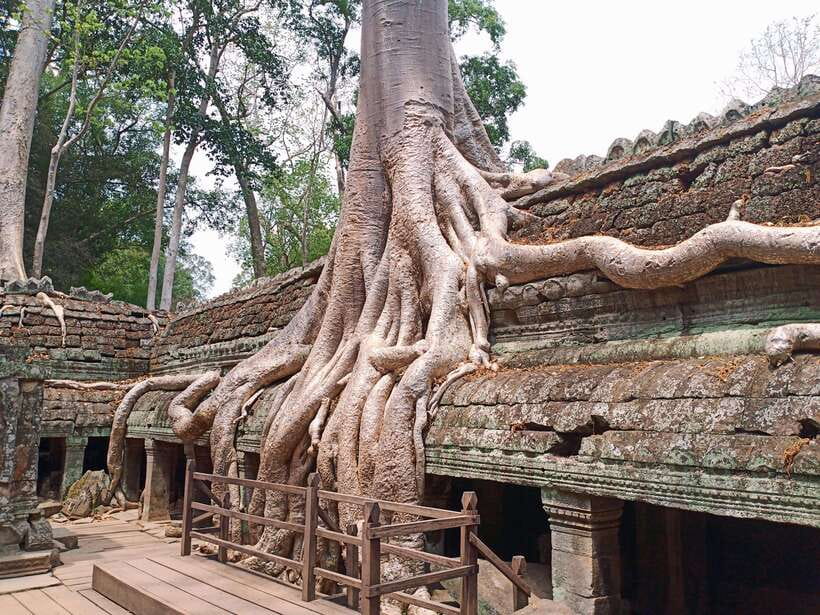
- Ta Prohm brings the drama: Spung tree roots twist through moss-covered stone, creating the atmospheric scene made famous by Tomb Raider.
- The walking is serious: Comfortable closed shoes, sun protection, water, and a reasonable level of fitness matter more than fancy camera gear.
- Cold water and wipes are provided: This small touch is useful after long walks on dusty paths under the tropical sun.
- The price needs careful reading: Transport, guide, insurance, parking, tolls, gasoline, water, and hotel transfers are included, but the temple pass and lunch are extra.
A full day among Angkor’s great monuments
This is a shared day trip based in Siem Reap Province, with pickup and drop-off at your hotel lobby. The drive to the temple area takes about 15 minutes in the stated schedule, though the exact time can vary with your hotel location and traffic.
The day is designed to cover the three major names most people come to Siem Reap to see: Angkor Wat, Angkor Thom, and Ta Prohm. It adds several important stops inside Angkor Thom, so you get more than a quick circuit of the famous landmarks.
I see the appeal for a first visit. You do not need to arrange a tuk-tuk, car, driver, parking, or route planning. The guide handles the sequence, while the driver gives you a cool place to recover between walks. At $19, the tour portion is inexpensive for a full day, but the entry fee changes the real cost. Add the $37 temple pass and roughly $7 to $10 for lunch, and the practical total is closer to $56 to $66 per person.
The experience includes travel insurance, toll roads, parking, gasoline, cold water, and wipes. It also offers free cancellation up to 24 hours before departure and reserve-now, pay-later booking. Those terms are useful if your Siem Reap plans are still shifting, but they do not reduce the separate temple admission cost.
More Angkor Wat Tours in Siem Reap:
- Angkor Wat Sunrise or Sunset Tour with Guide from Siem Reap
★ 5.0 · 12,109 reviews - Siem Reap: Angkor Wat: Small-Group Sunrise or Sunset Tour
★ 5.0 · 9,444 reviews - Siem Reap: Angkor Wat 2-Day Tour with Sunrise and Sunset
★ 4.9 · 4,429 reviews
Angkor Wat: begin with Cambodia’s great symbol
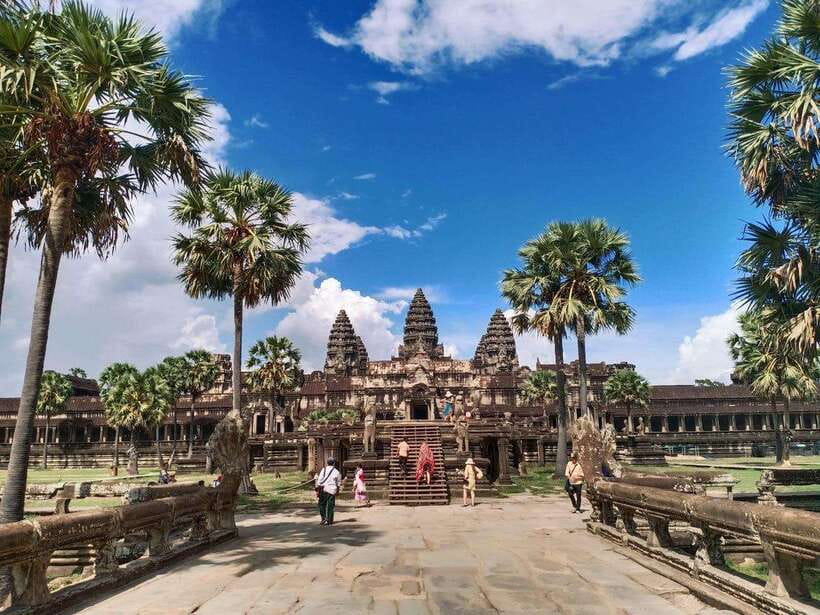
You start at Angkor Wat, the largest religious monument in the world and the image used on Cambodia’s national flag. It began as a Hindu temple complex and later became Buddhist, a change that helps explain why the site carries several layers of religious meaning.
The planned visit lasts about two and a half hours. That is enough time to walk through the main areas, study the architecture, listen to the guide, and take photographs without treating the temple as a quick background for selfies.
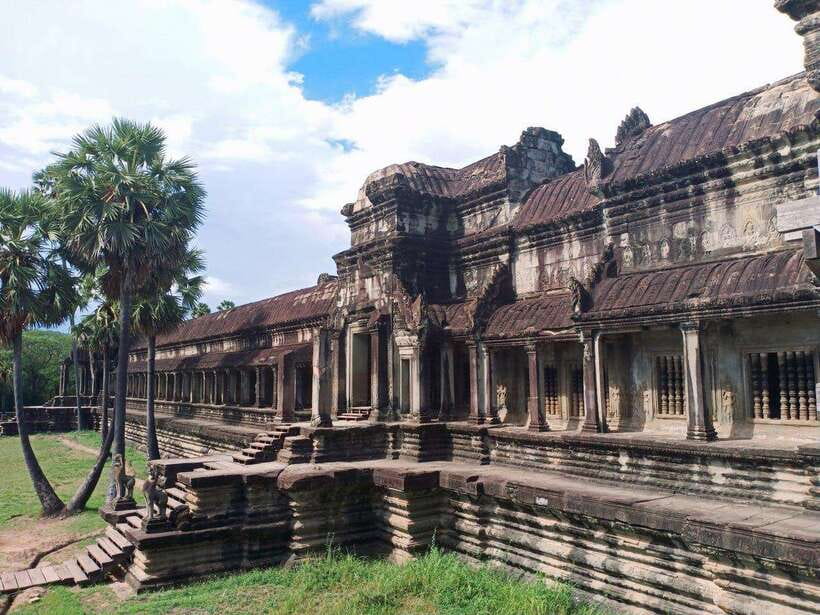
Look for the balance between scale and detail. The broad causeways and towers give Angkor Wat its grand shape, but the carved galleries reward slower attention. A guide is particularly useful here because the complex can feel overwhelming at first. Instead of seeing only towers and corridors, you get explanations of the religious purpose, construction, carvings, and changing use of the site.
The practical problem is exposure. Much of the visit takes place outdoors, and the heat can build quickly. Wear long trousers and a shirt that covers your shoulders, both for sun protection and for the religious dress rules. A hat, sunglasses, sunscreen, and biodegradable insect repellent belong in your day bag.
Angkor Thom and the South Gate
After Angkor Wat, the vehicle takes you to Angkor Thom, the ancient city enclosed by laterite walls about eight meters high. The city measures roughly three kilometers by three kilometers and is protected by a moat that remains flooded today.
You enter through the South Gate, a short stop of about 20 minutes. This is a fine place to understand the defensive scale of Angkor Thom before moving into its central monuments. It also gives you a clear change of mood: Angkor Wat feels like a monumental temple complex, while Angkor Thom presents itself as a walled royal city.
The South Gate is mainly a photo and orientation stop, so do not expect a long visit here. Its value comes from the approach and the guide’s explanation of how the walls and moat shaped the city. If you are already feeling the heat, use this transition to drink water and adjust your hat or sunscreen.
Bayon’s 216 stone faces
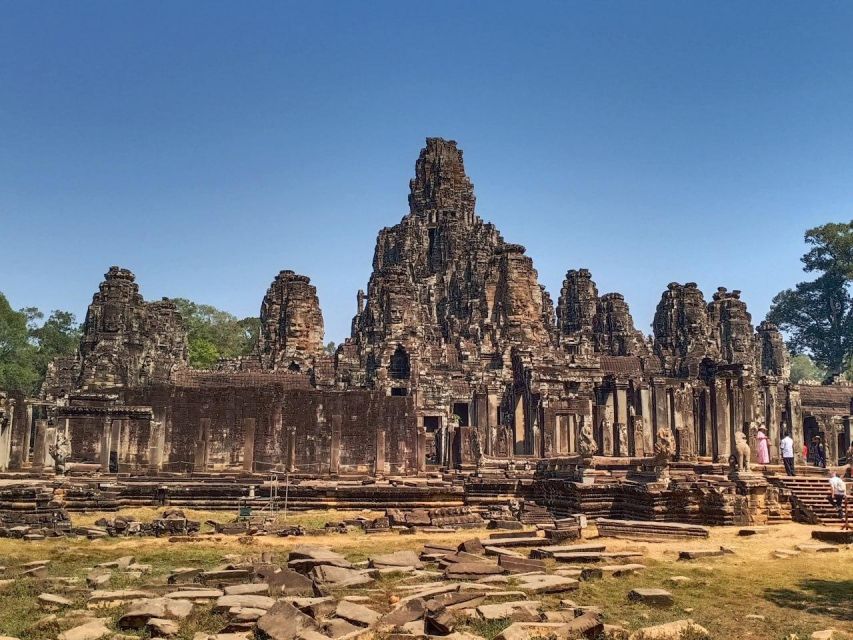
Inside Angkor Thom, Bayon gets about an hour and a half. This is one of the strongest parts of the day because the temple asks you to look closely rather than simply take in a large silhouette.
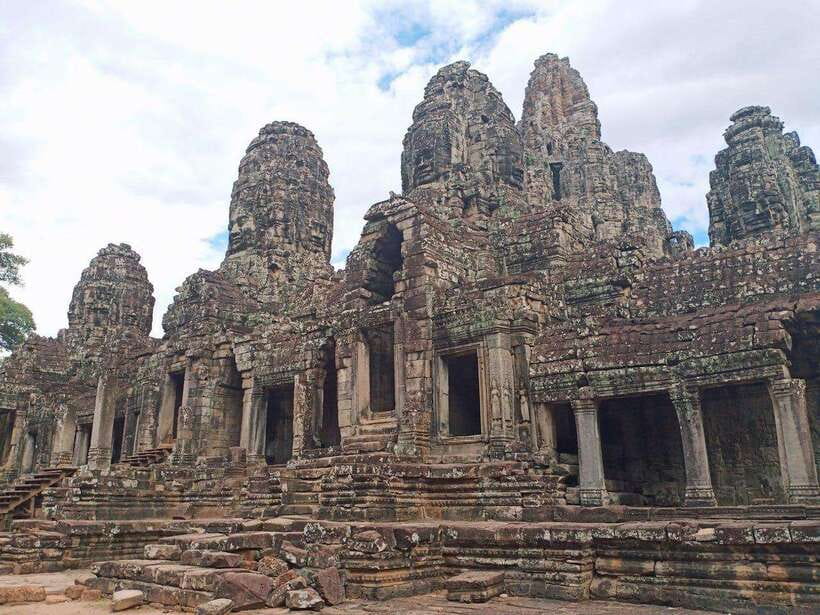
The 216 enigmatic faces gaze out from the towers, giving the central sanctuary its famous calm and slightly mysterious character. The faces appear from different levels and angles, so walking around the temple changes what you see. Your guide points out the best positions for photographs and explains the intricate carvings along the gallery walls.
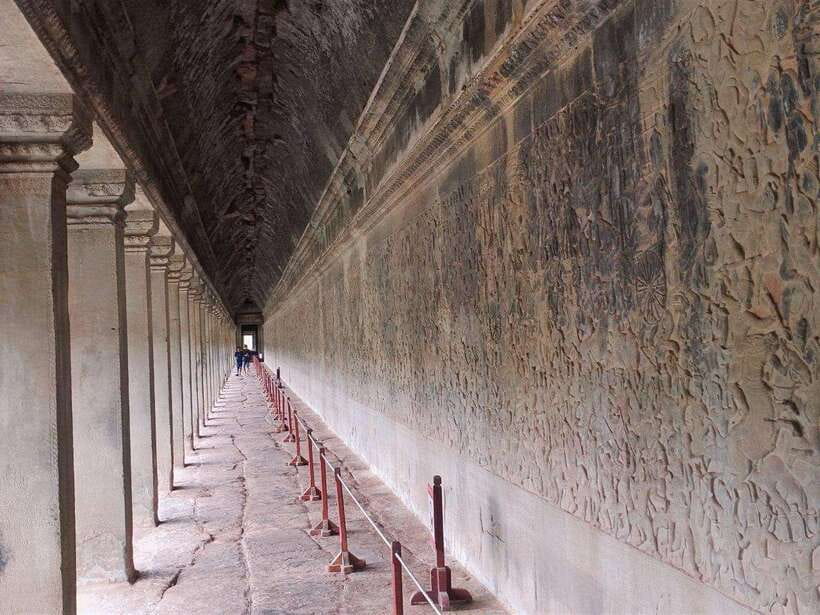
Allow yourself time for those wall scenes. They show more than decorative patterns and help connect the temple to daily life, warfare, ceremony, and the society that built it. The guide’s role matters here because the carvings can be easy to pass without context.
Bayon can also feel crowded, and its narrow passages require patience. The schedule gives you a useful amount of time, but the morning heat and uneven ground still add up. Comfortable shoes are essential, and you should not count on finding shade every few minutes.
A few more Siem Reap trips to weigh up
- Sunset tour of Kampong Phluk stilts home village on the Tonle Sap
★ 5.0 · 4,865 reviews - Siem Reap: Full-Day Angkor Wat Guided Tour with Sunset
★ 4.9 · 3,803 reviews - Angkor Wat Sunset Small Group Tour with Lunch Included
★ 5.0 · 3,059 reviews - Angkor 2-Day Sunset & Sunrise Small-Group Tour
★ 5.0 · 2,567 reviews
Baphuon, Phimeanakas, and the royal terraces
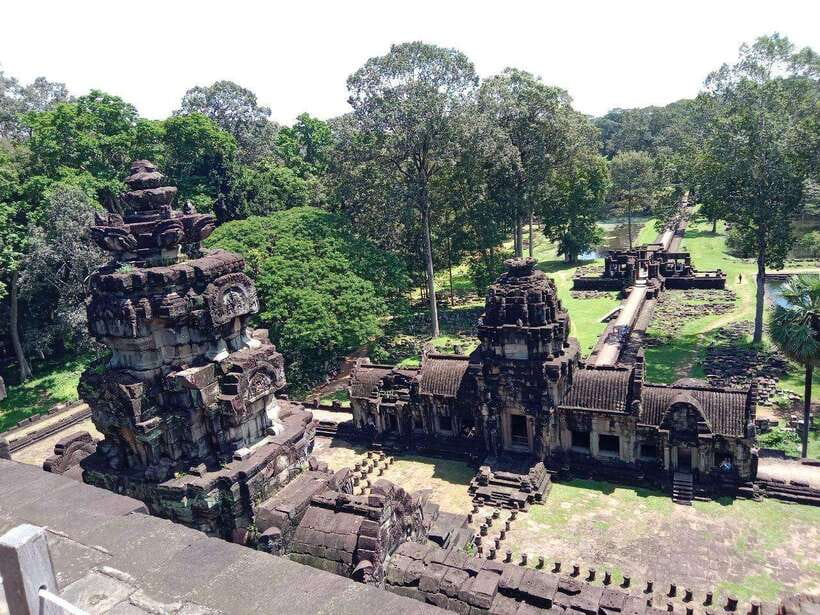
The next stops fill out the story of Angkor Thom. Baphuon takes about 30 minutes and is reached by a long causeway. The temple also contains an impressive reclining Buddha, reconstructed as a huge jigsaw puzzle in 2011 after a 37-year interruption caused by war.
That detail gives Baphuon a human dimension. You are not only looking at old stone. You are also seeing the result of a long, difficult effort to put a damaged monument back together.
Phimeanakas follows, with another 30-minute visit. This temple sits in a shaded jungle setting and offers a view over the treetops to people who climb its steep steps. The climb is not for everyone, and you should take it slowly, especially after several hours in the sun. If the steps are too much, the surrounding setting still gives you something to see without forcing the highest viewpoint.
The route then continues along the Esplanade of the Royal Palace, usually called the Terrace of the Elephants. This 30-minute stop connects the temples with the ceremonial and royal life of the old city. Finish the Angkor Thom section at the shaded area around Preah Palilay, a more quiet and picturesque place before the lunch break.
The order makes sense, but the number of stops creates a demanding morning. One person who completed the day found the heat and long walking difficult and suggested more rest pauses, perhaps with one temple removed. I think that is fair advice for older visitors or anyone unused to walking in tropical conditions.
Lunch is simple, practical, and extra
Lunch is not included. You should plan on spending about $7 to $10, with the stop taking place between the morning and afternoon visits.
The supplied details do not name the restaurant or provide a fixed menu, so treat lunch as a convenient break rather than a central food experience. Bring cash, and do not use the midday pause as an excuse to skip water. You have already spent several hours walking, and the afternoon still includes Ta Prohm and sunset.
This is also the best point to check your phone, camera, and power bank. A full day around the temples can drain a battery quickly, especially if you use your camera often.
Ta Prohm and the power of the trees
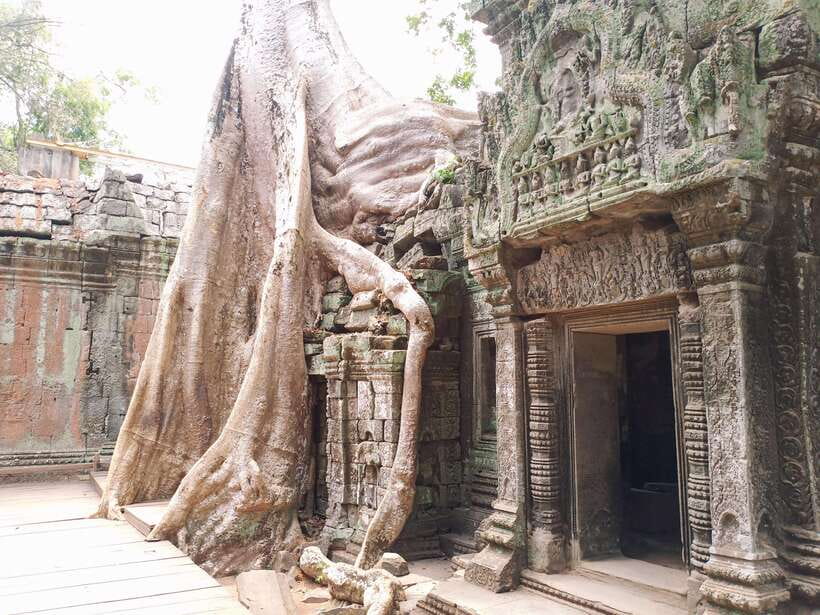
The afternoon visit to Ta Prohm lasts about an hour. The temple became widely known in the 21st century after appearing in Tomb Raider, but its appeal does not depend on the film.
Ta Prohm shows an unusually vivid meeting of trees and architecture. Spung tree roots, from Tetrameles nudiflora, wind over ancient blocks and through walls covered in moss. Some corners look carefully composed for a photograph, even though the effect comes from years of growth, weather, and partial ruin.
I like Ta Prohm because it is easier to understand how time changes a building here. At Angkor Wat, the design and scale dominate. At Ta Prohm, roots, shade, stone, and silence share the scene. Your guide can explain the monument while also helping you find good angles for photographs.
It is also one of the most popular stops, so the paths may feel busy. Stay aware of the ground, wait your turn at narrow photo spots, and avoid rushing from one framed view to the next. The atmosphere comes from taking a little time to notice the details.
Sunset closes a long day
The tour includes sunset, though the supplied schedule does not state the exact sunset viewpoint. That means you should confirm the final location and timing when you book or meet the guide.
By this point, the sunset is less about adding another major monument and more about ending the day in changing light. The stone, trees, and open sky can look very different from the hard midday conditions. Still, do not underestimate the walk back to the vehicle. You may be tired by then, and the ground can be dusty and uneven.
The return drive takes you back to your hotel in Siem Reap. Hotel drop-off is included, which is welcome after a day that may involve around 10 kilometers on foot.
Heat, clothing, and physical effort
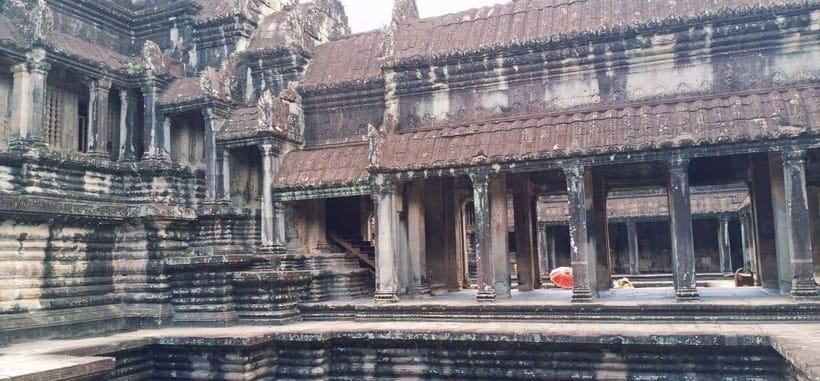
The main challenge is not the route finding. It is the weather and the amount of walking. A full day outdoors in March, for example, can feel punishing, with few shaded areas at some monuments.
Pack:
- Closed, comfortable walking shoes
- Long trousers and a shirt covering your shoulders
- Sun hat and sunglasses
- Sunscreen
- Biodegradable insect repellent
- Camera and power bank
- Cash for lunch and the temple ticket
The operator provides drinking water, cold water, and wipes. That was a particularly useful part of the outing for people dealing with the heat. Even so, drink often rather than waiting until you feel thirsty.
This experience is not suitable for children under 10, wheelchair users, or people with visual impairments. The steps, uneven paths, distance, and temple access make those limits important. If you have a knee, heart, or heat-related concern, ask about the walking expectations before paying.
What the guide and vehicle add
The English-speaking guide has a licensed professional role, and the driver and gasoline are included. That is more important than it may sound. Angkor is not one compact building. It is a large collection of monuments spread across an extensive area, so a vehicle saves time and energy between sections.
The guide also gives the day structure. At Bayon, you get help with photography and wall carvings. At Baphuon, the reconstruction story adds meaning. At Angkor Wat and Ta Prohm, the guide connects architecture, religion, trees, and the wider Khmer civilization.
The experience is marketed as a sharing trip, with the chance to meet someone new during the day. At the same time, the description also refers to a private trip, so group arrangements are not perfectly clear. Ask how many people will be in your vehicle if that matters to you. A shared outing can be sociable and good value, while a larger group may make it harder to move at your own pace.
Who will get the most from this tour?
I would choose this for a first visit to Angkor when I want the major sites in one organized day. It suits people who value a guide’s explanations, need hotel transport, and prefer not to negotiate each transfer separately.
It is also a good fit if you want a friendly group setting rather than a fully independent day. The low tour price leaves more of your budget for other Siem Reap activities, although the temple pass must be added.
I would think twice if you dislike long walking days or struggle in high heat. A private, slower arrangement might suit you better, even if it costs more. For this tour, the schedule is ambitious, and the suggestion to add more breaks is sensible.
Should you book it?
Book this experience if you want Angkor Wat, Angkor Thom, Bayon, Baphuon, Phimeanakas, the Terrace of the Elephants, Ta Prohm, and sunset in one day, with an English-speaking guide, hotel transfers, air conditioning, water, and basic trip costs included.
Skip it or seek a slower option if you need frequent rests, want a quiet visit, or find 8 hours and close to 10 kilometers of walking too much. For an active first-time visitor who prepares for the heat, the $19 tour fee offers good value. Just budget for the $37 temple ticket and $7 to $10 lunch, and treat sturdy shoes and sun protection as necessities, not extras.
FAQ
Is hotel pickup and drop-off included?
Yes. The guide and driver meet you in your hotel lobby in Siem Reap and return you to your hotel after the tour. You need to provide the hotel name and address.
How much does the tour cost?
The tour costs $19 per person. The Angkor temple ticket is not included and costs $37. Lunch is also separate and is expected to cost about $7 to $10.
What temples are included?
The route includes Angkor Wat, Angkor Thom’s South Gate, Bayon, Baphuon, Phimeanakas, the Terrace of the Elephants, Ta Prohm, and sunset.
Is transportation included?
Yes. Transport by air-conditioned vehicle, driver, gasoline, toll roads, and parking are included. Cold water and wipes are also provided.
What language does the guide speak?
The tour includes a live English-speaking guide with a professional license.
Is the tour suitable for children and wheelchair users?
No. It is not suitable for children under 10 or wheelchair users. It is also not suitable for people with visual impairments.
Just added around Siem Reap
- Ultimate Sunrise to Angkor Wat, Angkor Thom and Bayon Temple★ 5.0 · 3 reviews
- Twilight Tastes of Siem Reap Include Dinner★ 5.0 · 13 reviews
- Trekking Tour at Phnom Kulen National Park from Siem Reap★ 5.0 · 3 reviews
- Full-Day Private Tour of Angkor Wat with Pick Up★ 5.0 · 12 reviews
- Private Day Trip to Angkor Temples with Expert Guide★ 5.0 · 4 reviews
- Waterfall & River of 1000 Siva Linga- Kulen Mountain Private Tour★ 5.0 · 3 reviews
- Professional Photo Shoot in Angkor Archaeological Park, Siem Reap★ 5.0 · 42 reviews
- Unveiling 2 Days Private Angkor Wat/Beyond In Sunrise/Sunset Tour★ 5.0 · 48 reviews
Angkor Wat Tours, compared.

Angkor Wat Sunrise or Sunset Tour with Guide from Siem Reap
Read our review →
Angkor Wat: Small-Group Sunrise or Sunset Tour
Read our review →
Angkor Wat 2-Day Tour with Sunrise and Sunset
Read our review →

Angkor Wat Sunrise tour with Small – Group and Guide tours
Read our review →
Angkor Wat Highlights and Sunrise Guided Tour from Siem Reap
Read our review →
Angkor Wat Sunset Small Group Tour with Lunch Included
Read our review →
Full-Day Angkor Wat Sunrise Private Tour with Guide from Siem Reap
Read our review →Browse the lists this tour appears in