
Reviewed · ANGKOR WAT TOURS
Angkor Wat, Ta Promh, Banteay Srei, Bayon temples Private Tour
Angkor Wat is only the beginning on this full day around Siem Reap. You’ll see the grandest temple in Cambodia, the tree-wrapped ruins of Ta Prohm, tiny carvings at Banteay Srei, and Bayon’s famous stone faces, all with a private English-speaking guide to explain what you’re seeing. If your guide is Mr. Lorn Leap, expect a patient approach and close attention to carvings, statues, and Khmer culture.
I like the private format, since your group can travel in an air-conditioned vehicle without waiting for strangers. I also like the useful extras: hotel pickup and drop-off, cold drinking water, and chilled towels. The main consideration is cost beyond the advertised $65.55. Your Angkor Pass and lunch are not included, and the long itinerary can feel tiring in Cambodia’s heat.
Key points at a glance
- Four major temple experiences: See Angkor Wat, Ta Prohm, Banteay Srei, and Bayon, each with a very different style and mood.
- Private air-conditioned transport: Hotel pickup, temple transfers, and drop-off are included for your own group.
- A guide brings the carvings into focus: An English-speaking licensed guide explains the temples, Khmer culture, statues, and architectural details.
- Banteay Srei adds something special: Its pink sandstone and fine carving are unlike the heavier scale of Angkor Wat.
- A long day with several stops: The planned visit lasts about 7 to 9 hours, so comfortable shoes, water, and realistic expectations matter.
- Budget for extras: The Angkor Pass, lunch, and tips are separate from the tour price.
Why this temple route works so well
This tour gives you a broad look at the Angkor Archaeological Park rather than stopping at Angkor Wat alone. That matters because the temples do not all offer the same experience. Angkor Wat gives you scale and symmetry. Ta Prohm gives you atmosphere. Banteay Srei rewards close looking. Bayon and Angkor Thom show the power of a royal capital.
I like that mix. You get the famous sights, but also enough contrast to understand why the park is more than one spectacular building. The guide is an important part of that equation. Without context, it is easy to see a wall of carvings as decoration. With a guide, the figures, temple plans, and religious changes begin to make sense.
The day is private, but it is not leisurely. The stated duration is 7 to 9 hours, and the temple time alone adds up to more than seven hours before allowing for driving, lunch, and the park entrance. You should plan on a full day rather than a quick morning outing.
More Angkor Wat Tours in Siem Reap:
- Angkor Wat Sunrise or Sunset Tour with Guide from Siem Reap
★ 5.0 · 12,109 reviews - Siem Reap: Angkor Wat: Small-Group Sunrise or Sunset Tour
★ 5.0 · 9,444 reviews - Siem Reap: Angkor Wat 2-Day Tour with Sunrise and Sunset
★ 4.9 · 4,429 reviews
Starting at Angkor Wat for two hours
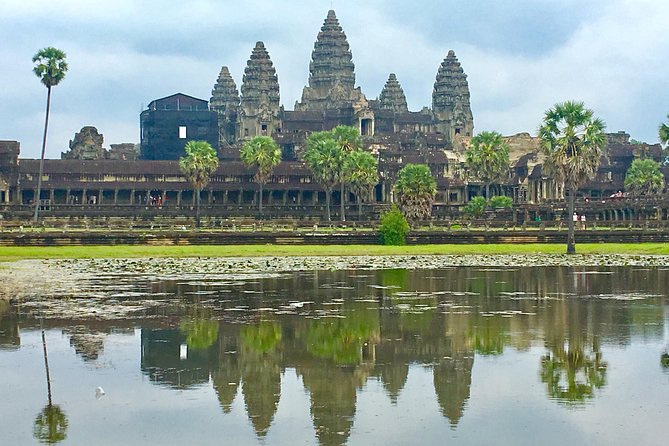
Angkor Wat is the natural first stop, and two hours gives you enough time to appreciate more than its famous towers. The complex was built in the first half of the 12th century as a Hindu temple and is now a major Buddhist site. Its scale is hard to grasp from a photograph. The grounds cover more than 400 acres, and the carefully balanced layout gives the whole complex a sense of order.
Look for the long bas-reliefs and the way the temple is arranged around its central towers. This is where a guide earns his fee. You can walk past carved scenes quickly, but an English-speaking guide can point out important figures, explain the religious setting, and help you notice details at a sensible pace.
Two hours is a useful amount of time, though it will not cover every corner. If you like architecture and carving, you may wish the stop were longer. Still, the rest of the day includes several more temples, so the schedule has to protect time for the other sites.
The Angkor Pass is not included. You buy it at the entrance to Angkor Park, with help from the guide. Since every temple on this route requires park admission, treat the pass as a required extra rather than an optional add-on.
Ta Prohm and the drama of stone and trees
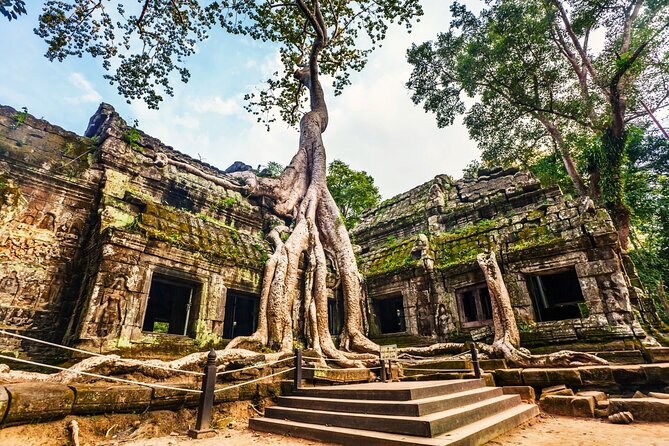
Ta Prohm receives about an hour and a half, making it the second major stop. This is the temple most closely linked with the image of jungle roots wrapping around old stone. Archaeologists have left much of the site in its weathered state, while clearing paths and strengthening parts of the structure for safety.
I like Ta Prohm because it feels different from Angkor Wat. Angkor Wat presents careful control and formal balance. Ta Prohm shows what happens when trees, weather, and time press against a large religious complex. The result is atmospheric without needing much explanation.
That atmosphere also creates a practical issue. Uneven surfaces and old stone passages can make walking slower. You will want shoes with a firm grip and enough time to stop for photographs without blocking narrow paths. The private vehicle will be waiting, but the day’s schedule still has several stops ahead.
A guide can also help you separate genuine features of the site from the parts that simply look dramatic in a photograph. You get the visual effect of roots and ruins, along with a better idea of how the temple functioned.
Banteay Srei rewards close attention
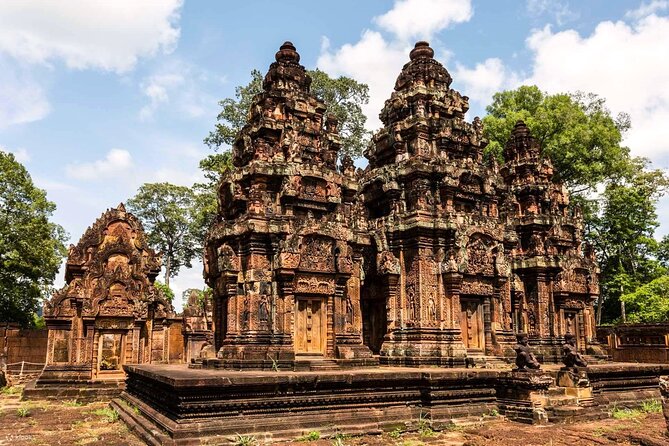
Banteay Srei is about an hour from the schedule, and it changes the scale of the day. This 10th-century temple was dedicated to Shiva and is celebrated for its pink sandstone and unusually fine carving. The walls, lintels, and friezes are covered with small, careful details.
I especially like this stop for people who enjoy sculpture. Angkor Wat can overwhelm you with size. Banteay Srei asks you to slow down and look closely. The carvings are delicate, and the warmer sandstone gives the temple a different character from the larger stone complexes.
The drawback is the time available. An hour is enough for an introduction, but it may feel short if you want to study every carved panel. Banteay Srei also sits apart from the central group of temples, so part of the day goes toward reaching it. That distance is worthwhile if you want more than the standard Angkor Wat and Ta Prohm pairing, but it contributes to the tour’s long hours.
Your guide can make this stop more useful by directing your attention to the carvings rather than leaving you to wander without a plan. The tour description specifically promises cultural and historical explanations at each site, which is valuable here because the fine details are easy to miss.
More Banteay Srei Tours in Siem Reap:
- Full-Day Banteay Srei & 4 Temples – Grand Tours Join-in Tour
★ 5.0 · 1,155 reviews - Siem Reap Tour: Angkor Wat Sunrise, Bayon, Ta Prohm, Banteay Srei
★ 5.0 · 931 reviews - 2-Day Angkor Wat With Small, Big Circuit and Banteay Srei Tour
★ 5.0 · 545 reviews - From Siem Reap: Banteay Srei Temple & Grand 5 Temple Tour
★ 4.8 · 262 reviews
Pre Rup and the sunset question
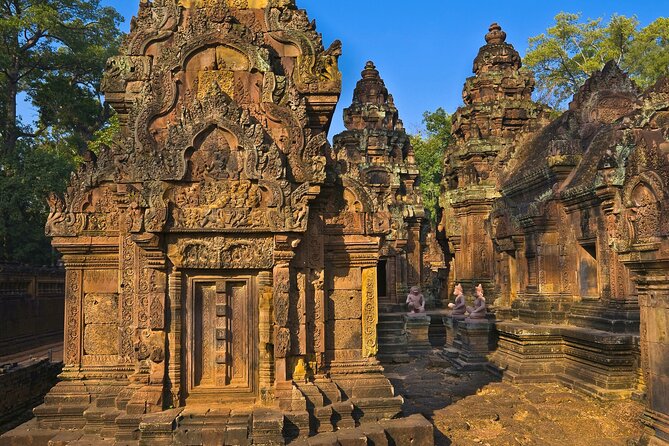
Pre Rup is scheduled for about 40 minutes, with a sunset view described as the closing moment of the day. The temple offers a high point from which you can look across the surrounding area, and the warm light can suit its old stone surfaces.
There is one scheduling detail you should clarify before booking. The route also lists the Victory Gate, Bayon Temple, and Angkor Thom after Pre Rup. If sunset at Pre Rup is meant to be the final stop, those later visits may take place before it in the actual running order. Ask the operator how the guide handles the sequence and sunset timing on your date.
Forty minutes is a short visit, but that can work well for a viewpoint stop. You get time to climb, look around, and take in the setting without turning the whole day into a single temple visit. If sunset is a top priority for you, confirm that weather and timing changes will be handled clearly.
The Victory Gate and Angkor Thom
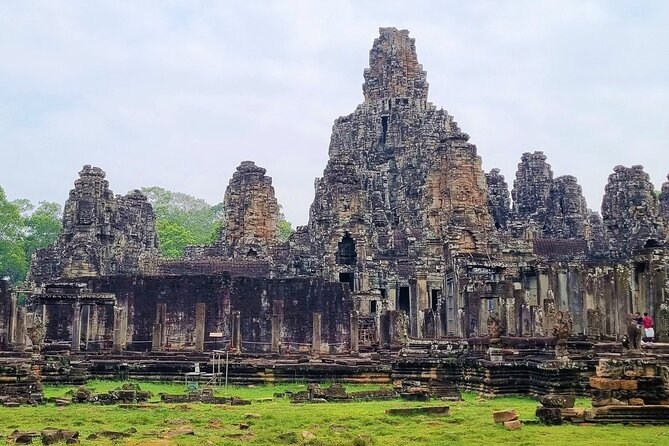
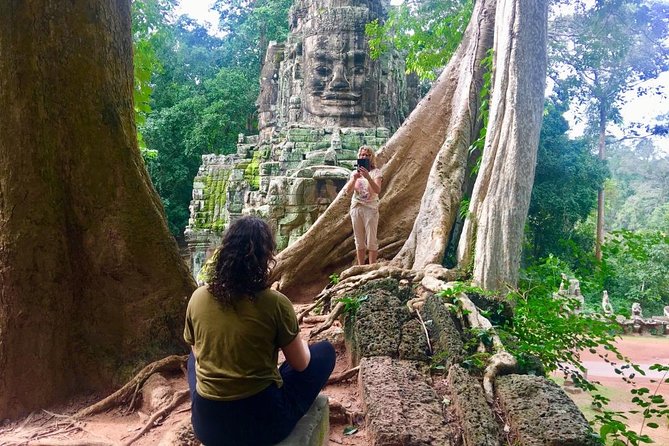
The Victory Gate receives about 30 minutes and offers a focused look at one of the best-known entrances to Angkor Thom, the former capital of the Khmer Empire. A short stop here helps connect the individual temples to the larger city that once surrounded them.
Angkor Thom itself is also allotted 30 minutes. The name means Great Angkor or Great Capital, and it was the last capital of the Khmer Empire. That context matters. You are not simply visiting separate ruins scattered through trees. You are moving through the remains of a major royal center.
The brief timing means this portion will be more of an orientation than a full exploration. You can see the scale of the old capital and learn how the gate fits into it, but you should not expect to inspect every wall or path. The private guide helps by giving the stop a clear purpose instead of leaving you to guess what you are looking at.
Bayon’s stone faces
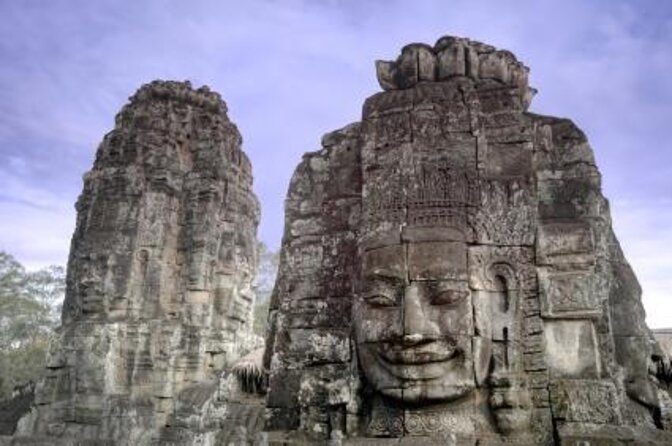
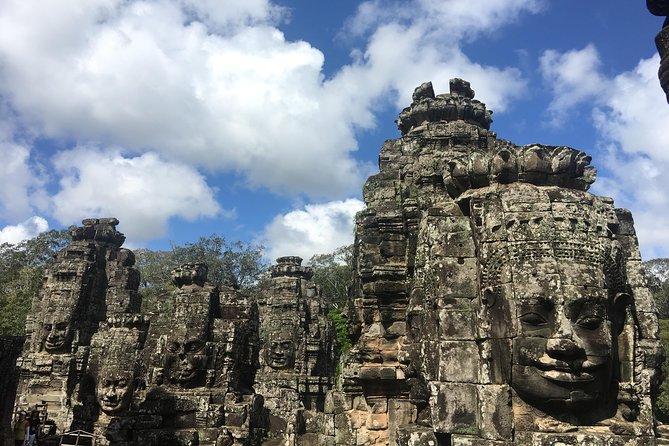
Bayon gets about two hours, which is generous compared with the Victory Gate and Angkor Thom stops. Built during the reign of Jayavarman VII, Bayon is a Buddhist state temple and the last state temple built during the Angkor period. Its most famous feature is the collection of towers carved with large stone faces.
This is another place where a guide can change your experience. The faces are instantly recognizable, but the temple can be confusing at first. Towers, galleries, corridors, and carvings crowd together, and the best view is not always obvious. A guide can help you find the important areas and explain why Bayon is different from the Hindu temple tradition represented by Angkor Wat.
Two hours lets you look carefully rather than rush through for a single photograph. You can pay attention to the faces, the structure, and the carved scenes around the temple. If you are already tired by this point, however, the amount of walking and the heat may reduce your attention. This is a good reason to use the vehicle breaks, drink the provided water, and keep lunch simple.
What the private guide adds
The tour includes a professional, English-speaking licensed guide rather than only a driver. That is a major part of the price. Angkor’s temples are visually powerful, but the meaning behind the buildings, carvings, and religious changes is not always clear without help.
One account specifically praises Mr. Lorn Leap for being patient and for pointing out important temples, carvings, and statues while explaining Khmer culture. He may not be the guide assigned to every booking, so you should not assume his availability. Still, his described approach gives you a useful picture of what to value: clear explanations, time for questions, and help noticing details you might otherwise pass.
The private setup also gives you more control than a shared coach. Your group is the only group participating, and hotel pickup and drop-off are included. You will not be paying for a private vehicle only to join a large walking group at each ruin.
Tips for the guide and driver are not included. If the guide helps you understand the sites and keeps a long day organized, plan to tip separately at the end.
Transport, food, and the real price
The advertised price is $65.55 per person. For a private 7 to 9 hour experience with an air-conditioned vehicle, hotel transfers, a licensed English-speaking guide, water, towels, service charges, and current government VAT, that can be a fair price, especially for a small group that wants personal transport.
But the headline figure is not the full day’s spending. The Angkor Pass is separate, and the amount is not specified in the supplied details. Lunch is also your responsibility. Local restaurants offer vegetarian and non-vegetarian dishes, with menu prices listed at about $3 to $10 per dish. Tips for the guide and driver are extra as well.
That makes this tour best judged as a guiding and transport package, not an all-inclusive temple ticket. If you compare it with a cheaper shared outing, ask whether that alternative includes a private guide, hotel transfers, and the same range of temples. If you compare it with a more expensive private tour, check what additional meals, tickets, or special arrangements are included.
Cold water and towels are small details, but they matter in a long temple day. You still need sensible clothing, comfortable walking shoes, and a willingness to spend most of the day outside.
Who should book this Angkor tour
I would choose this experience if you want the major Angkor sights in one organized day and prefer not to arrange transport between distant temple areas. It suits couples, families, and small groups that want to stay together with a dedicated guide.
It is also a good choice if you care about details. Banteay Srei and Bayon are not just extra stops added to a checklist. They give you different forms of Khmer art and architecture, while the guide can help explain what makes each place distinct.
I would think twice if you want a slow, photographic visit to only one or two temples. Seven to nine hours is a serious commitment, and the route includes several walks, stairs, old stone surfaces, and transfers. You may also prefer a shorter tour if your group includes anyone who finds heat or extended walking difficult.
The itinerary gives Angkor Wat two hours, Ta Prohm an hour and a half, Banteay Srei one hour, Pre Rup 40 minutes, and 30 minutes each for the Victory Gate and Angkor Thom, with two hours at Bayon. That is a useful spread, but it is still a schedule. You will see a lot, not linger endlessly.
Final booking advice
Book this tour if you want a private, guide-led introduction to the Angkor park with strong variety in one day. The combination of Angkor Wat, Ta Prohm, Banteay Srei, Bayon, and Angkor Thom gives you a far fuller picture than visiting Angkor Wat alone.
Before paying, confirm the pickup address, ask about the day’s exact order, and check how the Pre Rup sunset plan fits with the later temple stops. Also budget separately for the Angkor Pass, lunch, and tips. If those points suit you, the $65.55 price offers useful convenience and personal guiding, especially for a small group.
FAQ
How long does the private temple tour last?
The tour lasts approximately 7 to 9 hours. The listed temple visits total several hours, with additional time needed for transport, lunch, and moving between sites.
Is hotel pickup included?
Yes. Pickup and drop-off at your hotel are included. You need to provide the hotel name when booking.
Is the Angkor Pass included in the price?
No. The Angkor Pass is not included. The guide will assist you with purchasing it at the entrance to Angkor Park before the tour begins.
Is lunch included?
No. Lunch is at your own expense. Local restaurants offer vegetarian and non-vegetarian choices, with dishes priced at approximately $3 to $10.
What temples and sites are visited?
The route includes Angkor Wat, Ta Prohm, Banteay Srei, Pre Rup, the Victory Gate, Bayon Temple, and Angkor Thom.
Is this a shared group tour?
No. This is a private activity, and only your own group participates.
Can I cancel for a full refund?
Yes, if you cancel at least 24 hours before the experience start time. Cancellations or changes made less than 24 hours in advance are not accepted for a refund.
Just added around Siem Reap
- Ultimate Sunrise to Angkor Wat, Angkor Thom and Bayon Temple★ 5.0 · 3 reviews
- Twilight Tastes of Siem Reap Include Dinner★ 5.0 · 13 reviews
- Trekking Tour at Phnom Kulen National Park from Siem Reap★ 5.0 · 3 reviews
- Full-Day Private Tour of Angkor Wat with Pick Up★ 5.0 · 12 reviews
- Private Day Trip to Angkor Temples with Expert Guide★ 5.0 · 4 reviews
- Waterfall & River of 1000 Siva Linga- Kulen Mountain Private Tour★ 5.0 · 3 reviews
- Professional Photo Shoot in Angkor Archaeological Park, Siem Reap★ 5.0 · 42 reviews
- Ultimate Siem Reap Food Tour by Tuk Tuk – 20 Tastings, 8 Stops★ 5.0 · 13 reviews
Angkor Wat Tours, compared.

Angkor Wat Sunrise or Sunset Tour with Guide from Siem Reap
Read our review →
Angkor Wat: Small-Group Sunrise or Sunset Tour
Read our review →
Angkor Wat 2-Day Tour with Sunrise and Sunset
Read our review →

Angkor Wat Sunrise tour with Small – Group and Guide tours
Read our review →
Angkor Wat Highlights and Sunrise Guided Tour from Siem Reap
Read our review →
Angkor Wat Sunset Small Group Tour with Lunch Included
Read our review →
Full-Day Angkor Wat Sunrise Private Tour with Guide from Siem Reap
Read our review →Browse the lists this tour appears in